
Men's Health · Sleep
Daylight Saving Time Ends: How Men Over 50 Can Keep Sleep on Track
By OakMan Guide Editorial Team Updated 8 min read
The short answer
The clocks go back at 2 a.m. on Sunday, November 1, 2026. The extra hour is real, but the CDC says the body can take about a week to settle, and people who naturally wake early tend to have more trouble in the fall. Keep your usual bedtime and wake-up time, keep the lights low for the first hour, get outside later, and save coffee for the morning.
We're not doctors, and this is not medical advice.
Photo: Katie Harp on Pexels.
On Saturday night we all do the same small chore and wind the clocks back. The body does not get the memo, so Sunday morning it wakes us an hour early by the new clock. Here is what the official sources say, and a plain plan for the week.
When do the clocks go back in 2026?
At 2 a.m. local time on Sunday, November 1. NIST says daylight saving time runs from March 8 to November 1 this year, and that at 2 a.m. the local time becomes 1 a.m., so that hour repeats and the day has an extra hour. If you are reading this on Saturday, you still have tonight to get ready.
Not everyone changes. NIST lists Hawaii, American Samoa, Guam, Puerto Rico, the Virgin Islands and the state of Arizona as places that do not observe daylight saving time, with one exception: the Navajo Indian Reservation does.
Do I really get an extra hour of sleep?
On the clock, yes. In real life it is less simple. The American Academy of Sleep Medicine (AASM) notes in its 2024 position statement that the fall change is commonly seen as a gain because of "an extra hour of sleep," yet it has still been associated with sleep disruption, mood disturbance and traffic accidents. A CDC/NIOSH bulletin adds that it can take about one week for the body to adjust its times for sleeping, eating and activity, and that until then people can have trouble falling asleep, staying asleep and waking at the right time.
None of that is a reason to worry. It is a reason to treat this week gently, the way you would after a long trip.
Why can it be harder for men over 50?
Two reasons show up in the sources. First, sleep changes with age. The National Institute on Aging says older adults tend to go to bed earlier and wake earlier, and that their sleep tends to be shorter and lighter, with more waking during the night.
Second, the CDC/NIOSH bulletin says people who naturally go to bed early and rise early "will tend to have more difficulties adjusting to the Fall time change," because it goes against their natural tendency, and that older adults tend to be morning types. In plain arithmetic: if your body usually wakes you at 5:30, on Sunday it will do the same, and the new clock will read 4:30.
The same bulletin mentions a 2015 study (Kirchberger and colleagues) that reported men and people with heart disease may be at higher risk for a heart attack during the week after the time changes, in spring and in fall. We read that as a reason to take the week easy, not as a reason to be afraid. If you have heart disease, it is a fair thing to mention at your next visit, and our guides to checkups after 50 and blood pressure and the heart cover what to ask.
What should I do this weekend?
Keep it simple. We put the plan in one picture, and the details are below it.
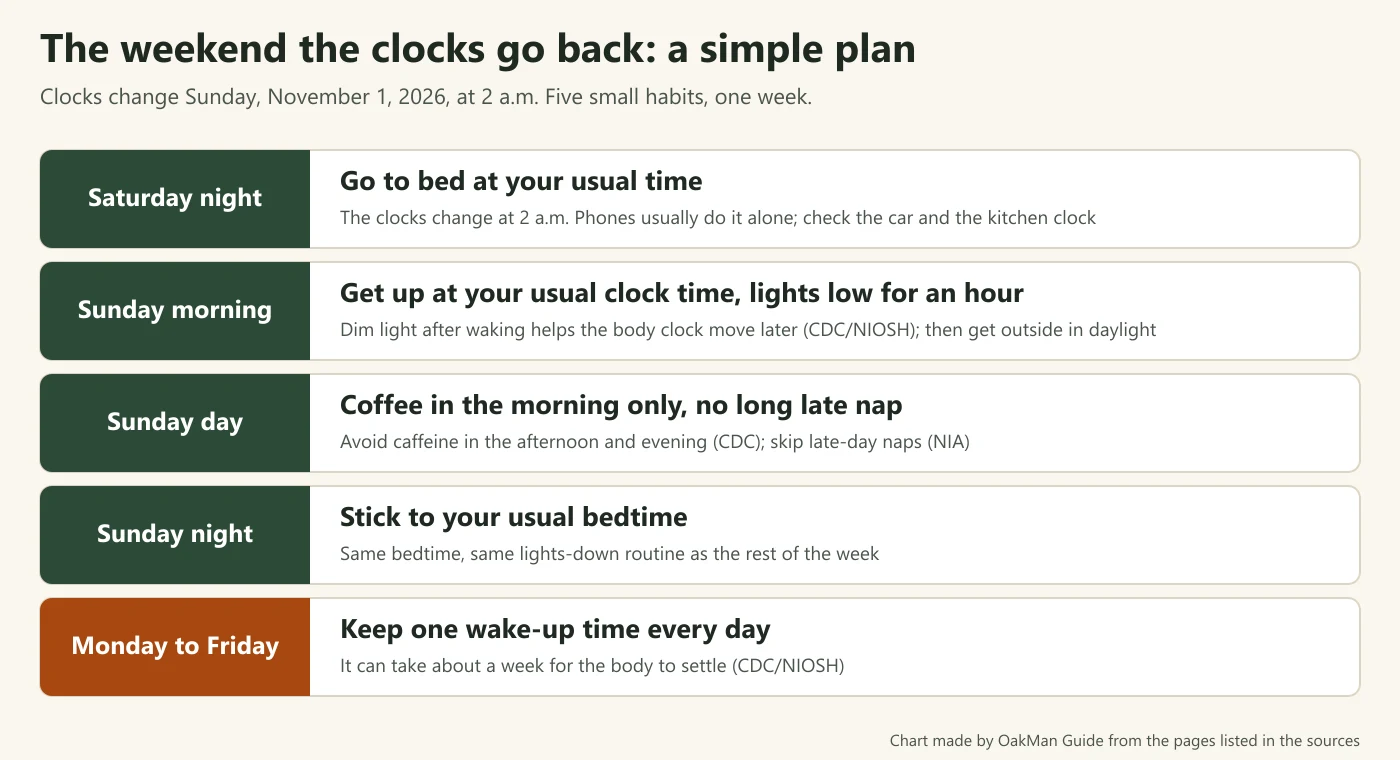
- Saturday night: go to bed at your usual time. The NIA says to follow a regular schedule by going to sleep and getting up at the same time each day, even on weekends.
- Sunday morning: get up at your usual time by the new clock. The CDC/NIOSH bulletin says that for the fall change, keeping the lights dim and avoiding bright screens for about an hour after waking can help the body move to a later wake-up time.
- Sunday daytime: get outside in daylight. The AASM statement says the sleep-wake cycle relies on bright light in the morning and on darkness in the evening.
- Sunday night: stick to your usual bedtime, and turn off screens at least 30 minutes before it, as the CDC advises.
- Monday to Friday: keep one wake-up time every day. It can take about a week to settle.
The NIOSH bulletin has a gentler method for next time: starting about three days before the change, move wake-up time, bedtime, meals, exercise and light by 15 to 20 minutes a day until they match the new clock. It gives those steps for the spring change and the mirror image, later each day, for the fall. If you are reading this the weekend of the change, file it for March.
What about coffee, alcohol and naps this week?
This is where most of us can help ourselves. The CDC lists avoiding caffeine in the afternoon or evening and avoiding large meals and alcohol before bedtime among its habits for better sleep. The NIA goes a step further: it says to avoid alcohol even in small amounts, to skip naps in the late afternoon or evening, to finish exercise at least three hours before bedtime, and to avoid large meals within two to three hours of bed and large amounts of liquid late in the day.

That last item matters if the night usually includes a trip to the bathroom. Two earlier pieces go deeper: how evening coffee and alcohol affect the bladder, and why some men wake up to pee at night. The foods and habits guide covers the rest of the day.
What changes with the darker evenings?
The light moves, too. The CDC/NIOSH bulletin points out that the fall change brings a sudden shift in the late-afternoon drive home, from daylight to darkness, and that people may not have changed their driving habits yet. Plan for it: leave a little more time, clean the windshield and take it slowly on Monday.
At home, the NIA suggests a few simple safety steps for anyone who wakes at night: a lamp that is easy to reach, a nightlight in the hallway and bathroom, and no area rugs or cords to trip over. If you are up more often this week, those take five minutes and are worth it.
When is it more than the time change?
Most clock-change sleep trouble fades within days. The NHLBI says short-term insomnia can be caused by stress or by changes in your schedule or environment, and can last a few days or weeks. It calls insomnia chronic when it happens three or more nights a week, lasts more than three months and cannot be fully explained by another health problem. The NIA adds that insomnia is the most common sleep problem in adults 60 and older.
If it drags on, keep a sleep diary for two weeks, as the NIA suggests: when you go to bed, when you wake in the night, when you get up, whether you had caffeine or alcohol and whether you exercised. Bring it to your doctor. The NIA also says snoring can be a sign of sleep apnea, though not everyone who snores has it, and that you should talk with your doctor before starting sleep medicine or supplements, because sleep medicines may help in the short term but carry risks. For a look at what a wrist tracker can and cannot add to that diary, see our sleep and recovery guide.
What do sleep doctors say about changing the clocks at all?
The AASM position is that the United States should eliminate seasonal time changes in favor of permanent standard time, which it says lines up best with human circadian biology. Its 2024 statement notes that the National Sleep Foundation, the Sleep Research Society and the American Medical Association have voiced support too. That is a view about policy, and we are not taking a side on the law. It does explain why sleep specialists bring the subject up every November.
What is the bottom line?
Treat the extra hour as a small gift and the week after it as an adjustment period. Keep your usual bedtime and wake-up time, keep the lights low for the first hour, get outdoors in daylight, and keep coffee to the morning. If you still sleep badly after a couple of weeks, write it down and take it to your doctor.
Frequently asked questions
When does daylight saving time end in 2026?
At 2 a.m. local time on Sunday, November 1, 2026. NIST says the local time becomes 1 a.m. at that moment, so the hour from 1 to 2 a.m. repeats and the day has an extra hour. Phones and computers usually change on their own, but the stove, the car and the wall clocks do not.
Do I really gain an hour of sleep when the clocks go back?
On the clock, yes. In practice, the American Academy of Sleep Medicine says the fall change has still been linked to sleep disruption, mood disturbance and traffic accidents, and the CDC says the body can take about a week to adjust. Treat the extra hour as a bonus, not a cure for a short week.
Why am I waking up earlier after the time change?
Your body clock does not move with the wall clock. If it usually wakes you at 5:30, it will do the same on Sunday, and the new clock will read 4:30. A CDC/NIOSH bulletin says people who naturally rise early tend to have more trouble with the fall change, and that older adults tend to be early risers.
How long does it take to adjust after the clocks go back?
The CDC/NIOSH bulletin says it can take about one week for the body to adjust its times for sleeping, eating and activity. Keeping the same bedtime and wake-up time every day is the simplest way to shorten that week.
How much sleep do men over 50 need?
The CDC lists 7 or more hours for ages 18 to 60, 7 to 9 hours for ages 61 to 64, and 7 to 8 hours for ages 65 and older. The National Institute on Aging says older adults need about the same as other adults, seven to nine hours a night.
Which places do not change their clocks?
NIST lists Hawaii, American Samoa, Guam, Puerto Rico, the Virgin Islands and the state of Arizona, with the exception of the Navajo Indian Reservation, which does observe daylight saving time.
When should I talk to a doctor about my sleep?
If the trouble is still there after a couple of weeks, if it happens three or more nights a week, or if you snore or feel sleepy all day. The NIA and the CDC both say to talk with a health care provider about regular sleep problems, and the NIA suggests a two-week sleep diary to bring to the visit.
Sources we checked for this article
- NIST: Daylight Saving Time rules (2026 dates, read October 31, 2026)
- American Academy of Sleep Medicine: Permanent standard time is the optimal choice for health and safety (J Clin Sleep Med 2024;20(1):121-125)
- CDC NIOSH Science Bulletin: Daylight Saving, suggestions to help workers adapt to the time change (posted March 9, 2016)
- CDC NIOSH Science Bulletin: Here Comes the Sun! Tips to adapt to Daylight Saving Time (posted March 8, 2022)
- CDC: About Sleep (page dated May 15, 2024)
- National Institute on Aging: Sleep and Older Adults (reviewed February 6, 2025)
- NHLBI (NIH): Insomnia, What Is Insomnia? (last updated March 24, 2022)