
Fitness & Food · Strength
Strength Training After 50: A Simple Starter Plan for Men
By OakMan Guide Editorial Team Updated 8 min read
The short answer
A simple plan for men over 50 is two or three short full-body sessions a week, on days that are not back to back. Do six basic moves, start with one set of 8 to 12 repetitions, and add sets or weight slowly over several weeks. Begin without weights until the moves feel natural.
We're not doctors, and this is not medical advice.

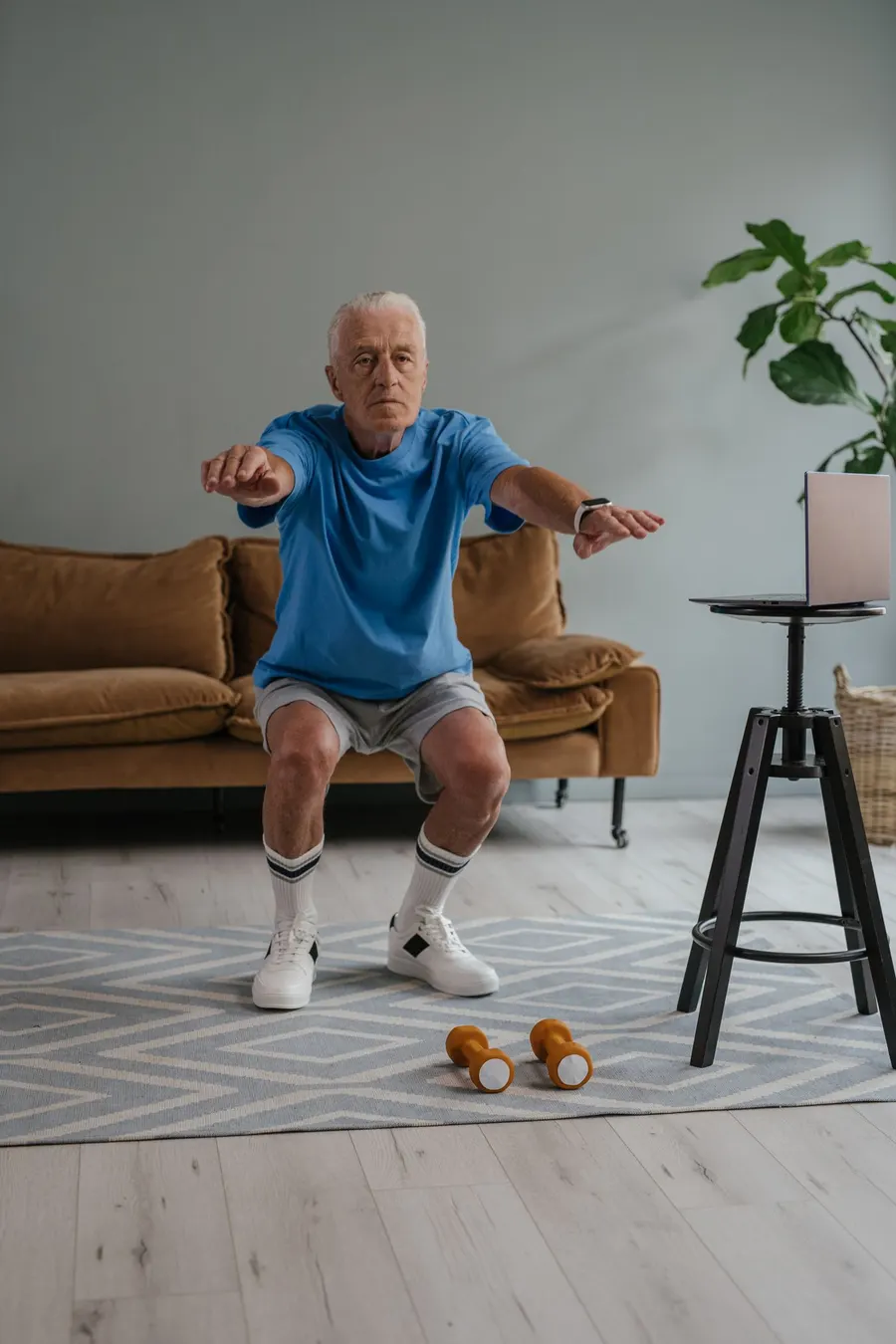
Photo: SHVETS production on Pexels.
You do not need a gym membership or a heavy barbell to get stronger after 50. Here is a plan you can start in your living room this week: six moves, two or three short sessions and a clear way to make it a little harder as you go.
Why does strength training matter more after 50?
Because strength is what you use every day. The National Institute on Aging (NIA) says muscle-strengthening exercise makes everyday jobs such as getting up from a chair, climbing stairs and carrying groceries easier. It adds that this kind of exercise is key to keeping the strength you already have, slowing the loss of muscle mass and helping prevent falls and fall-related injuries.
The HHS Physical Activity Guidelines for Americans say that progressive muscle-strengthening activities preserve or increase muscle mass, strength and power, and that the effect shows up in younger and older adults alike. The same NIA booklet puts the starting line plainly: it is never too late to begin.
Strength is one half of the picture. Walking and other aerobic activity are the other half, and our Fitness and Food guide covers it. This plan is the strength half, built to be simple enough to repeat.
How often should I train?
The CDC and the HHS guidelines ask for strength work on at least 2 days a week that covers the whole body: legs, hips, back, abdomen, chest, shoulders and arms. The NIA adds a rule that shapes the whole plan: avoid working the same muscle group two days in a row, so your muscles can recover between sessions.
That is why each session below trains the whole body, and why the days should not be back to back:
- 2 days a week: Monday and Thursday, or Tuesday and Friday. This meets the guideline.
- 3 days a week: Monday, Wednesday and Friday. A third day is optional. The HHS guidelines describe building from 2 days toward more than 2 over time.
Strength days do not replace walking. The CDC counts the two separately: about 150 minutes of moderate aerobic activity a week plus the strength days. Walks fit well on the days in between.
What do I need to get started?
Very little: a sturdy chair, a wall or kitchen counter, a floor mat or carpet, and a pair of light dumbbells or a resistance band if you want them. Grocery bags work for the carry. The CDC list of strength activities is broad: free weights, resistance bands, push-ups and sit-ups, gardening that involves digging, even certain yoga poses.
If you are new to this, the NIA suggests trying the exercises without weights or resistance bands until you are comfortable with the movements. That is how the first week of this plan works.
What are the six moves?
Squats, push-ups, planks, resistance-band work and carrying heavy items such as groceries all appear on the NIA's list of muscle-strengthening examples. The glute bridge is the one move we added, for the hips. Picking these six is our choice, not an official program, and together they cover every muscle group the CDC names.
| Move | Works | Easier version | Harder version |
|---|---|---|---|
| 1. Chair squat | Legs, hips | Sit down onto a higher seat and use your hands to help | A lower seat, then a dumbbell held at your chest |
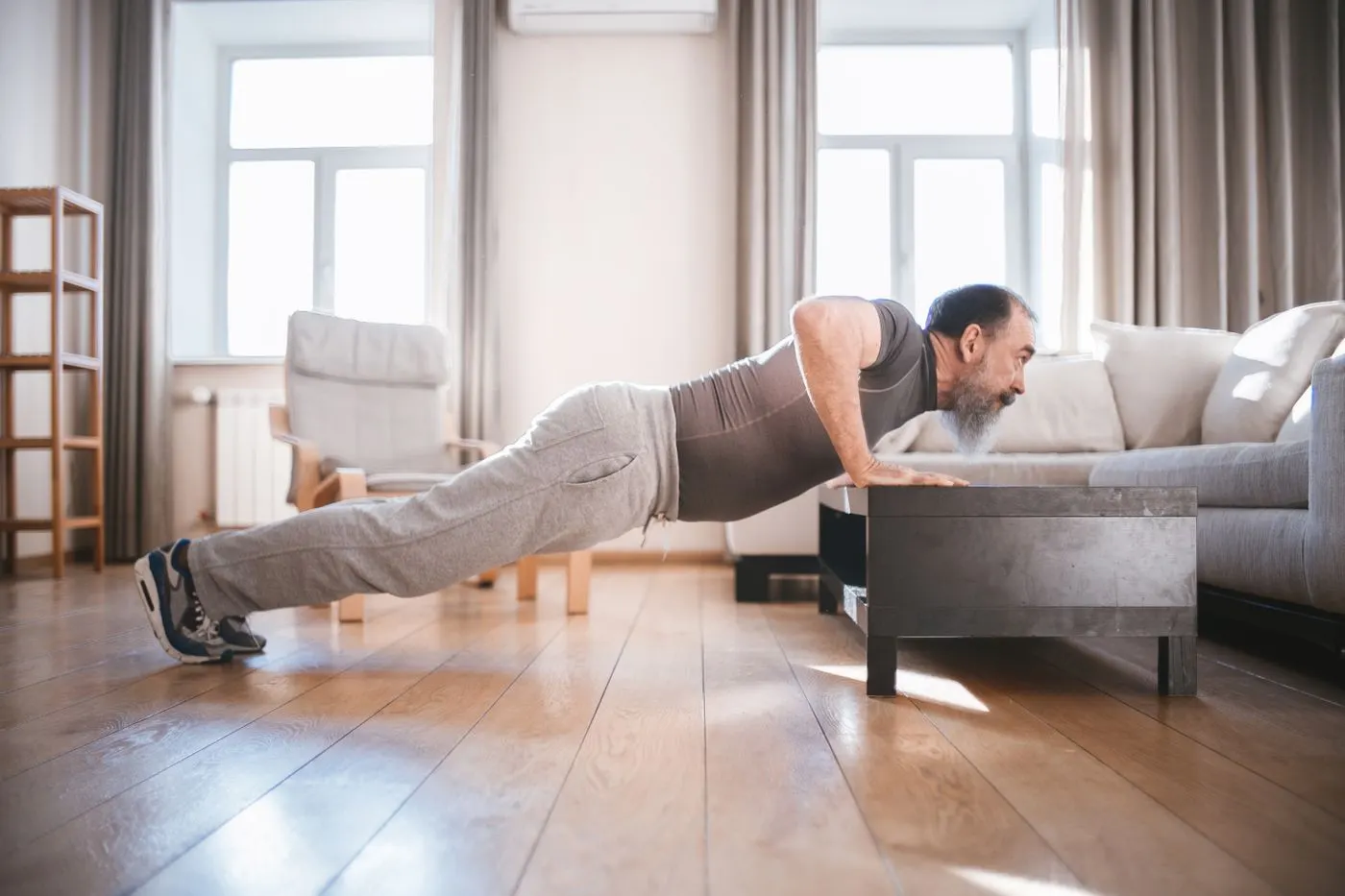
| 2. Push-up | Chest, shoulders, arms | Against a wall | Hands on a counter or sturdy table, then lower surfaces step by step, down to the floor |
| 3. Band row | Back, arms | A lighter band, or hold it with less stretch | A thicker band, or more repetitions |
| 4. Glute bridge | Hips, lower back | A smaller lift | Hold for a few seconds at the top |
| 5. Plank | Abdomen, shoulders | Hands on a counter, or knees down | On your forearms on the floor, held longer |
| 6. Carry | Grip, shoulders, abdomen, legs | Lighter bags, shorter walk | Heavier bags or dumbbells, longer walk |
A few cues, ours and kept simple:
- Chair squat. Stand with your feet about shoulder-width apart, sit back toward the chair and stand up again. Breathe out as you stand.
- Push-up. Put your hands on the wall or counter at chest height, step your feet back, lower your chest toward your hands and press away. Keep your body in one line.
- Band row. Sit with your legs out and the band looped around your feet. Pull your hands toward your belly, squeeze your shoulder blades together and let the band go back slowly.
- Glute bridge. Lie on your back with your knees bent and feet flat. Lift your hips until your shoulders, hips and knees make a line, then lower them.
- Plank. Hold your body straight on a counter or the floor and keep breathing. A short hold, say 10 to 20 seconds, is a fair start.
- Carry. Hold a bag or dumbbell in each hand, stand tall and walk 20 to 30 steps.
How many sets and repetitions should I do?
The CDC and the NIA agree on the basics. A repetition is one full movement, such as one squat. Eight to twelve repetitions in a row count as one set. One set of each exercise is effective, and two or three sets may be more effective. Choose an effort that is at least moderate, and stop a set when one more repetition would need a helping hand.
For the plank and the carry, count seconds or steps instead of repetitions. Take a short break between exercises so each one gets your best form.
How do I progress over the first six weeks?
The NIA and the HHS guidelines describe progress as gradual increases in the amount of weight, the number of sets or repetitions, or the number of days a week. The HHS guidelines suggest that someone new to strength work can begin with just 1 day a week at a light or moderate effort, move up to 2 days, then possibly more, and raise the effort slightly each week until it is moderate or greater. We turned that into a six-week example.
| When | Days | Sets and repetitions | Effort |
|---|---|---|---|
| Week 1 | 1 day | 1 set of 8 to 12 | Light. Learn the moves without weights. |
| Week 2 | 2 days (for example Mon and Thu) | 1 set of 8 to 12 | Light to moderate. |
| Weeks 3 and 4 | 2 days | 2 sets of 8 to 12 | Moderate: the last repetitions feel hard. |
| Weeks 5 and 6 | 2 or 3 days, never back to back | 2 or 3 sets of 8 to 12 | Moderate or harder, adding weight or a harder version as you can. |
| After week 6 | 2 or 3 days | 2 or 3 sets | Keep it going and raise the challenge slowly. |
One simple test tells you when to move up. If you can finish 12 clean repetitions and another one still feels easy, make the move a little harder: a heavier weight, a thicker band, a lower surface for the push-up. When the new version brings you back to 8 or 9 hard repetitions, stay there until 12 feels good again.
How do I stay safe while I train?
The NIA gives six safety tips for muscle-strengthening that we think are worth printing and keeping near the mat:
- Listen to your body. Overdoing strength exercises can cause exhaustion, sore joints and muscle pain or injury.
- Warm up with lighter weight or no weight first.
- Do not hold your breath. Breathe out during the effort and in as you relax.
- Avoid locking your arm and leg joints in a straight position.
- Ask if you are unsure about a movement. The NIA says to seek guidance from your health care provider.
- Learn the form. Consider a session or two with a personal trainer, or a group class at a gym, recreation center or senior center. Free online videos of strength exercises can help too.
The NIA's section on chronic pain adds a line worth remembering: if you have pain, swelling or inflammation in a specific area, you may need to work another area or rest for a day or two.
Who should talk to a doctor first?
The NIA says older adults with no existing injury or chronic condition who plan to increase activity gradually generally do not need to talk with a doctor before starting. The CDC says that people with a chronic condition (heart disease, arthritis and diabetes are its examples) should ask their doctor which kinds of activity, and how much, are right for them. The NIA also says that with high blood pressure, you should work with your health care provider as you increase activity.
How does this connect to the rest of life after 50?
Strong legs and hips are the same muscles that keep you steady on stairs and getting up from a chair. Our Home and DIY guide includes strength and balance work in its fall-prevention list. The CDC adds balance activities, such as standing on one foot, for adults 65 and older.
If you also want to train the pelvic floor, that is a separate set of muscles, and our Kegel routine for men shows how it fits next to a walk or a strength day. For the heart-health side of staying active, see ED and heart health, and for rest between training days, sleep and recovery after 50. Bring the plan to your next visit using our checkups guide, and find the wider picture in the men's health guide.
How do I get going this week?
- Pick your days. Two days with a rest day between them, such as Monday and Thursday.
- Do the first session without weights. One set of 8 to 12 repetitions of each move, with the easy version if you need it. Slow and steady counts more than speed.
- Write it down. Note the date, the version of each move and how it felt. It makes the next step easy to choose.
- Add the second day in week 2 and the second set in week 3.
That is the whole plan. It is small on purpose, because a plan you repeat beats a perfect one you quit.
Frequently asked questions
How many days a week should a man over 50 do strength training?
At least 2 days a week, according to the CDC and the HHS guidelines, working all the major muscle groups. The NIA says to avoid training the same muscle group two days in a row, so a full-body plan fits best on days that are not back to back, such as Monday and Thursday.
Do I need a gym or weights to start?
No. The CDC lists push-ups and other moves that use your own weight, resistance bands, lifting weights and even digging in the garden. The NIA suggests beginners start without weights or bands until the movements feel comfortable, then add them gradually.
How many sets and repetitions should I do?
The CDC and NIA say a single set of 8 to 12 repetitions per exercise works, and two or three sets may work better. Pick an effort where one more repetition would be a struggle, and begin with one set while you learn the moves.
How do I know when to make an exercise harder?
The NIA and HHS describe progress as gradual increases in weight, sets, repetitions or days per week. A simple rule of ours: when you can finish 12 clean repetitions and another one still feels easy, use a heavier weight, a thicker band or a harder version of the move.
Can I lift on back-to-back days?
The NIA advises against working the same muscle group two days in a row, so muscles can recover between sessions. If you train the whole body each session, choose days with a rest day between them.
Do I need to see a doctor before I start?
The NIA says older adults with no existing injury or chronic condition who increase activity gradually generally do not need to talk with a doctor first. With a chronic condition, the CDC says to ask your doctor which kinds of activity, and how much, are right for you. Its examples are heart disease, arthritis and diabetes.
Is it too late to start strength training at 60 or 70?
The NIA says it is never too late to begin, and the CDC says the same for older adults. The HHS guidelines note that the benefits of muscle-strengthening show up in younger and older adults alike.
Sources we checked for this article
- NIA (NIH): Exercise and Physical Activity for Older Adults: Staying Active as You Age (booklet, NIH Publication No. 25-AG-8135, March 2025)
- HHS: Physical Activity Guidelines for Americans, 2nd edition (PDF, read November 4, 2026)
- CDC: What Counts as Physical Activity for Adults (page dated December 6, 2023)
- CDC: What Counts as Physical Activity for Older Adults (page dated December 4, 2025)
- CDC: Adding Physical Activity as an Adult (page dated December 4, 2025)
- CDC: Older Adults: Adding Activity Recommendations (page dated December 4, 2025)