
Men's Health · Heart and Blood Pressure
Blood Pressure at Home After 50: How Men Can Measure It Right
By OakMan Guide Editorial Team Updated 8 min read
The short answer
Sit quietly for five minutes, with your back supported, feet flat and your bare upper arm resting on a table at heart level. Take two or three readings a minute apart, at the same time each day. The CDC and the NHLBI both say to skip food, caffeine, smoking and exercise for 30 minutes first. Write every number down and bring the log to your doctor.
We're not doctors, and this is not medical advice. Everything below comes from the official sources listed at the end, and what your numbers mean for you is a question for your doctor.
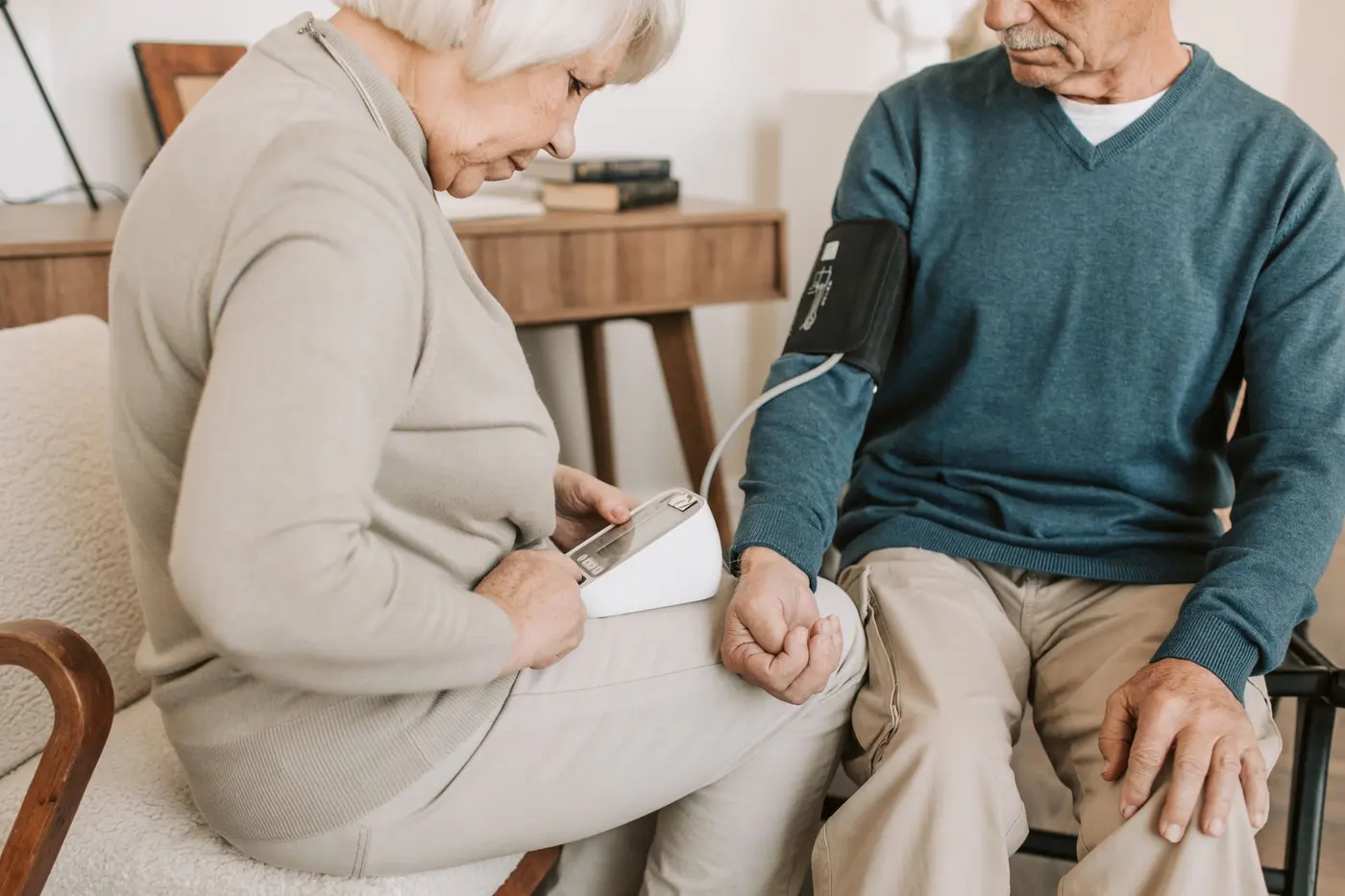
Photo via Pexels.
A blood pressure reading in the doctor's office is one number on one day. At home you can see the pattern, as long as you measure it the same careful way every time.
Why measure blood pressure at home after 50?
The NHLBI fact sheet puts the reason in one line: half of all Americans have high blood pressure and many do not even know it. Adults should have it checked by a healthcare provider, and if the numbers are high, the provider may suggest measuring it yourself outside the office. The same fact sheet says studies have shown that self-measured blood pressure, along with clinical support, can help people with hypertension lower their blood pressure.
That is why a home reading is worth doing well. A sloppy one can scare you for no reason or, worse, calm you for no reason. The steps below are the ones the CDC and the NHLBI both publish, and they are short. If you are here because of the link between blood pressure and erections, our article on erectile dysfunction and heart health explains why your doctor asks about it, and this one shows how to bring good numbers to that conversation.
What kind of monitor should I use?
The NHLBI says to use an approved home blood pressure device and points to validatebp.org on its diagnosis page. Its steps are written for a monitor with a cuff that goes on the upper arm, above the elbow, so that is the kind to look for.
Fit matters too. The NHLBI says readings can be different if the cuff is too small or too big, so ask your doctor or the clinic staff which size suits your arm. If your doctor wants you to track your numbers, ask what targets to aim for and how often to check, because the fact sheet says that is a decision to make together.
What should I do before I take a reading?
Most wrong readings come from what happens in the half hour before. Both sources agree on the core rules:
- Wait 30 minutes after exercise, a meal, caffeine or a cigarette. The NHLBI lists exercising, eating a meal, drinking caffeine and smoking. The CDC says not to eat or drink anything for 30 minutes and adds alcohol to the list.
- Empty your bladder. Both the CDC and the NHLBI say to go to the bathroom first.
- Find a quiet spot with a table and a chair. The NHLBI asks for no distractions.
- Sit and relax for 5 minutes. The CDC says at least 5 minutes with your back supported.
- Measure before your medicine. The NHLBI says that if you take blood pressure medication, take your reading before the dose. Ask your doctor if that fits your schedule.
If coffee is part of your morning, you can keep it. Just take the reading first, or wait the 30 minutes. Caffeine and alcohol are both on the 30-minute list, and we cover what they do to your nights in our guide to caffeine, alcohol and night-time urination.
How should I sit and where does the cuff go?
This is the part people get wrong most often, and it takes about a minute to fix. Following the NHLBI fact sheet and the CDC page:
- Uncover your upper arm. Put the cuff above the elbow, mid-arm, on bare skin and not over clothing. The CDC says to make sure it fits snugly.
- Rest your arm on the table. The cuff should sit at heart level, with your arm supported and your palm up. The CDC says to rest your arm on a table so the cuff is at chest height.
- Feet flat on the floor, legs uncrossed. The CDC says crossed legs can make your blood pressure go up.
- Sit up straight with your back supported. Stay calm and relaxed.
- Do not talk or watch TV while the cuff is on.
Here is the same list as a quick check of the slips that change a reading, using only what the two sources say:
| Common slip | What the source says | The fix |
|---|---|---|
| Coffee, a cigarette, alcohol or a workout just before | The CDC says your reading might be higher if you did any of these within 30 minutes. | Wait 30 minutes first. Do not eat or drink anything in that time. |
| Legs crossed or arm drooping | The CDC says both can make your blood pressure go up. | Feet flat and uncrossed, arm resting on a table. |
| Cuff over a sleeve | The NHLBI says not to put the cuff over your clothing. | Uncover your upper arm and put the cuff above the elbow. |
| Cuff too small or too big | The NHLBI says readings can be different if the cuff is the wrong size. | Ask at your next visit which size fits your arm. |
| Talking or watching TV | Both sources say not to talk while the cuff is on, and the NHLBI adds no TV. | Quiet room, no screen, no phone call. |
| Full bladder | Both sources say to empty your bladder before the reading. | Use the bathroom first. |
How many readings should I take, and how often?
More than one, every time. The NHLBI fact sheet says to take two to three measurements, 1 minute apart. The CDC says at least two readings, 1 or 2 minutes apart. Both say to measure at the same time each day, so your numbers are comparable from one day to the next.
How often and for how long is something the sources leave to your doctor. The CDC says that if you have high blood pressure you may need to measure it more often, and the NHLBI says to ask your doctor what your target numbers should be and how often to check. Do not invent a schedule on your own, and do not measure ten times in a row hoping for a better number. A calm, careful set of two or three readings tells you more.
What should I write down?
Both sources say to record your readings. The CDC links a printable blood pressure log, and the NHLBI points to a blood pressure tracker. A notebook works as well, as long as it has these columns:
| Write down | Why it helps |
|---|---|
| Date and time | Same time each day, so the numbers compare |
| Both numbers, every reading | For example 128/82. Write all two or three readings, not just the lowest |
| Medicine taken | Before or after the reading, since the NHLBI says to measure before the dose |
| Anything unusual | Poor sleep, a hard day, a coffee you forgot to skip |
Bring the log to your next appointment. It answers the first question any doctor asks, and it fits neatly into the list in our guide to men's health checkups after 50.
What do my numbers mean?
The first number, systolic, is the pressure when your heart pumps blood out. The second, diastolic, is the pressure between beats, when the heart fills with blood. The NHLBI describes four steps above normal, and this is its table:
| Category | Systolic (top number) | Diastolic (bottom number) |
|---|---|---|
| Normal | Less than 120 | and less than 80 |
| Elevated | 120 to 129 | and less than 80 |
| Stage 1 high blood pressure | 130 to 139 | or 80 to 89 |
| Stage 2 high blood pressure | 140 or higher | or 90 or higher |
| Hypertensive crisis | Higher than 180 | or higher than 120 |
The NHLBI says a healthy blood pressure is typically less than 120/80 mm Hg, and that you should talk to your provider if your readings are consistently higher than that. A home number is not a diagnosis. The same page says you need two or more readings at separate medical appointments to be diagnosed, and the fact sheet says you may be diagnosed when readings are consistently higher than 130/80 mm Hg. So one odd day is not a verdict. A pattern across weeks is what your doctor will want to see.
When a number is an emergency
The NHLBI says readings above 180/120 mm Hg are dangerously high and require immediate medical attention. Its diagnosis table says to contact your provider immediately.
Its "Living With" page lists signs that call for 9-1-1: a sudden, severe headache, difficulty breathing, a sudden, severe pain in your abdomen, chest or back, numbness or weakness, a sudden change in vision, and problems talking.
What should I do with the numbers?
Take them to your doctor. That is the whole job of a home log. The NHLBI says everyone age 3 or older should have their blood pressure checked by a healthcare provider at least once a year, and a home monitor adds the days in between.
If your numbers are in the normal range, keep the habits that help. Our guide to foods and habits for prostate health covers everyday eating habits worth building, and the strength training starter plan shows how to add movement without guesswork. If your readings run high, do not try to fix them on your own with supplements or by skipping medicine. Bring the log to your doctor and decide together. For the full picture, start from the Men's Health Guide.
What is the bottom line?
Wait 30 minutes after food, coffee, a cigarette or exercise. Empty your bladder, sit for 5 minutes, rest your bare arm on a table at heart level, feet flat, and take two or three readings a minute apart. Write them down and show your doctor. That is the full routine, and it takes less time than the coffee you skipped.
Frequently asked questions
How long should I sit before I measure my blood pressure at home?
Five minutes. The CDC says to sit in a comfortable chair with your back supported for at least 5 minutes before your reading, and the NHLBI says the same: sit and relax for 5 minutes in a quiet space with no distractions.
Can I measure my blood pressure after coffee or a workout?
Better to wait. The NHLBI says to avoid exercising, eating a meal, drinking caffeine or smoking for 30 minutes before. The CDC adds alcohol to that list and says that if you smoked, drank alcohol or caffeine, or exercised within 30 minutes, your reading might be higher.
How many readings should I take each time?
More than one. The CDC says to take at least two readings, 1 or 2 minutes apart. The NHLBI fact sheet says to take two to three measurements 1 minute apart each time, so you can be sure your results are the same.
What time of day should I measure?
The sources do not name a best hour. Both the CDC and the NHLBI say to measure at the same time each day, so your numbers can be compared. Ask your doctor how often to check and whether to measure before your medicine.
Should I measure before or after taking my blood pressure medicine?
The NHLBI fact sheet says that if you are on blood pressure medication, you should measure before you take it. Ask your doctor whether that fits your own plan, and never change or skip a dose because of a home number.
What blood pressure number is too high?
The NHLBI says a healthy blood pressure is typically less than 120/80 mm Hg, and that stage 1 high blood pressure starts at 130 systolic or 80 diastolic. Readings above 180/120 mm Hg are dangerously high and require immediate medical attention, and a diagnosis needs readings at separate medical appointments, not one home number.
Does one high reading at home mean I have high blood pressure?
No. The NHLBI says a diagnosis needs two or more readings at separate medical appointments, and that you may be diagnosed when your readings are consistently higher than 130/80 mm Hg. A single high number is a reason to measure again, write it down and mention it to your doctor.
Sources we checked for this article
- CDC: Measuring Your Blood Pressure (updated and reviewed October 13, 2026)
- NHLBI, NIH: Self-Measured Blood Pressure Fact Sheet (publication date May 2023)
- NHLBI, NIH: High Blood Pressure, Diagnosis (last updated June 26, 2025)
- NHLBI, NIH: High Blood Pressure, Living With High Blood Pressure (last updated April 30, 2024)