
Men's Vitality · Sleep and Recovery
Sleep and Recovery After 50: What a Wrist Tracker Can and Can't Show
By OakMan Guide Editorial Team Updated 8 min read
The short answer
A wrist tracker shows how long you slept, how your heart rate and HRV move, and how ready you look from one day to the next. It shows trends, not diagnoses, so read the weekly pattern and ignore one bad night. The Hume Band 2.0 does this for one price, with no required subscription and up to 14 days of battery.
We're not doctors, and this is not medical advice. This article may contain affiliate links, always to the official websites of the products mentioned. If you buy through one of these links, you support our work at no additional cost to you. This never influences what we write.
Photo: SHVETS production on Pexels.
Ask most men over 50 how they slept and you get a shrug and a guess. A tracker swaps the guess for a number, and the trick is knowing which numbers to trust.
What does a wrist tracker measure while I sleep?
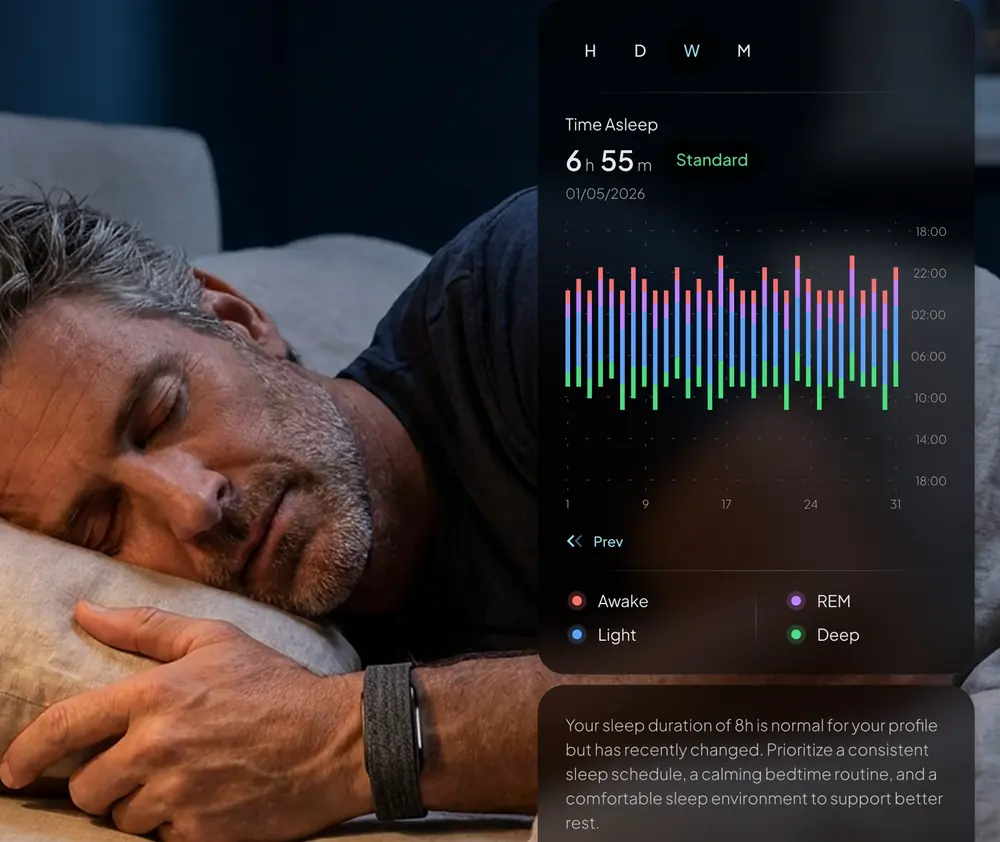
Less than the ads suggest, and more than most of us expect. Under the band sits a small sensor pod. On the Hume Band 2.0 the official page lists 5 LEDs and 4 photodiodes: light goes into the skin, and the sensors read tiny changes in blood flow. From that signal, plus movement, the app estimates your heart rate, HRV, blood oxygen and when you were asleep. Here is the short version of each number and how to read it.
| What it records | What it is | How to read it |
|---|---|---|
| Sleep length and stages | Hours asleep, split into light, deep, REM and awake time | Compare the average of the week with the CDC range for your age. One short night means little. |
| Heart rate and resting heart rate | Your pulse through the night and the lowest, calmest stretch | Watch it against your own baseline. A few days running higher than usual is a reason to look at your sleep and ease off. |
| HRV | The small changes in time between heartbeats | Best as your own trend over weeks. Hume uses it as part of its recovery picture. |
| Blood oxygen and skin temperature | Overnight estimates from the same optical sensor and a temperature reading | Look for a change against your normal, not for a perfect number. |
| Recovery and strain | How hard the day was and how ready you look for the next one | A pacing tool for walks, yard work and lifting days. |
Notice the pattern in the right-hand column. Every line says "against your own baseline" or "over weeks". That is how these numbers earn their keep.
How many hours should the tracker show at my age?
The CDC gives recommended daily sleep by age group, and it is a handy yardstick for what your band reports:
| Age group | Recommended sleep (CDC) |
|---|---|
| Adults 18 to 60 | 7 or more hours |
| Adults 61 to 64 | 7 to 9 hours |
| Adults 65 and older | 7 to 8 hours |
Most men in their fifties fall in the "7 or more hours" row. Notice that the range changes at 61 and again at 65. If you are in your sixties, a week of 7-hour nights is still inside the line. If you are watching your sleep because of night trips to the bathroom, our night-time urination article and the caffeine and alcohol guide are the places to start, and a tracker will show you whether the changes actually helped.
What can a tracker not show me?
A few things, and they matter. The American Academy of Sleep Medicine put out a position statement on consumer sleep technology. It says these devices are widely used and have not been validated against polysomnography, the lab sleep study, and that they cannot be used to diagnose or treat sleep disorders at this time. It also says they can enrich the conversation with your doctor when they are part of a proper evaluation. That is a fair description of the job: a tracker is a scorekeeper, and a diagnosis is a different tool.
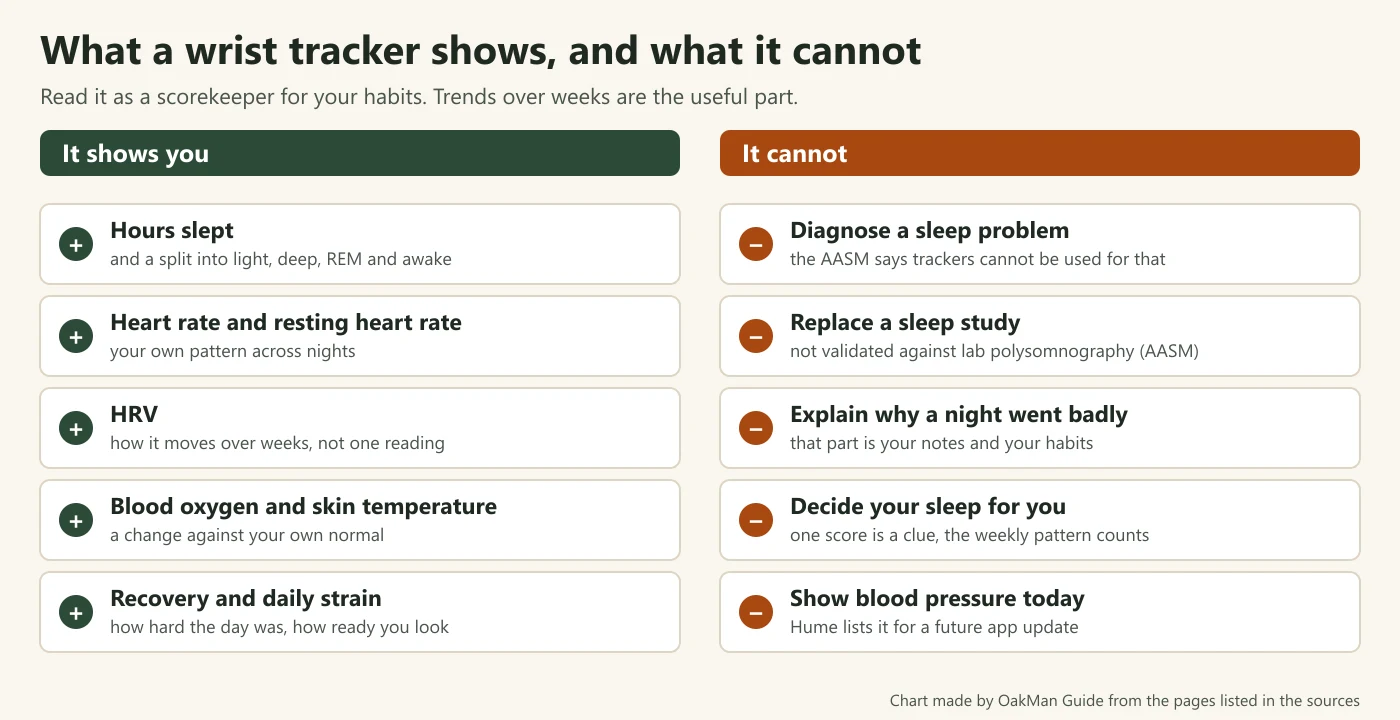
Two practical points follow. First, a tracker cannot tell you why a night went badly. Only your notes can: the late coffee, the second beer, the heavy dinner. Second, the sleep stages are estimates, so use them for trends and leave the exact minutes of deep sleep alone. For the daily habits that move those numbers, there is a list in our foods and habits guide.
How do I use the numbers without driving myself crazy?
Keep it simple. This is a simple routine to follow:
- Wear it for two weeks first. That gives you your own baseline for sleep length, resting heart rate and HRV before you change anything.
- Look once a morning. A quick look over coffee is enough. Checking five times a day turns a tool into a worry.
- Change one habit at a time. Move bedtime 30 minutes earlier, or drop the late coffee, then watch the weekly average.
- Judge the week, not the night. A single poor score is a clue. Three or four weeks of a trend is a pattern.
- Write down what you did. A line of notes beside the numbers answers the "why" that the band cannot.
The tracker also fits nicely beside the yearly visit. If you are putting together your list for the doctor, the checkups after 50 guide has the questions, and your sleep charts are a good page to bring along. And if you are curious why heart numbers come up in so many of these conversations, our article on ED and heart health explains the connection.
Where does the Hume Band 2.0 fit in?
The Hume Band 2.0 is the one wrist tracker we cover on this site, and it suits the routine above for one simple reason: you pay once. Hume's page says no subscription is required to use the band or see your raw data, and the Hume Health app is free for band owners. Premium, with AI coaching and deeper analysis, is optional and starts at $8.99 a month. If you like to read your own numbers and make your own calls, the free app does the job.
- Battery: up to 14 days per charge, so the band stays on through the night, every night.
- What it records: sleep stages, heart rate, HRV, blood oxygen, skin temperature, activity and recovery, all in the app.
- Water: IP68 rating, so the shower is no problem.
- Phones: works with iPhone and Android.
- Trial: a 45-day refund window on the official page, long enough to test it against your own sleep.
Blood pressure trends are listed for a future app update, while sleep, heart rate and recovery are there from day one. You can read the full details in our Hume Band 2.0 review, and the current price and offer are always on the official Hume store.
What is the bottom line?
Use a tracker the way you would use a tape measure: it gives you a number, and you decide what to do with it. Two weeks for a baseline, one change at a time, and the weekly pattern as the verdict. If you want a band for exactly that, with no monthly bill, the Hume Band 2.0 is built for it. For the other side of recovery, our guide to men's health checkups after 50 lists what is worth checking at your next visit.
Frequently asked questions
Can a wrist tracker tell me if I sleep well?
It gives you a good estimate of how long you slept and how your night was split into light, deep, REM and awake time. Treat it as a scorekeeper for your habits. Your own feeling in the morning counts too, and the weekly pattern tells you more than any single night.
How many hours of sleep should I get after 50?
The CDC lists 7 or more hours for adults 18 to 60, 7 to 9 hours for ages 61 to 64 and 7 to 8 hours for ages 65 and older. Those are the numbers to compare against what your tracker shows.
Can a tracker diagnose sleep apnea or any sleep disorder?
No. The American Academy of Sleep Medicine says consumer sleep technologies cannot be used for the diagnosis or treatment of sleep disorders at this time, although they may help the conversation with your doctor. A tracker shows a pattern, and a diagnosis comes from a proper evaluation.
What is HRV and should I watch it?
HRV is the small variation in the time between heartbeats. Hume uses it as part of its recovery picture. The useful way to read it is as your own trend over weeks, not as a number to compare with someone else.
Does the Hume Band 2.0 need a monthly subscription?
No. Hume's page says the band and your raw data work without a subscription, and the Hume Health app is free for band owners. Premium, with AI coaching and deeper analysis, is optional and starts at $8.99 a month.
How long does the Hume Band 2.0 battery last?
Up to 14 days per charge, according to the official page. That is long enough to wear it through every night and charge it once in a while, for example during a shower.
Should I wear a tracker every night?
A week or two of steady wear gives you a baseline of your own numbers. After that, wearing it most nights keeps the trend honest, and a longer battery makes that easier because the band stays on your wrist.
Sources we checked for this article
- CDC: About Sleep (page dated May 15, 2024)
- American Academy of Sleep Medicine: Consumer Sleep Technology, position statement (J Clin Sleep Med) (published May 15, 2018)
- Hume Health: Hume Band 2.0 official page (read October 2 and October 30, 2026)