
Fitness & Food · Start here
Fitness and Food After 50: A Simple Starting Guide for Men
By OakMan Guide Editorial Team Updated 9 min read
The short answer
Start with two habits. Move about 150 minutes a week at a pace where you can talk but not sing, and work your muscles on 2 days. Then build meals around protein foods, vegetables and whole grains, and cut back on sugary drinks, packaged snacks and alcohol. This guide takes each step in turn, with the official page behind it.
We're not doctors, and this is not medical advice.
Photo via Pexels.
Nobody needs a perfect plan after 50, just a repeatable one. Here is the whole picture on one page, from how much to move to what to put on the plate, so you can pick the first step and add the rest later.
Why does moving more matter after 50?
The CDC calls physical activity one of the most important things you can do for your health. It says activity helps you feel better, function better and sleep better right away, and that at least 150 minutes a week of moderate activity lowers your risk of heart disease and stroke, with regular activity also helping to lower blood pressure and improve cholesterol. Regular activity can also reduce the risk of type 2 diabetes and metabolic syndrome.
For older adults, the CDC page on older adults adds that activity helps you keep doing everyday things without depending on others. Its last line is the one to remember: it is never too late to start. For the vitality side of the same story, see our guide to erectile dysfunction and heart health.
How much should I move each week?
The CDC adult guideline, which covers men in their 50s and early 60s, asks for 150 minutes of moderate activity a week, such as 30 minutes on 5 days, plus muscle-strengthening on at least 2 days. You can break the time into smaller chunks. The older-adult version for 65 and up has the same numbers and adds balance activities.
| Type of activity | What counts | How much, per the CDC |
|---|---|---|
| Aerobic ("cardio") | Brisk walking, biking, dancing, raking leaves, mowing the lawn, water aerobics | At least 150 minutes a week of moderate effort, or 75 of vigorous, or a mix |
| Muscle-strengthening | Weights, resistance bands, push-ups or sit-ups, digging in the garden, some yoga | At least 2 days a week, all major muscle groups |
| Balance (CDC age 65+) | Walking backward, standing on one leg, walking heel-to-toe, a wobble board | Part of each week at 65 and older |
How hard is "moderate"? The CDC scale runs from 0 (sitting) to 10 (all out). Moderate is a 5 or 6, where you breathe harder and your heart beats faster but you can still talk, though not sing. Vigorous is a 7 or 8, and you can say only a few words without stopping for breath. About one vigorous minute equals two moderate ones.
Two more lines from the CDC take pressure off. Some activity is better than none, and adults who sit less and do any amount of moderate or vigorous activity gain some benefit. If you cannot reach the targets, be as active as your abilities and conditions allow.
What does a simple week look like?
The CDC's adding activity page gives three sample schedules. The first is the easiest to copy: a 30-minute brisk walk on five days and weight training on two. We turned it into a chart.
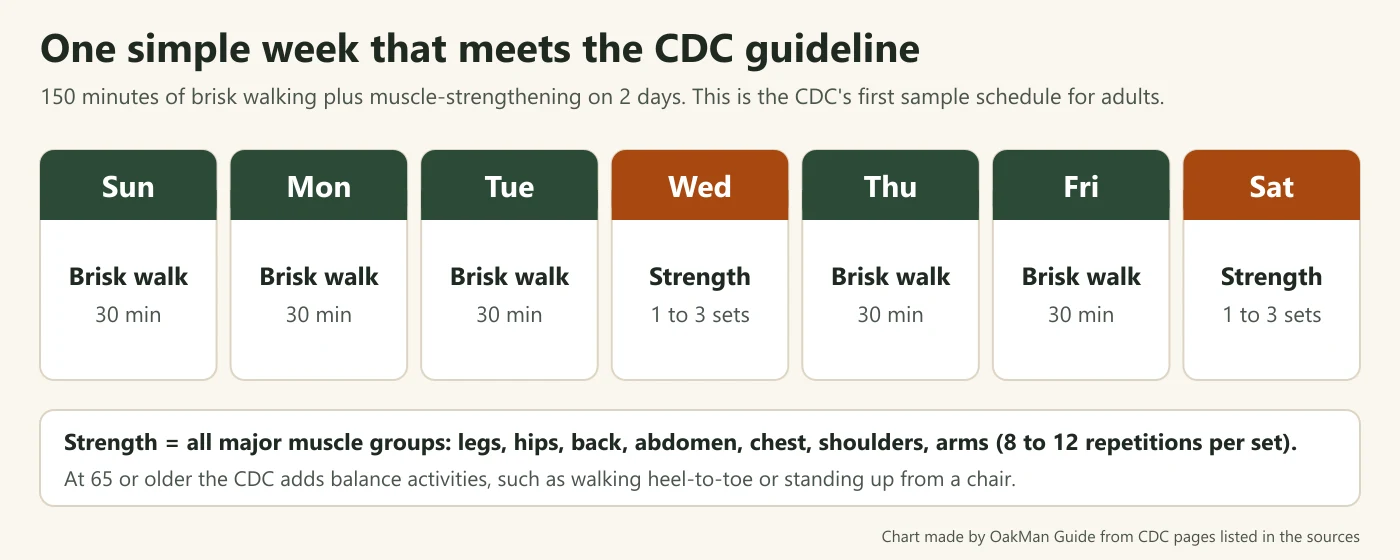
If five walks sound like too much, start smaller. The CDC's weight-loss page gives a model goal that works for any habit: "I will walk 15 minutes, 3 days a week for the first week" is specific and realistic, where "exercise more" is not. It also says to focus on two or three goals at a time, and that setbacks are expected, so you get back on track as soon as you can.
Do I need a gym to build strength?
No. The CDC list of muscle-strengthening activities includes lifting weights, working with resistance bands, body-weight moves such as push-ups and sit-ups, digging in a garden and some yoga postures. Choose moves that work all the major muscle groups: legs, hips, back, chest, abdomen, shoulders and arms.
The CDC's advice is plain: aim for 8 to 12 repetitions of an activity, which counts as one set, and work to the point where another repetition would be hard to do without help. Do at least one set, and for more benefit, two or three. Strong back, abdomen and leg muscles also help your balance, which is also why our Home and DIY guide lists strength and balance exercises among the ways to prevent falls. For a full routine, see our starter plan for strength training after 50.
What if I have been inactive or have a health condition?
The CDC says activity of moderate effort is safe for most people. Two situations call for a call to your doctor first. If you have a chronic condition such as heart disease, arthritis or diabetes, talk about the types and amounts of activity that suit you. And if you have been inactive, have overweight or have a disability, talk to your doctor before starting vigorous activity such as jogging.
The same page has a practical tip for restarts: if you take a break because of illness or travel, begin again at a lower level and work back up slowly. If it is too hot, cold or wet outside, it suggests walking in a mall or following an online fitness program at home. Bring your plan to the visit in our checkups guide, which shows how to build that list.
What should I put on my plate?
The Dietary Guidelines for Americans, 2025-2030, released in January 2026, are the current federal advice. Its central ask is to eat whole, nutrient-dense foods and to cut back on highly processed ones. The numbers below are goals for a 2,000-calorie pattern, and the guidelines say to adjust them to your own calorie needs.
| Food group | Daily goal | Serving examples |
|---|---|---|
| Protein foods | 1.2 to 1.6 g of protein per kg of body weight a day | 3 oz cooked meat, poultry or seafood; 1 egg; 1 oz nuts or seeds; 2 tbsp nut or seed butter; beans, peas and lentils |
| Dairy | 3 servings | 1 cup milk; 1 oz cheese |
| Vegetables | 3 servings | 1 cup raw or cooked; 2 cups leafy greens |
| Fruit | 2 servings | 1 cup raw |
| Whole grains | 2 to 4 servings | 1 slice bread; 1 tortilla |
A few more lines from the guidelines are worth keeping:
- Protein at every meal. Choose a variety of animal and plant sources: eggs, poultry, seafood, red meat, beans, peas, lentils, nuts, seeds and soy.
- Vegetables and fruit in their original form. Frozen, dried or canned with no or very limited added sugars are also fine. Juice should be limited or diluted with water.
- Limit highly processed foods, added sugars and sugary drinks. The guidelines name chips, cookies, candy and sugar-sweetened drinks such as soda, fruit drinks and energy drinks.
- Sodium under 2,300 mg a day for the general population ages 14 and up.
- Water or unsweetened drinks for hydration, still or sparkling.

For older adults, the guidelines add a point that matters: some need fewer calories but still need equal or greater amounts of key nutrients such as protein, vitamin B12, vitamin D and calcium. That is the reason to choose nutrient-dense foods first. If dietary intake is not enough, the guidelines say fortified foods or supplements may be needed under medical supervision. Our foods and habits guide for the prostate shows how the same plate looks through a prostate lens.
How much protein is that in real life?
The guidelines' protein goal is 1.2 to 1.6 grams per kilogram of body weight a day, adjusted to your calorie needs. To turn that into a number, divide your weight in pounds by 2.2 to get kilograms, then multiply. For a man who weighs 180 pounds (about 82 kg), that works out to roughly 98 to 131 grams a day. That math is ours, not the guidelines', so treat it as a ballpark.
For anyone with a chronic disease, the guidelines add a check with a health care professional, in case the plan needs to change. Our guide to protein after 50 goes into more detail, with a table of everyday foods and portions.
Do weight and waist size matter?
They are two simple numbers you can track. The CDC calls body mass index (BMI) a quick, low-cost screening measure, but says it does not tell fat from muscle and bone, and that for you it should be read with your blood pressure, cholesterol and a physical exam. NHLBI says a healthy BMI for adults is generally 18.5 to 24.9, and to ask your provider what your number means for you.
Waist size adds a second clue. NHLBI says that if most of your fat sits around your waist, your risk of heart disease and type 2 diabetes is higher, and that a waist over 40 inches for men raises it. To measure, stand and place a tape around your middle just above your hipbones, then read it right after you breathe out.
If you want to lose weight, the numbers are kind. The CDC says even a modest loss helps blood pressure, cholesterol and blood sugar: for someone who weighs 200 pounds, 5 percent is 10 pounds. NIDDK says people at risk of type 2 diabetes may be able to prevent or delay it by losing 5 to 7 percent of their starting weight. Going slowly pays off, since the CDC says people who lose about 1 to 2 pounds a week are more likely to keep it off. It adds that you may need to eat fewer calories and do more than the recommended amount of activity, and that medicines and medical conditions can affect weight, so ask your provider about both.
Where does alcohol fit?
The CDC defines moderate drinking for men as two drinks or fewer in a day, and notes that moderate drinking carries less risk than drinking excessively. It also says that even moderate drinking may raise your risk compared with not drinking, and that low levels, under one drink a day, can raise the risk of certain cancers. The 2025-2030 Dietary Guidelines put it simply: consume less alcohol for better overall health.
Both say some people should skip it completely, including anyone taking medicines that can interact with alcohol, anyone with certain medical conditions such as some liver diseases, and anyone who cannot control how much they drink. The bladder side of the story is in our article on caffeine, alcohol and night urination, and the sleep side is in sleep and recovery after 50.
Where should I start this week?
Pick the smallest version of each habit and keep it for a week before adding more:
- Walk. Try 15 minutes on 3 days, briskly enough that you can talk but not sing. Add minutes until you reach 150 a week.
- Strengthen. Choose 2 days and one set of 8 to 12 repetitions of moves for your legs, back, chest and arms, with weights, bands or your own body weight.
- Add protein to breakfast. Eggs, yogurt, beans or leftover chicken count. Protein at every meal is the guideline.
- Swap one sugary drink for water or an unsweetened drink.
- Measure your waist once and write the number down for your next checkup, along with the activity you plan to do.
That is enough for week one. For the wider view, our men's health guide links the rest of the topics, and our strength training plan takes the second habit further.
Frequently asked questions
How much exercise do men over 50 need each week?
The CDC says adults need at least 150 minutes of moderate activity such as brisk walking (or 75 minutes of vigorous activity, or an equivalent mix), plus muscle-strengthening on at least 2 days. At 65 and older it adds balance activities. Some activity is better than none.
What counts as moderate activity?
On the CDC scale of 0 to 10, moderate is a 5 or 6: you breathe harder and your heart beats faster, and you can talk but not sing. Vigorous is a 7 or 8, where you can say only a few words before you need a breath. One vigorous minute counts about the same as two moderate ones.
Do I need a gym to build strength?
No. The CDC lists lifting weights, working with resistance bands, body-weight moves such as push-ups or sit-ups, digging in the garden and some yoga postures. It suggests 8 to 12 repetitions per set, working until another repetition would be hard to do without help.
How much protein do I need?
The Dietary Guidelines for Americans 2025-2030 give a goal of 1.2 to 1.6 grams of protein per kilogram of body weight per day, adjusted to your calorie needs. For a 180-pound (82 kg) man, our math puts that at about 98 to 131 grams. With a chronic disease, the guidelines add a check with a health care professional first.
How many servings of vegetables and fruit should I eat?
For a 2,000-calorie pattern, the 2025-2030 Dietary Guidelines say 3 servings of vegetables and 2 of fruit a day, with 2 to 4 servings of whole grains, adjusted to your own calorie needs.
Is my belly size a health risk?
NHLBI says a waist measuring more than 40 inches for men raises the risk of heart disease and type 2 diabetes when most of your fat sits around the middle. Measure standing, with the tape just above the hipbones, right after you breathe out, and bring the number to your next checkup.
How much weight loss helps?
The CDC says even modest loss helps: for a person who weighs 200 pounds, a 5 percent drop is 10 pounds, which could lower the risk of some chronic diseases. It also says people who lose weight gradually, about 1 to 2 pounds a week, are more likely to keep it off.
Is a drink or two a day fine?
The CDC defines moderate drinking for men as two drinks or fewer in a day, but says even moderate drinking may raise risk compared with not drinking. The 2025-2030 Dietary Guidelines say to consume less alcohol for better overall health. Anyone taking medicines that interact with alcohol should skip it.
Sources we checked for this article
- CDC: Adult Activity: An Overview (page dated December 20, 2023)
- CDC: Older Adult Activity: An Overview (page dated December 4, 2025)
- CDC: What Counts as Physical Activity for Older Adults (page dated December 4, 2025)
- CDC: Adding Physical Activity as an Adult (page dated December 4, 2025)
- CDC: Benefits of Physical Activity (page dated December 4, 2025)
- CDC: Steps for Losing Weight (page dated January 17, 2025)
- CDC: About Body Mass Index (BMI) (page dated December 16, 2025)
- CDC: About Moderate Alcohol Use (page dated January 14, 2025)
- NHLBI: Heart-Healthy Living, Aim for a Healthy Weight (page last updated December 11, 2025)
- NIDDK: Health Risks of Overweight & Obesity (page last reviewed May 2023)
- USDA and HHS: Dietary Guidelines for Americans, 2025-2030 (PDF, January 2026)
- USDA and HHS: Daily Servings by Calorie Level (PDF from the 2025-2030 Dietary Guidelines, read November 3, 2026)