
Home & DIY · Start here
Home and DIY After 50: Keeping Your House Safe, Comfortable and Sound
By OakMan Guide Editorial Team Updated 9 min read
The short answer
A safe, comfortable home after 50 comes down to four jobs: prevent falls, keep working smoke and carbon monoxide alarms, service the heating and cooling system, and know which repairs to do yourself and which to hand to a pro. Start with the ones that prevent injuries: light, clear floors, handrails and alarms. This guide covers each, with the official page behind it.
We're not doctors, home inspectors, electricians or fire-safety professionals, and this is not medical or professional advice. Every house is different, so follow the maker's instructions and the official pages linked here, and call a licensed pro for electrical, gas and heating work.

Photo via Pexels.
Most of what keeps a house safe is small, cheap and done once or twice a year. Here is the whole house on one page, with the official source for each job, so you can see what comes first and what can wait.
Why start with falls?
Because the CDC calls them the leading cause of injury death for older adults. Its fall prevention page says falls among adults 65 and older caused over 43,000 deaths in 2024, the leading cause of injury death for that group, and about 4.5 million emergency department visits. The CDC counts older adults as 65 and over, so those are the numbers behind the advice. The home fixes below cost little to do sooner.
The CDC facts page adds two points worth knowing. More than one in four older people falls each year, but fewer than half tell their doctor, and falling once doubles your chances of falling again. It also says most falls come from a combination of risk factors, and that many of them can be changed. That is the good news: a fall usually has several causes, and the house is the part you control.
What should I fix, room by room?
The CDC publishes a one-page home checklist, Check for Safety. We turned it into a table. Walk through the house once with the table in your hand and mark what applies.
| Where | What to look for | The CDC fix |
|---|---|---|
| Stairs and steps | Objects on the stairs, broken or uneven steps, burned-out bulbs, loose carpet, a handrail on one side only | Keep stairs clear, fix steps, put a light and switch at the top and bottom, fasten carpet, and have handrails on both sides, as long as the stairs |
| Floors | Furniture you walk around, throw rugs, cords across the path | Clear a path, remove rugs or use double-sided tape or a non-slip backing, coil or tape cords along the wall |
| Kitchen | Things you use often on high shelves, an unsteady step stool | Keep everyday items about waist high, and use a sturdy step stool with a bar to hold. Never use a chair |
| Bedroom | A light that is hard to reach, a dark path to the bathroom | Put a lamp within reach of the bed and a nightlight along the path |
| Bathroom | A slippery tub or shower floor, nothing to hold when getting in, out or up from the toilet | Add a non-slip mat or strips, and have grab bars put in next to and inside the tub and next to the toilet |
Light matters more than it seems. The CDC's prevention page says to make sure your home has lots of light by adding more or brighter bulbs, and its What YOU Can Do sheet says that as you get older you need brighter light to see well, and that light-weight curtains or shades cut glare. If the night path to the bathroom is part of your routine, our guide to waking up at night to pee explains why it happens and why that path is worth lighting. For the same checklist ordered from free fixes to jobs for a pro, see our ten simple fixes for fall-proofing your home.
What about the parts of a fall that are not the house?
The CDC lists four things you can do, and only one is about the house. The same sheets and the prevention page also say to:
- Have your medicines reviewed. Ask your doctor or pharmacist to look at everything you take, including over-the-counter products, because some can make you dizzy or sleepy.
- Do strength and balance exercises. The CDC says exercises that make your legs stronger and improve your balance lower your chances of falling, and gives Tai Chi as an example.
- Have your eyes and feet checked. See an eye doctor once a year and update your glasses. The CDC also says to have a provider check your feet once a year and to wear well-fitting shoes with good support, inside and outside the house.
- Ask about vitamin D and bone health. The CDC says to ask your provider about vitamin D, and to get screened for osteoporosis and treated if needed.
Those belong on the list you bring to the doctor. Our checkups guide shows how to build that list, and the men's health guide links the rest.
Where do smoke alarms go, and what else should I do about fire?
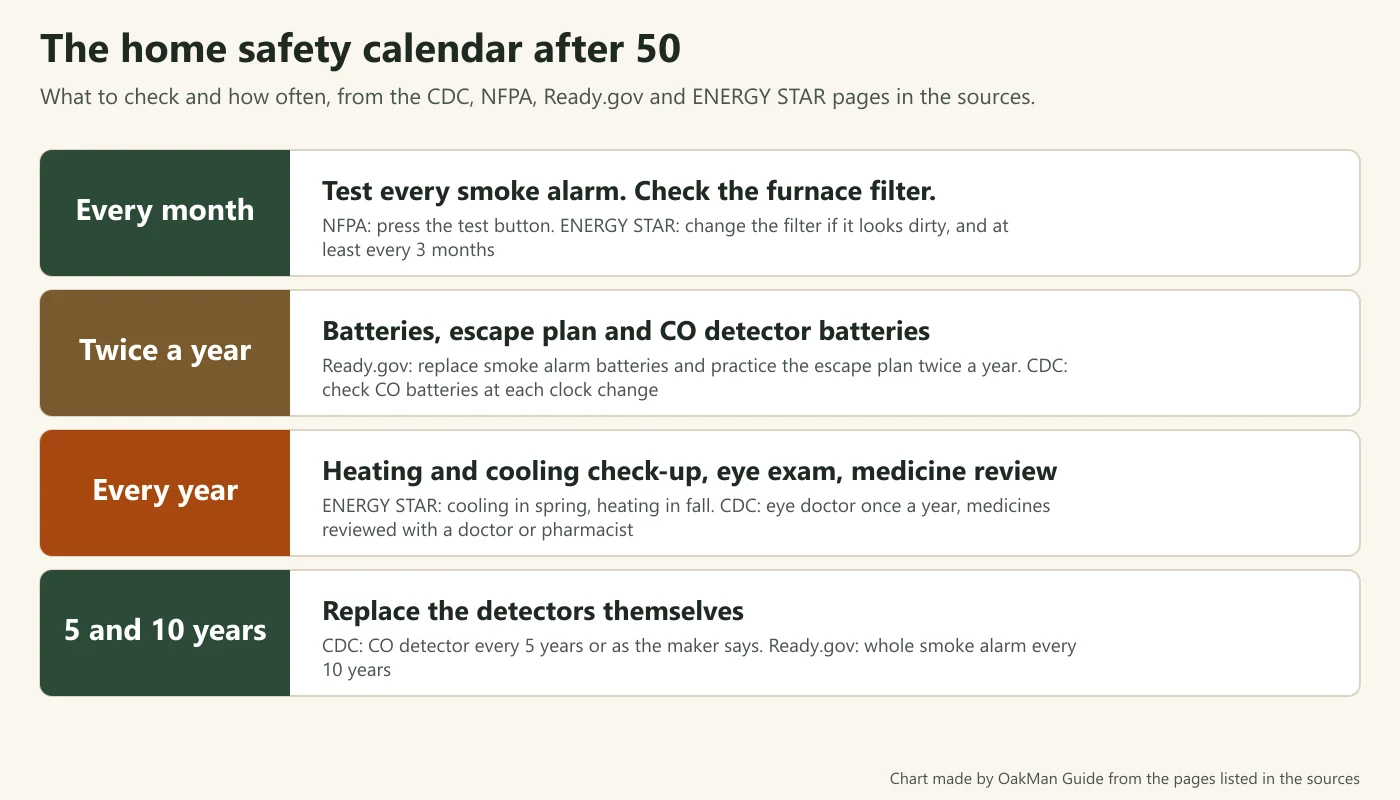
NFPA says roughly three out of five fire deaths happen in homes with either no smoke alarms or no working smoke alarms. Its tips are short: install alarms in every sleeping room, outside each separate sleeping area and on every level, including the basement; use interconnected alarms if you can, so one sounds all of them; and test every alarm at least once a month.
Ready.gov fills in the upkeep. Its upkeep list: fresh batteries twice a year (not needed with a 10-year lithium battery), a new alarm after 10 years or sooner if the maker says so, and never disabling an alarm while you cook. A few more lines from the same page are worth a minute:
- Plan two ways out of each room, check that windows are not stuck, and practice twice a year, including once in the dark.
- Check your doorways if you use a walker or wheelchair.
- Sleep with the bedroom door closed, and keep a fire extinguisher in the kitchen.
- Stay in the kitchen when you are frying, grilling or broiling, and turn the stove off if you leave, even briefly.
- Replace frayed cords and never run a cord under a rug.
Ready.gov also says a small flame can turn into a major fire in less than 30 seconds. That is why the alarm and the plan, not the extinguisher, come first.
Do I need a carbon monoxide detector too?
Yes, it is a separate device from a smoke alarm. The CDC wants one near every sleeping area, running on a battery or with a battery back-up, and says to replace it every 5 years or sooner if the maker says so. Its warning is plain: everyone is at risk, older adults and people with heart or breathing problems or anemia face a higher risk of getting sick from CO, and someone asleep can die before any symptoms show.
The CDC also says to check the batteries when you change your clocks each spring and fall. That is an easy habit to pin to the date, and we wrote about the fall clock change in our daylight saving time guide. For heating season, generators and what not to heat the house with, see our winterize your home checklist, and for clearing the driveway without straining your heart or back, our guide to snow shoveling after 50.
How do I keep the heating and cooling system in shape?
ENERGY STAR says nearly half the energy used in a home goes to heating and cooling, so this is where comfort and the monthly bill meet. Its advice is practical:
- The filter: look at it monthly. If it looks dirty, change it, and change it at least every 3 months either way. A dirty filter slows airflow and makes the system work harder.
- The yearly check-up: have a contractor do a pre-season visit, cooling in spring and heating in fall. For heating, the maintenance checklist includes gas or oil connections, gas pressure, burner combustion and the heat exchanger.
- Ducts: sealing and insulating ducts that run through the attic, crawlspace, unheated basement or garage can improve efficiency by as much as 20 percent.
- Air leaks: sealing leaks and adding insulation can give up to 10% savings on annual energy bills. Weather stripping on doors and caulk around windows are the simple fixes. Attic work is the bigger job.
- An older system: if it is more than 10 years old or not keeping the house comfortable, ENERGY STAR says to have a professional HVAC contractor evaluate it, and to deal with big air leaks and the ducts before buying a new one.
One more line from ENERGY STAR is worth keeping: improper installation can reduce a system's efficiency by up to 30 percent. A good installer matters as much as a good machine.
Which jobs can I do myself, and which should I hand to a pro?
The pages above answer this, a little at a time. We put the answers in two lists: what the sources describe as ordinary upkeep, and where they say to bring someone in.
Fine to do yourself
- Keep stairs, floors and walking paths clear, and remove or secure throw rugs (CDC).
- Coil or tape cords along the wall, and add nightlights and a lamp within reach of the bed (CDC).
- Test smoke alarms every month and change their batteries twice a year (NFPA, Ready.gov).
- Check the furnace filter every month and change it when it is dirty (ENERGY STAR).
- Add weather stripping to doors and caulk around windows (ENERGY STAR).
The sources say to bring someone in
- A light and light switch at the top and bottom of the stairs: the CDC says to have an electrician put them in.
- Grab bars next to and inside the tub and next to the toilet: the CDC says to have them put in.
- The yearly heating and cooling check-up: ENERGY STAR says a contractor does it, before each season.
- A system more than 10 years old, or one that does not keep the house comfortable: ENERGY STAR says to have a professional HVAC contractor evaluate it.
- A switch that feels hot, or lights that flicker: Ready.gov says to shut it off right away and have it replaced professionally.
One small note: the CDC checklist says that if a bulb is out on the stairs, a friend or family member can change it. Asking for help is part of the plan, not a failure of it.
Where should I start this weekend?
You can do this list in an afternoon, in this order, because it puts injuries first:
- Test every smoke alarm and check how old each unit is. Ready.gov says the alarm itself should go after 10 years.
- Find your CO detectors. There should be one near each sleeping area, and the battery should be fresh.
- Walk the CDC checklist with the table above: stairs, floors, bedroom path, bathroom.
- Change the furnace filter if it is dirty, and book the heating check-up if you have not had one this fall.
- Write down two ways out of each bedroom and practice them once.
For the money side of the years ahead, see our Money and Medicare guide. We will link new Home & DIY guides here as they come out.
Frequently asked questions
How often should I test my smoke alarms?
NFPA says to test all smoke alarms at least once a month by pressing the test button. Ready.gov adds fresh batteries twice a year (a 10-year lithium battery needs none) and a new alarm after 10 years or sooner if the manufacturer says so.
Where should smoke alarms go?
NFPA says in every sleeping room, outside each separate sleeping area and on every level of the home, including the basement. It also says interconnected alarms are best, so that when one sounds they all sound.
Where do carbon monoxide detectors go, and how long do they last?
The CDC wants one near every sleeping area, running on a battery or with a battery back-up. Swap it every 5 years, or sooner if the maker says so, and check its batteries each time the clocks change in spring and fall.
What are the most common fall hazards at home?
The CDC lists objects on stairs and floors, broken or uneven steps, throw rugs, cords across walking paths, loose stair carpet, missing or one-sided handrails, poor lighting, slippery tub floors and the lack of grab bars. Its checklist shows a fix for each one.
How often does the furnace filter need changing?
ENERGY STAR says to look at it monthly, especially in winter and summer. If it looks dirty after a month, change it, and even a clean-looking one should go at least every 3 months. A dirty filter slows airflow and makes the system work harder.
Do I need a yearly heating and cooling check-up?
ENERGY STAR recommends having a contractor do annual pre-season check-ups: the cooling system in spring and the heating system in fall. For heating, the check includes gas or oil connections, gas pressure, burner combustion and the heat exchanger.
How many ways out of the house do I need?
Ready.gov says to find two ways out of each room, in case the first is blocked by fire or smoke, and to practice the escape plan twice a year. It also suggests practicing in the dark, and checking that doorways work for a walker or wheelchair.
Which repairs should I hand to a professional?
The official pages point to a few: an electrician for stair lights and switches, grab bars put in by someone who installs them, a contractor for the yearly heating and cooling check-up and for evaluating a system more than 10 years old, and a professional replacement for any switch that feels hot.
Sources we checked for this article
- CDC: About Older Adult Fall Prevention (page updated September 4, 2026 and reviewed September 8, 2026)
- CDC: Facts About Older Adult Falls (page updated September 4, 2026 and reviewed September 8, 2026)
- CDC: Preventing Falls and Hip Fractures (page dated January 27, 2026)
- CDC STEADI: Check for Safety, A Home Fall Prevention Checklist for Older Adults (brochure, 2017)
- CDC STEADI: What YOU Can Do to Prevent Falls (brochure, 2017)
- NFPA: Smoke alarm information, stats and safety tips (read November 3, 2026)
- Ready.gov: Home Fires (read November 3, 2026)
- CDC: Carbon Monoxide (CO) Poisoning Basics (page updated and reviewed October 26, 2026)
- ENERGY STAR: Heat and Cool Efficiently (read November 3, 2026)
- ENERGY STAR: Heating and Cooling Maintenance Checklist (read November 3, 2026)
- ENERGY STAR: Seal and Insulate with ENERGY STAR (read November 3, 2026)