
Money & Medicare · Original Medicare vs Advantage
Medicare vs Medicare Advantage: The Basics Before You Choose
By OakMan Guide Editorial Team Updated 8 min read
The short answer
Original Medicare lets you see any doctor or hospital that accepts Medicare, and you pay your share as you use care. Medicare Advantage puts Parts A and B, usually drug coverage and a yearly spending limit into one private plan, but you may need to stay in its network. Neither is better for everyone: your doctors, your medicines and your travel plans decide.
Nothing here is insurance or financial advice, and we do not sell or recommend any plan. Plans, networks and prices differ by county and by year, so check your own doctors and medicines on Medicare.gov before you choose.

Photo: Kampus Production on Pexels.
The Medicare card looks the same whichever way you go. What changes is what sits behind it: who runs your coverage, which doctors you can use and how you pay for care. Here are the basics, straight from Medicare.gov, so the choice is easier to see.
What are the two ways to get Medicare?
Medicare.gov describes two main routes. With Original Medicare, which is Part A (hospital insurance) and Part B (medical insurance), you pay for services as you get them: Medicare pays part of the cost and you pay your share. You can add a separate drug plan and extra coverage for your share of costs. With Medicare Advantage, also called Part C, you join a plan from a private company that Medicare approved. It gives you Part A and Part B, and most plans add drug coverage.
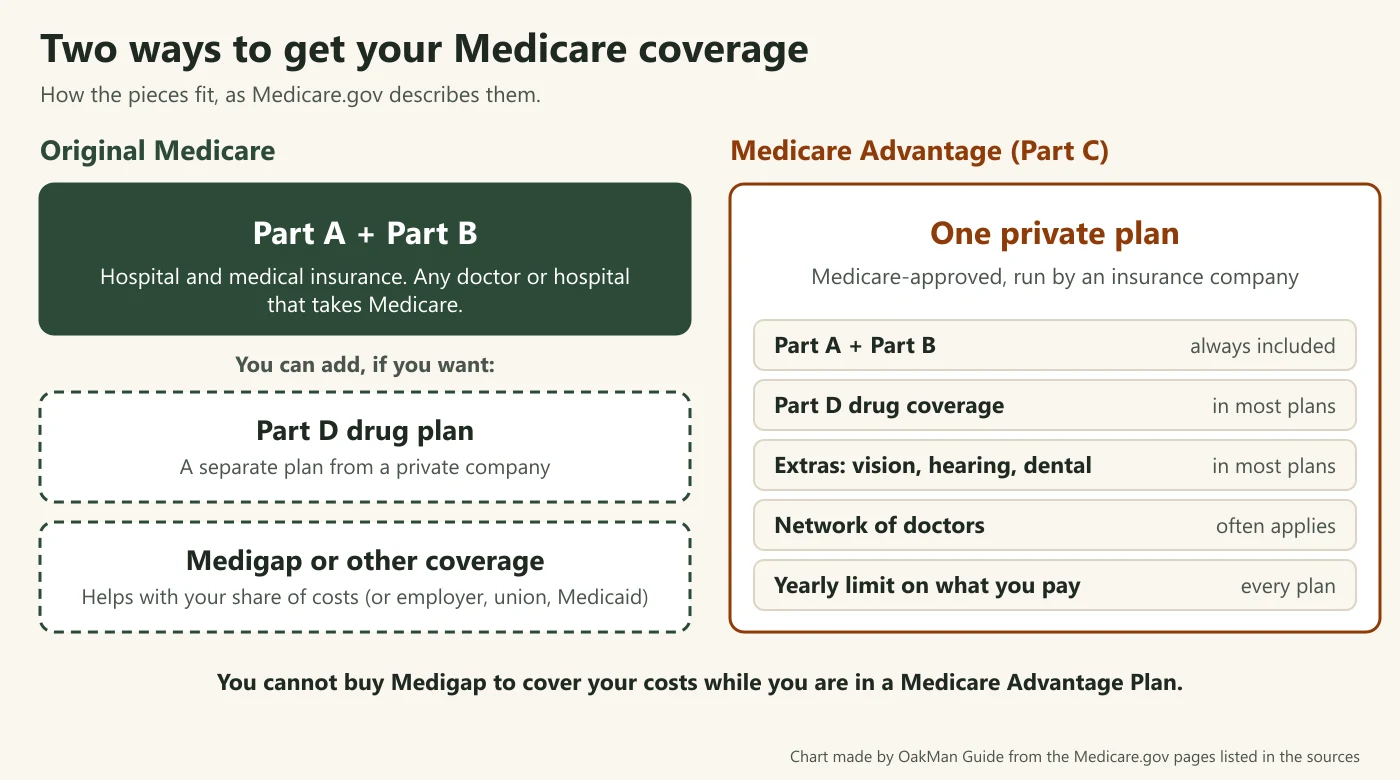
Part A helps pay for hospital stays, skilled nursing care, hospice and home health. Part B helps cover doctors and other providers, outpatient care, equipment such as walkers and hospital beds, and many preventive services, like screenings, shots and the yearly "Wellness" visit. Our checkups guide lists the visits and tests men over 50 usually ask about.
Two rules are worth knowing before anything else. To join an Advantage plan you must already have both Part A and Part B. And an Advantage plan has to cover everything Original Medicare covers, so the real differences are in how you get care and what you pay, not in whether the basics are there.
Which doctors and hospitals can I use?
This is the question that settles most decisions. The Medicare.gov comparison says that with Original Medicare you can use any doctor or hospital that accepts Medicare, anywhere in the U.S., which it defines as the 50 states, Washington, D.C., Puerto Rico, the U.S. Virgin Islands, Guam, the Northern Mariana Islands and American Samoa. You may pay more if your doctor does not accept assignment, meaning the Medicare-approved amount as full payment. In most cases you do not need a referral to see a specialist.
With Medicare Advantage, for non-emergency care you may need to use doctors, providers and hospitals in the plan's network and service area. A few plans will pay for care outside the network too, but your share is bigger. You may also need a referral to see a specialist.
How strict the network is depends on the type of plan. Medicare.gov lists five types: HMO, PPO, Private Fee-for-Service, Special Needs Plans and Medical Savings Accounts. The two most common show the range:
| HMO | PPO | |
|---|---|---|
| Can I go outside the network? | Generally no, except for emergency care, out-of-area urgent care and temporary out-of-area dialysis. Some HMOs (point-of-service) allow certain services out of network at a higher cost | Yes, for covered services, but you usually pay more |
| Do I choose a primary care doctor? | Usually | No |
| Do I need a referral to see a specialist? | Yes, in most cases | No |
| What if I get care outside the network? | You may have to pay the full cost | You pay less inside the network and usually more outside it |
Plans are also local. Medicare.gov says insurance companies decide whether a plan is offered across a whole state or only in some counties, and that each year they can decide to join or leave Medicare. If your plan stops participating, you will have to join another Medicare health plan or go back to Original Medicare. That is one more reason to check your doctors against next year's network, not only this year's.
How do the costs compare?
Medicare.gov lists the amounts below on its costs page. They are the 2026 numbers: on November 5, 2026 the page had not yet posted the 2027 premium or deductible, so we are not guessing at them.
| Original Medicare | Medicare Advantage | |
|---|---|---|
| Monthly premium | Part B: $202.90 a month in 2026, higher for some incomes. Part A: $0 for most people | You still pay the Part B premium, plus a plan premium in many plans (some plans have a $0 premium) |
| Yearly deductible | Part B: $283. Part A: $1,736 for each inpatient hospital benefit period | Varies by plan |
| Your share of each service | Typically 20% of what Medicare approves for Part B services, once the deductible is met | Copayments or coinsurance set by the plan, different from service to service |
| Yearly limit on what you pay | No yearly cap, unless Medigap or other coverage is in place | Every plan has one; after you reach it, the plan pays 100% of covered services for the rest of the year |
| Drug coverage | Separate Part D plan, optional. Out-of-pocket limit of $2,100 in 2026 | Most plans include it, so there is no separate Part D premium |
Read the table as two different ways of paying, not as a price tag on each. With Original Medicare, your bills follow how much care you use, and nothing stops them at a yearly ceiling unless you have other coverage. With an Advantage plan, the copays are known in advance and the ceiling is built in, but the plan's own rules decide who you see and what needs approval. Medicare.gov also notes that some plans with a $0 premium help pay all or part of your Part B premium, and that you must keep paying Part B to stay in any Advantage plan.
If you get Social Security, remember the premium comes out of the same income. Our piece on the 2027 Social Security raise shows how the two meet.
What about prescription drugs?
With Original Medicare, drug coverage is optional and separate. Medicare.gov says you can join a Medicare drug plan if you want one, and that it is available to everyone with Medicare. Most Advantage plans already include it, and in most types of plan you cannot join a separate drug plan on top. The plan comparison adds the detail that matters: if you join an HMO or PPO that does not offer drug coverage, you cannot get a separate Medicare drug plan. Private Fee-for-Service plans are the exception that can be paired with one.
Every drug plan has a list of covered drugs, called a formulary, and sorts them into tiers by cost, so the same medicine can cost different amounts in different plans. There is a timing rule too. Medicare.gov warns of a late enrollment penalty for anyone who goes 63 days or longer without creditable drug coverage after first getting Medicare, and in most cases it is paid for as long as you have Part D. Before you pick a plan, make a list of your medicines and their doses, so you can check each one.
What do they cover, and what needs approval?
Original Medicare covers most medically necessary services and supplies in hospitals, doctors' offices and other care settings. Medicare.gov says it does not cover some things, like routine physical exams, eye exams and most dental care. An Advantage plan must cover all the medically necessary services Original Medicare covers, and may add extras Original Medicare does not, like some vision, hearing and dental services.

The other difference is permission. In most cases you do not need approval, called prior authorization, for Original Medicare to cover your services or supplies. With an Advantage plan you may need the plan's approval before it covers certain services or supplies. Medicare.gov adds two protections for HMO and PPO members: an approval for a treatment must stay valid for as long as the treatment is medically necessary, and if you are in treatment and switch to a new plan, you have at least 90 days before the new plan can ask for a new approval.
What happens when I travel?
Inside the U.S., Original Medicare goes where you go. An Advantage plan goes by its network and service area for non-emergency care, so if you spend months away from home, ask the plan how it handles care there before you join. Emergency and urgent care are the exceptions Medicare.gov names for HMOs and PPOs.
Outside the U.S., both routes are limited. Original Medicare generally does not cover care abroad, and Medicare.gov says you may be able to buy a Medigap policy that covers emergency care outside the U.S. Advantage plans generally do not cover it either, though some offer an extra benefit for emergency and urgently needed services when you travel outside the U.S. If you leave the country often, this one line may matter more than any other in the comparison.
Where does Medigap fit in?
Medigap, formally Medicare Supplement Insurance, is a policy sold by private insurers that picks up part of what Original Medicare leaves to you: copayments, coinsurance and deductibles. Medicare.gov says it only works with Original Medicare, and its comparison page adds that it cannot be bought to cover your costs while you are in an Advantage plan.
Medigap policies are standardized. In most states there are 10 types named by letters (A to D, F, G and K to N), and the same letter means the same basic benefits whichever company sells it, so price is the only difference. Massachusetts, Minnesota and Wisconsin standardize them differently. The timing is the part to plan for. Medigap Open Enrollment is a single 6-month window, and it begins in the month your Part B starts, provided you are 65 or older. Inside it, no insurer can refuse you over health problems you already have, and Medicare.gov stresses that, unlike the yearly Open Enrollment, it does not come around again. Once it closes, buying a policy can get harder or cost more. Our Open Enrollment guide explains what that means if you are thinking of leaving an Advantage plan.
Can I change my mind later?
Yes, at set times. The yearly Open Enrollment window is October 15 to December 7, and changes begin on January 1. In it you can move from Original Medicare into an Advantage plan or back again, swap one Advantage plan for another, and add, drop or change a drug plan if you stay in Original Medicare. Medicare.gov cautions that returning to Original Medicare can mean joining a drug plan separately and possibly adding Medigap, which has its own timing limits. The same guide covers the January to March window for Advantage members.
One warning is for people who still have job or union coverage. Medicare.gov says to talk to your employer, union or benefits administrator before joining an Advantage plan, because joining might make you lose that coverage, and if you drop it for yourself you may lose it for your spouse and dependents too, and may not get it back.
How do I check a plan before I choose?
Use Medicare Plan Finder with a short list in hand:
- Your doctors and hospital: are they in the network, and does the plan need referrals?
- Your medicines: is each one on the formulary, and in which tier?
- Your yearly cost: the premium plus copays, and the plan's yearly limit, not only the monthly price.
- Your time away: what the plan covers when you travel, in the U.S. and abroad.
- Your extras: whether the vision, hearing or dental benefits are ones you would actually use.
Free human help is available. You can call 1-800-MEDICARE (1-800-633-4227; TTY 1-877-486-2048) any time, day or night, except some federal holidays. Your State Health Insurance Assistance Program (SHIP) gives free one-on-one counseling, and Medicare.gov says SHIPs are not connected to any insurance company or health plan.
What is the bottom line?
Original Medicare keeps the widest choice of doctors and lets you use them anywhere in the U.S. Medicare Advantage often bundles drug coverage and extras with a yearly limit on what you pay. Neither is the right answer for everybody, and both are real Medicare. Start with your doctors, your medicines and where you spend your time, run them through Plan Finder, and use the Open Enrollment dates to plan when to act. For the bigger picture of what to do and when after 50, the Money and Medicare guide and our men's health guide are good places to keep going.
Frequently asked questions
Is Medicare Advantage the same as Medicare?
It is a way of getting Medicare, not a separate program. Medicare.gov describes Medicare Advantage (Part C) as an alternative to Original Medicare: you get your Part A and Part B benefits, and usually drug coverage, through a private plan that Medicare approved. You must have both Part A and Part B to join, and you keep paying your Part B premium.
Can I use any doctor with Medicare Advantage?
Not always. Medicare.gov says you may need to use doctors and providers in the plan's network and service area for non-emergency care. A few plans will also pay for care outside the network, but your share is bigger. Original Medicare works with any provider that accepts Medicare, anywhere in the U.S.
Do I need a separate drug plan if I choose Medicare Advantage?
Most Advantage plans include Part D drug coverage, so you do not need one. In most types of plan you also cannot join a separate drug plan, which means that if you pick an HMO or PPO without drug coverage, you cannot add one. With Original Medicare, a separate Part D plan is optional.
Can I buy Medigap if I have Medicare Advantage?
Not to cover your costs. Medicare.gov says you can only buy Medigap if you have Original Medicare, and that you cannot buy it to help pay your out-of-pocket costs while you are in an Advantage plan. Coverage from a current or former employer or union, or Medicaid, can still be used.
Does Medicare cover me if I travel outside the U.S.?
Generally not, under either route. Original Medicare generally does not cover care outside the U.S., though some Medigap policies cover emergency care abroad. Advantage plans generally do not either, though some offer an extra benefit for emergency and urgently needed services when you travel outside the U.S.
Which one costs less, Original Medicare or Medicare Advantage?
Medicare.gov does not rank them, because costs depend on what you use and on the plan. Original Medicare usually means a monthly Part B premium plus a 20% share of most approved Part B services once the deductible is met, and no yearly cap unless you add other coverage. Advantage plans set their own copays, include a yearly cap and sometimes charge no plan premium.
Can I switch from one to the other later?
Yes, at set times. The yearly Open Enrollment window, October 15 to December 7, lets you move between the two routes, and the change begins on January 1. Our Open Enrollment guide covers the other windows.
Where can I get free help choosing?
Call 1-800-MEDICARE (1-800-633-4227), open 24 hours a day, 7 days a week except some federal holidays, or contact your State Health Insurance Assistance Program (SHIP). Medicare.gov says SHIPs are not connected to any insurance company or health plan and offer free personalized counseling.
Sources we checked for this article
- Medicare.gov: Parts of Medicare (read November 5, 2026)
- Medicare.gov: Your coverage options (read November 5, 2026)
- Medicare.gov: Compare Original Medicare & Medicare Advantage (read November 5, 2026)
- Medicare.gov: Your health plan options (read November 5, 2026)
- Medicare.gov: Health Maintenance Organizations (HMOs) (read November 5, 2026)
- Medicare.gov: Preferred Provider Organizations (PPOs) (read November 5, 2026)
- Medicare.gov: Compare types of Medicare Advantage Plans (read November 5, 2026)
- Medicare.gov: Medicare costs (read November 5, 2026; 2026 amounts)
- Medicare.gov: Get Medigap Basics (read November 5, 2026)
- Medicare.gov: Open Enrollment (read November 5, 2026)
- Medicare.gov: Contact Medicare (read November 5, 2026)
- Medicare.gov: Medicare Plan Finder