
Men's Health · Start here
Men's Health After 50: A Practical Guide to What Matters Most
By OakMan Guide Editorial Team Updated 8 min read
The short answer
What matters most after 50 is a short list: regular checkups, a healthy prostate, enough sleep, a strong heart and an honest talk with your doctor about erections and energy. Most of it costs little. This guide shows what to do first in each area, which of our articles goes deeper, and the signs that mean you should not wait.
We're not doctors, and this is not medical advice. The facts below come from the official pages listed at the bottom, and what to do with them is for you and your doctor to settle.

Photo: Gizem Gökce on Pexels.
Nobody hands you a manual at 50. This is our short one: five areas, one plain answer for each and the article to read next.
What matters most for men's health after 50?
Five areas cover most of it. We put them in one table so you can jump to the one that is on your mind today, and the sections below give the short version of each.
| Area | The question | Start with |
|---|---|---|
| Checkups | What should I get checked, and when? | Checkups after 50 |
| Prostate | Why am I up at night, and what helps? | Waking up to pee at night and enlarged prostate symptoms |
| Sleep | How do I sleep better and read my own numbers? | Daylight saving and sleep and sleep and recovery |
| Heart | What does my blood pressure have to do with the rest? | ED and heart health |
| Sex and energy | Is this normal, and who do I ask? | Erectile dysfunction after 50 and BPH medicines and sexual effects |
You do not need to fix all five this month. Pick the one that bothers you most, read that guide and write down your questions. That one step already puts you ahead of most of us.
Which checkups should I put on the calendar?
MedlinePlus makes a simple point: you should visit your provider regularly even if you feel healthy, because high blood pressure, high blood sugar and high cholesterol may have no symptoms in the early stages. Blood pressure comes first, at least once a year. Cholesterol follows, and the same page covers blood sugar, colorectal screening, eye and dental exams and vaccines.
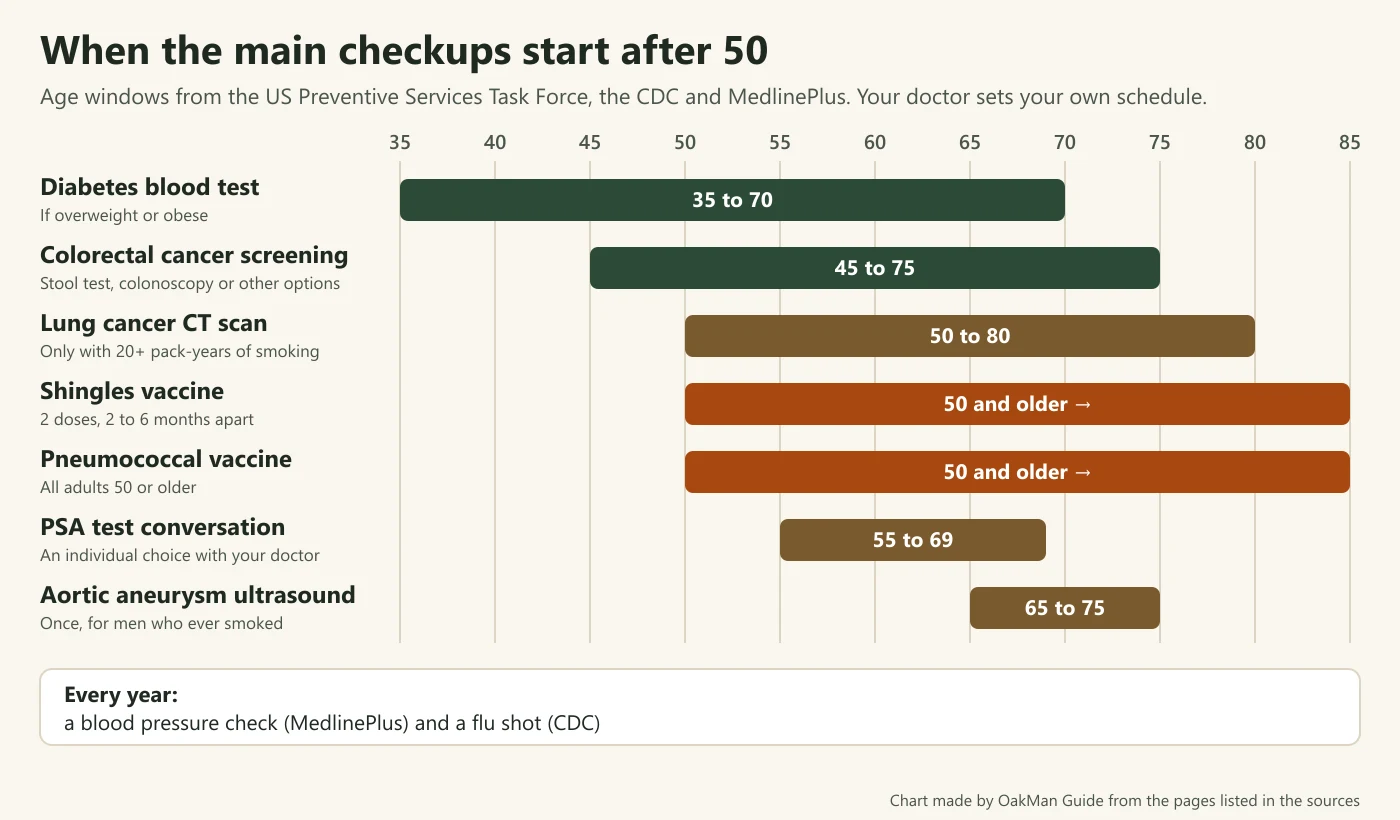
The prostate has its own question on that list. Whether and when to take a PSA blood test is a decision you make with your doctor, and our PSA test guide walks through what the number can and cannot tell you.
What changes with the prostate, and what helps?
The NIDDK estimates that benign prostatic hyperplasia (BPH, an enlarged prostate) affects about 5% to 6% of men between 40 and 64, and 29% to 33% of men 65 and older, and calls it the most common prostate problem in men older than 50. "Benign" means it is not cancer. It shows up as a weak stream, the feeling that you have not finished and trips to the bathroom at night, and it is worth mentioning to your doctor even when it is mild.
These guides take it one question at a time:
- Night-time trips to the bathroom: the causes, and the free habits to try first.
- Enlarged prostate symptoms: the eight common signs and why the size of the gland does not predict them.
- Weak urine stream: why the stream slows down and when it is time to see a doctor.
- Caffeine, alcohol and night trips: what to cut first, tested one change at a time.
- Prostatitis vs BPH: how pain, fever and age help tell them apart.
- BPH medicines: what tamsulosin and finasteride do, and the side effects to mention.
- Kegel exercises and foods and habits: the everyday side.
If you are curious about supplements, our articles on saw palmetto and on the three herbs side by side go through what the trials found, so you can talk about them with your doctor first.
How much sleep do I need, and what gets in the way?
The CDC sleep table sets the floor at 7 hours for adults up to 60, then gives a 7 to 9 hour range for ages 61 to 64 and a 7 to 8 hour range from 65 on. Two things break that most for men our age: a bladder that wakes you up and a body clock that gets thrown off twice a year.
For the first, start with the night-trip guides above. For the second, our daylight saving time guide has a plan for the week the clocks change. And if you already wear a tracker, our sleep and recovery article explains what the numbers show, and what they cannot.
Why does blood pressure keep coming up?
Because it is the number that connects the most things, and it is the one you cannot feel. MedlinePlus puts it plainly: high blood pressure often has no symptoms early on, so regular checks are how you find out, and some pharmacies and grocery stores have machines you can use. It lists a top number from 130 to 139, or a bottom number from 80 to 89, as stage 1 hypertension. Write your numbers down and bring them to the visit.
The heart also shows up in a place many men do not expect. The link between the two has its own write-up: ED and heart health explains why doctors reach for the blood pressure cuff when you mention erections.
Is a change in erections or energy just part of getting older?
Not by default. The NIDDK says the odds of erectile dysfunction rise with age, but that it is not an automatic part of aging. It lists diabetes, heart disease and obesity among the factors, along with some medicines, including blood pressure medicines and antidepressants, and mental health or emotional causes. Each of those is something a doctor can look at.
Our ED guide covers the common causes, what the visit involves and the habits that help. If you take a prostate medicine, read about the sexual side effects of BPH medicines before you decide anything on your own.
Which signs mean I should not wait?
Some things do not belong on a to-do list. We sorted the signs the CDC and the NIDDK list into three levels so you can see the difference at a glance.
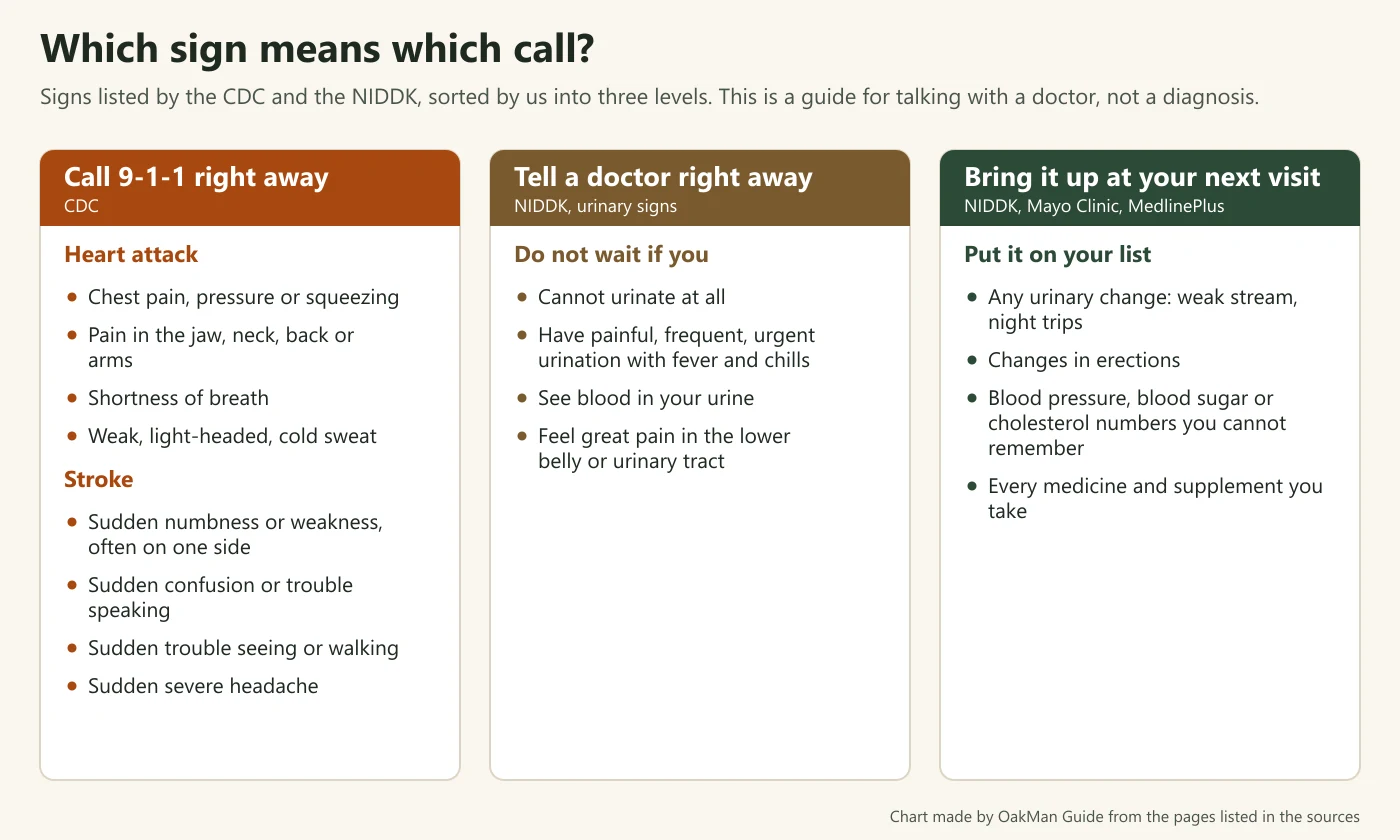
The CDC says to call 9-1-1 immediately if you notice the symptoms of a heart attack in yourself or someone else, and lists chest pain or discomfort, feeling weak, light-headed or faint, pain in the jaw, neck or back, pain in one or both arms or shoulders, and shortness of breath. On stroke, it says to call 9-1-1 right away for sudden trouble walking, dizziness or loss of balance, sudden trouble seeing, sudden numbness or weakness in the face, arm or leg, especially on one side, sudden confusion or trouble speaking, or a sudden severe headache, and not to drive to the hospital.
For the urinary signs, the NIDDK lists four reasons not to wait before contacting a health care professional: being unable to urinate at all, blood in the urine, a painful, urgent need to go along with fever and chills, and strong pain or discomfort low in the belly or urinary tract.
Where should I start this week?
Five small steps, in the order we would take them:
- Book the visit. If you cannot remember your last checkup, the date is the first thing to fix. Use our checkups guide to write your questions.
- Make the list. One page with your medicines, supplements, family history and latest numbers.
- Check your blood pressure. A pharmacy machine is fine for a first reading. Write it down.
- Count your night trips. Three nights is enough to give your doctor a real number, and the night-time urination guide shows how.
- Change one habit. The evening drink, a short walk after dinner or the five-minute pelvic floor routine. One at a time.
For the habit side, our Fitness and Food guide covers the weekly activity targets and what to put on the plate. Then come back and pick the next guide from the table at the top. We will keep adding to this page as new ones go up.
Frequently asked questions
What matters most for a man's health after 50?
Seeing a doctor on a regular schedule, even when you feel fine. MedlinePlus says high blood pressure, high blood sugar and high cholesterol may have no symptoms early on, and that simple checks and blood tests find them. After that come the habits you control: sleep, movement, food and speaking up about anything new.
How often should a man over 50 see a doctor?
MedlinePlus says to visit your provider regularly, even if you feel healthy, and to get a blood pressure reading at least yearly. Your own schedule depends on your age, family history and conditions, so ask your doctor when your next visit should be.
Is it normal to wake up at night to pee after 50?
It is common. The NIDDK calls an enlarged prostate the most common prostate problem in men older than 50, and night trips are one of its signs. Common does not mean you should ignore it: the NIDDK says any urinary symptom is worth raising with a health care professional.
How much sleep does a man over 50 need?
The CDC's sleep table sets the floor at 7 hours for adults up to 60, then gives a 7 to 9 hour range for ages 61 to 64 and a 7 to 8 hour range from 65 on. If night trips to the bathroom keep cutting your sleep short, that is worth raising at your next visit.
Is erectile dysfunction just something that comes with age?
The NIDDK says the odds rise with age, but that it is not an automatic part of aging. It names diabetes, heart disease, obesity and some medicines, such as blood pressure medicines and antidepressants, among the factors, which is why the conversation with your doctor is useful.
Which signs mean I should call 9-1-1?
The CDC says to call 9-1-1 right away for the symptoms of a heart attack, such as chest pain or pressure, pain in the jaw, neck, back or arms, and shortness of breath, and for stroke signs, such as sudden numbness or weakness on one side, sudden confusion or trouble speaking and a sudden severe headache. It says not to drive yourself to the hospital.
Which urinary signs should I report right away?
The NIDDK lists four: being unable to urinate at all, blood in the urine, a painful, urgent need to go along with fever and chills, and strong pain or discomfort low in the belly or urinary tract. It says to contact a health care professional right away.
Sources we checked for this article
- MedlinePlus (National Library of Medicine): Health screening, men ages 40 to 64 (reviewed June 24, 2025)
- CDC: About Heart Attack Symptoms, Risk, and Recovery (page dated October 24, 2024)
- CDC: Signs and Symptoms of Stroke (page dated May 19, 2026)
- CDC: About Sleep (page dated May 15, 2024)
- NIDDK: Enlarged Prostate (Benign Prostatic Hyperplasia) (last reviewed June 2024)
- NIDDK: Definition and Facts for Erectile Dysfunction (last reviewed October 2024)