
Money & Medicare · Start here
Money and Medicare After 50: A Plain-English Starter Guide
By OakMan Guide Editorial Team Updated 9 min read
The short answer
The ages to know after 50 are 59½ (the early-withdrawal tax ends), 62 (earliest Social Security), 65 (Medicare sign-up), 67 (full retirement age if you were born in 1960 or later), 70 (Social Security stops growing) and 73 or 75 (required withdrawals). Several have a window, and missing it can cost money. This guide explains each one and points to the official page.
We're not financial advisers, tax professionals or Medicare agents, and this is not financial, tax or insurance advice. Your birth year, plan and income change the details, so check each point on the official page before you act.

Photo via Pexels.
Nobody mails you a calendar for the money side of getting older. The dates come from three different agencies, and a few of them have a window that closes. This is our one-page map, with the official page for each step.
Which ages matter for money and Medicare after 50?
Seven. Each one is set by the IRS, the Social Security Administration (SSA) or Medicare.gov. The table shows the order first, and the sections after it explain what to do with each.
| Age | What happens | Official source |
|---|---|---|
| 50 | Catch-up contributions open for 401(k)s and IRAs | IRS |
| 59½ | The extra 10% tax on early withdrawals no longer applies | IRS |
| 62 | Earliest age to start Social Security retirement benefits | SSA |
| 65 | Your Medicare sign-up window is open | Medicare.gov |
| 67 | Full retirement age if you were born in 1960 or later | SSA |
| 70 | Social Security stops growing for waiting | SSA |
| 73 or 75 | Required withdrawals from retirement accounts begin | IRS |
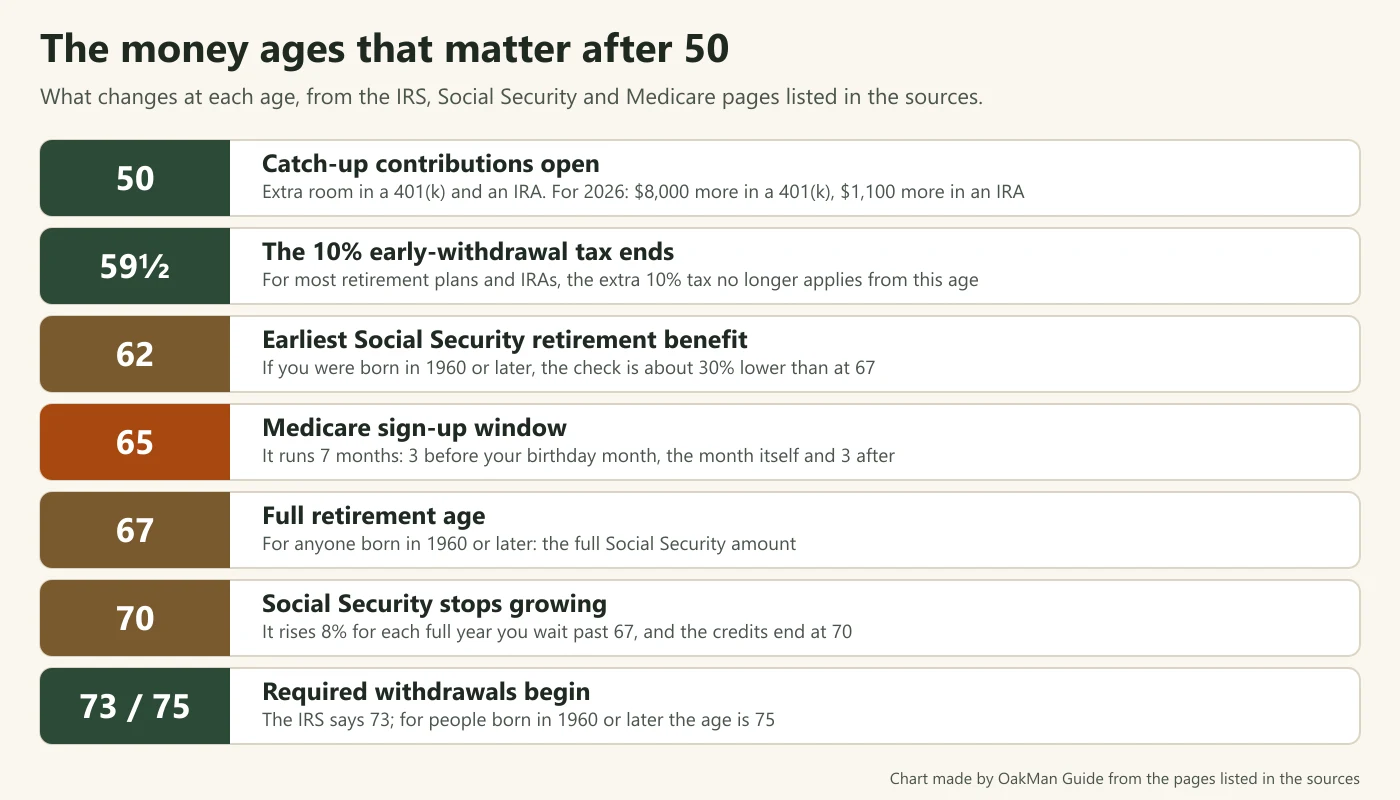
You do not need to act on all seven this year. Find the next one on the list, read that section and write down your questions.
What changes at 50?
The IRS lets you put in extra money once you turn 50, in IRAs and in workplace plans that accept elective deferrals, and calls it a catch-up contribution. The IRS limits for 2026 are the 401(k) employee limit of $24,500, plus a catch-up of $8,000, so $32,500 in all. Ages 60 to 63 can add $11,250 instead of $8,000. For an IRA the limit is $7,500, plus a $1,100 catch-up.
Whether you use the extra room is a budget question, and we are not the ones to answer it. The point is that the door opens at 50 and the numbers change every year, so check the current ones before you set up a payroll deduction.
What happens if I take money out before 59½?
The IRS says that distributions from qualified retirement plans, including IRAs, are not subject to the 10% additional tax on early distributions once you turn 59½. Before that age the tax generally applies.
There are exceptions, and they depend on the account. Topic 558 lists them for workplace plans, among them leaving your job in the year you turn 55 or later, total and permanent disability and medical expenses above 7.5% of your income. IRAs have their own list. Read the one for your account type before you move money, because a rollover and a withdrawal are treated differently.
What do I need to know about Medicare at 65?
Medicare has four parts, and it helps to know which is which before you sign up. Medicare.gov describes them this way, and the costs come from its costs page:
| Part | What it is | Cost in 2026 |
|---|---|---|
| Part A | Hospital insurance: inpatient care, skilled nursing facility care, hospice and home health care | $0 for most people, who paid Medicare taxes for about 10 years |
| Part B | Medical insurance: doctors, outpatient care, equipment and many preventive services | $202.90 a month in 2026 (more with a higher income), plus a $283 yearly deductible |
| Part C | Medicare Advantage: bundled plans from private companies that include A and B and usually D | Varies by plan |
| Part D | Prescription drug coverage | Varies by plan |
Your first sign-up window opens three months before the month you turn 65 and closes three months after it. Medicare.gov says coverage always starts on the first of a month, and that some people get Medicare automatically while others have to sign up, depending on whether they already get Social Security benefits before 65.
Missing the window has a price. Medicare.gov says that for Part B you can pay an extra 10% for each full 12-month period you could have signed up and did not. You can still sign up between January 1 and March 31 each year, with coverage starting the month after.
The next choice is how you get that coverage: Original Medicare, or a Medicare Advantage plan from a private company. Our Medicare vs Medicare Advantage guide sets the two side by side.
What if I am still working at 65?
Then the clock can be different. Medicare.gov says many people sign up for Part A at 65 even while working, since most do not pay a premium for it, and that you may want to wait on Part B, which has a monthly premium. If you have coverage through your own or your spouse's job, you get a Special Enrollment Period that ends 8 months after the employment or the group health plan ends, whichever comes first. COBRA does not count as job-based coverage for this purpose.
One detail is easy to miss. Medigap, the private policy some people buy to cover what Original Medicare leaves, can only be bought with Original Medicare and has a one-time six-month open enrollment that begins the month your Part B starts, once you are 65 or older. Inside it, the insurer cannot turn you down over a health problem. Outside it, you may not be able to buy a policy, or it may cost more. After you are in, the yearly choices are in our Medicare Open Enrollment guide.
When do I have to start taking money out?
The IRS says you generally have to start taking withdrawals from your IRA or workplace retirement account when you reach 73. These are called required minimum distributions, or RMDs. For people born in 1960 or later the final IRS regulations, published in Treasury Decision 10001, put the age at 75. If you were born in 1959, you sit between the two rules, so ask your plan which age it uses.
You can delay the first one until April 1 of the following year, but then you take two in the same year. Missing a withdrawal has a price: the IRS FAQ says an excise tax of 25% may apply, or 10% if you correct it in time. A Roth IRA owned by its original owner has no required withdrawals during the owner's life.
How does health fit into the money plan?
More than most of us expect. Part B pays for many preventive services, and the plans you pick decide which doctors and medicines you can use without a surprise bill. That is why our men's health guide and the checkups guide sit next to this one: they tell you what to ask, and this page tells you who pays. If a screening such as the PSA test is on your list, the Medicare part of your plan is the first place to check what it covers.

Where should I start this month?
You can finish this list in an afternoon:
- Write down your birth year. It sets your full retirement age and your required-withdrawal age.
- Open your Social Security account. Look at the estimates for 62, 67 and 70, and check that your earnings record looks right.
- Find your Medicare date. The window opens three months before your 65th birthday month. Put the date on the calendar.
- Read your latest retirement statement. Note the type of account, the balance and how much catch-up room you have.
- Make a list of questions. Counseling is free: 1-800-MEDICARE (1-800-633-4227) answers Medicare questions, and the state SHIP program, listed at shiphelp.org, offers one-on-one help.
New Money & Medicare guides will be linked from here as they are published.
Frequently asked questions
At what age can I start Social Security?
You can start your retirement benefit at 62. If you were born in 1960 or later, your full retirement age is 67, and SSA says a check started at 62 is about 30% lower than it would be at 67. Waiting past 67 raises it, up to age 70.
What is my full retirement age?
For anyone born in 1960 or later it is 67. People born earlier have a lower full retirement age, and SSA's age-reduction page has the table by birth year.
When should I sign up for Medicare?
Medicare.gov says your first window opens three months before the month you turn 65 and closes three months after it. If you are still covered by an employer plan, the rules change: you get a separate 8-month window that starts when that job or coverage ends.
What happens if I miss the Medicare sign-up window?
Medicare.gov says you can sign up between January 1 and March 31 each year, and that coverage then starts the month after you sign up. For Part B you can owe an extra 10% of the premium for each full 12-month period you could have signed up and did not, unless you qualify for a Special Enrollment Period.
Can I take money out of my 401(k) or IRA before 59½?
You can, but the IRS adds a 10% additional tax on most early distributions. Its Topic 558 page lists exceptions for workplace plans, such as leaving your job in the year you turn 55 or later, total and permanent disability and medical expenses above 7.5% of your income, and IRAs have their own list.
At what age do required withdrawals start?
The IRS says you generally have to start taking withdrawals from traditional IRAs and workplace plans when you reach 73. For people born in 1960 or later, the final IRS regulations set the age at 75. The first withdrawal can wait until April 1 of the following year.
How much more can I save after 50?
For 2026 the IRS says the 401(k) employee limit is $24,500 and the catch-up for age 50 and older is $8,000, so $32,500 in all. Ages 60 to 63 can add $11,250 instead of $8,000. The IRA limit is $7,500, with a $1,100 catch-up.
Sources we checked for this article
- IRS: 401(k) limit increases to $24,500 for 2026, IRA limit increases to $7,500 (IR-2025-111, November 13, 2025)
- IRS: Topic no. 558, Additional tax on early distributions from retirement plans other than IRAs (page reviewed September 24, 2026)
- IRS: Retirement topics, significant ages for retirement plan participants (page reviewed May 31, 2026)
- IRS: Retirement topics, required minimum distributions (RMDs) (page reviewed April 8, 2026)
- IRS: Retirement plans FAQs regarding required minimum distributions (page reviewed January 29, 2026)
- IRS: Internal Revenue Bulletin 2024-33, Treasury Decision 10001 (final RMD regulations) (August 12, 2024; preamble text checked November 2, 2026)
- SSA: Starting Your Retirement Benefits Early (page text checked November 2, 2026)
- SSA: Delayed Retirement Credits (page text checked November 2, 2026)
- SSA: Receiving Benefits While Working (page text checked November 2, 2026)
- Medicare.gov: Parts of Medicare (read November 2, 2026)
- Medicare.gov: When does Medicare coverage start? (read November 2, 2026)
- Medicare.gov: When can I sign up for Medicare? (read November 2, 2026)
- Medicare.gov: Medicare costs (read November 2, 2026)
- Medicare.gov: Avoid penalties (read November 2, 2026)
- Medicare.gov: Medigap basics (read November 2, 2026)
When can I start Social Security, and what does waiting do?
You can start your retirement benefit at 62, and that is also the youngest age to claim. For anyone born in 1960 or later, SSA sets the full retirement age at 67, and a benefit started at 62 is about 30% lower than the full amount.
Going the other way, SSA says delayed retirement credits add 8% for each full year you wait past full retirement age, and they stop at 70. For a full retirement age of 67, that means a check at 70 is 24% higher than the one at 67.
If you keep working while you collect before full retirement age, SSA sets an earnings limit. In 2026 it is $24,480, and SSA deducts $1 from your benefit for every $2 you earn above it. In the year you reach full retirement age the limit is $65,160, the deduction is $1 for every $3 above it, and only earnings before the month you reach that age count. From that month on, earnings no longer reduce your check, and SSA recalculates your benefit to credit the months it held back.
No age is right for everyone. It depends on your health, your work, your spouse and your other income. What helps is seeing your own numbers, and your my Social Security account on ssa.gov shows your earnings record and estimates for each age. Benefits also get a yearly cost-of-living raise, and we explain the 2027 Social Security raise in its own article.
One warning from the same SSA page: if you delay Social Security past 65, you should still apply for Medicare within 3 months of your 65th birthday, because waiting longer may make Part B and Part D cost more.