
Men's Health · Checkups
Men's Health Checkups After 50: What to Ask Your Doctor
By OakMan Guide Editorial Team Updated 9 min read
The short answer
Ask your doctor which checkups fit your age and history. After 50, the usual list is a yearly blood pressure check, blood sugar and cholesterol tests, colorectal cancer screening and vaccines such as flu and shingles. Lung, prostate and aortic checks depend on your age, smoking history and family history. Bring your medicine list, your last results and your questions.
We're not doctors, and this is not medical advice. Everything below comes from the sources listed at the end, and your own schedule belongs to you and your doctor.

Photo: Vitaly Gariev on Pexels.
Most of us over 50 remember our last oil change better than our last blood pressure reading. Here is a plain list of what is worth asking about, and the age each source puts on it.
Which checkups should I ask my doctor about after 50?
A handful, and they are not the same for every man. MedlinePlus has a page for men ages 40 to 64 that covers blood pressure, cholesterol, blood sugar, cancer screening, vaccines, eyes, teeth and a few one-time blood tests. The US Preventive Services Task Force (USPSTF) and the CDC then set the ages for the bigger ones. We put the main age windows in one picture so you can see where you stand at a glance.
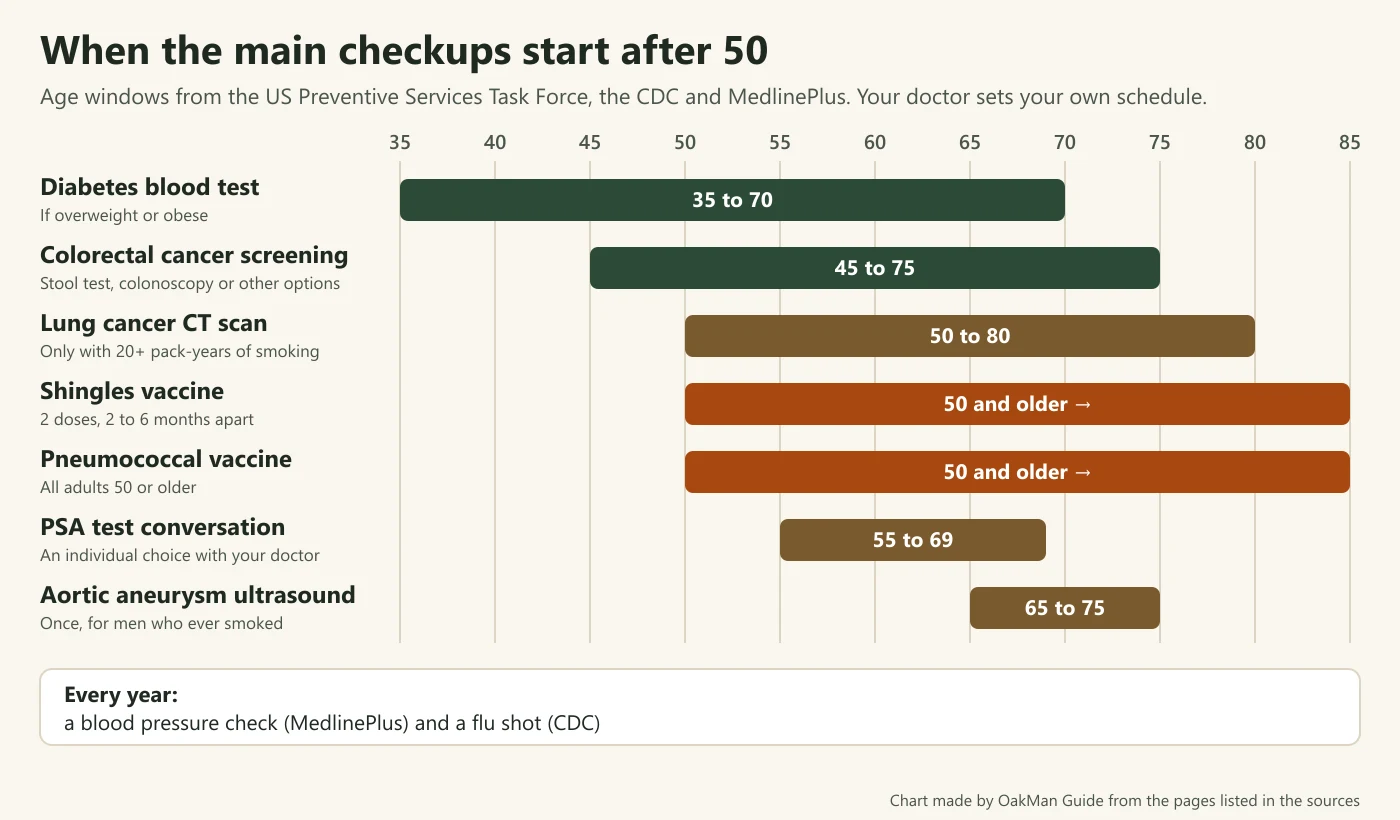
Two things before the details. First, these are screening ages for men without symptoms. If something is bothering you now, you do not wait for the next checkup. Second, every one of these sources says some version of the same sentence: your doctor decides with you. Use this article to walk in with better questions, not to run your own schedule.
What gets checked at every visit?
The simplest ones come first. MedlinePlus says to have your blood pressure checked at least once every year, more often if you have certain risk factors, and lists 130/80 mm Hg or higher as stage 1 hypertension. To track it between visits, here is how to measure blood pressure at home the way the CDC and NHLBI describe. MedlinePlus also says a physical exam covers blood pressure, height, weight and BMI at every visit, and that your provider may bring up depression and anxiety, diet and exercise, substance use, safety and medicine interactions.
That last item is the quiet one. A yearly visit is where somebody can look at everything you take, together. If you have been noticing erection changes, the heart and blood pressure link is worth a read in why doctors ask about blood pressure, and the wider picture is in erectile dysfunction after 50.
What should I ask about blood sugar and cholesterol?
Both are simple blood tests, and both are on the MedlinePlus list. For blood sugar, the USPSTF recommends screening for prediabetes and type 2 diabetes in adults aged 35 to 70 who are overweight or have obesity (a BMI of 25 or higher). It says screening every 3 years "may be a reasonable approach" for adults with normal blood glucose, and that clinicians should consider screening earlier for people with risk factors such as a family history of diabetes. MedlinePlus agrees on the starting point: age 35 if you are overweight or have obesity, repeated every 3 years while that stays true.
For cholesterol, MedlinePlus cites the American Heart Association: screening begins at age 20 and repeats every 4 to 6 years, and more often if you change your lifestyle or have certain conditions. The practical questions are easy: when was my last blood sugar test, what was the number, and when should I repeat it? Our foods and habits guide covers the everyday side of this.
Which cancer screenings should I talk about?
Colorectal cancer
This is the one most men put off. The USPSTF recommends screening for all adults aged 50 to 75 and for adults aged 45 to 49, and says clinicians should selectively offer it at 76 to 85. The good news is that you have choices, and MedlinePlus lists them:
| Option | How often (MedlinePlus) |
|---|---|
| Colonoscopy | Every 10 years |
| Stool test for hidden blood (FIT or fecal occult blood) | Every year |
| Stool DNA test | Every 1 to 3 years |
| Flexible sigmoidoscopy | Every 5 years (or every 10 years with a yearly FIT) |
| CT colonography | Every 5 years |
A good question for the visit: which of these fits me, and what do we do if I do not want a colonoscopy? Having a plan you will actually follow beats having the perfect plan on paper.
Lung cancer
This one is only for men with a smoking history. The USPSTF recommends a yearly low-dose CT scan for adults aged 50 to 80 who have at least a 20 pack-year smoking history and who currently smoke or quit within the past 15 years. Screening stops once you have not smoked for 15 years. If that is not your story, you can skip this line.
Prostate and skin
On the prostate, MedlinePlus says routine prostate physical exams are no longer done on men without symptoms, and that for ages 55 to 69 you should discuss the pros and cons of the PSA test with your provider. It adds that screening under 55 is generally not recommended unless you have higher risk, such as a family history or being African American. We go through the numbers in our PSA test guide. On skin, MedlinePlus says your provider may check it if you are at high risk, and that the professional groups do not recommend for or against self-exams.
One more line from the same page, since men ask: it quotes the USPSTF as recommending against testicular screening.
Which vaccines should I ask about?
Vaccines are the easiest win on this list because they are one visit. The CDC says adults 50 and older should get the shingles vaccine, 2 doses separated by 2 to 6 months, with no maximum age. The CDC pneumococcal page lists all adults 50 years or older, and the CDC flu page says everyone 6 months and older should get a flu vaccine every season with rare exceptions.
| Vaccine | What the source says | Source |
|---|---|---|
| Flu | Every year | CDC: everyone 6 months and older, every season, with rare exceptions |
| Shingles | 2 doses, 2 to 6 months apart | CDC: adults 50 and older |
| Pneumococcal | Ask which type and when | CDC: all adults 50 or older |
| Tetanus (Tdap or Td) | One Tdap if you never had it, then a booster every 10 years | MedlinePlus |
| COVID-19 | Discuss with your provider | MedlinePlus |
The one worth writing on the back of your hand is the shingles vaccine, because it starts at 50 and needs two visits. Ask which doses you have already had and whether the pharmacy can handle it or your doctor prefers to.

Are there tests I only need once?
A few. MedlinePlus lists a one-time hepatitis C test for ages 18 to 79 and a one-time HIV test for ages 15 to 65, with yearly testing for those at increased risk. The CDC says to screen all adults 18 and older for hepatitis C at least once. If you cannot remember ever having either, ask. It is a simple blood test.
The aortic aneurysm ultrasound is also a one-timer. The USPSTF recommends one-time ultrasound screening for men aged 65 to 75 who have ever smoked. For men that age who have never smoked, it says clinicians should selectively offer it, because the net benefit is small, and the decision should weigh your medical history, family history and personal values. If you are not 65 yet, put it in your notes and bring it up then.
What about eyes, teeth and bones?
They are easy to skip because they are not part of the regular doctor visit. MedlinePlus gives these intervals for men:
- Eye exam: every 2 to 4 years at ages 40 to 54, every 1 to 3 years at ages 55 to 64, and at least yearly, including a retinal exam, if you have diabetes.
- Dental exam and cleaning: once or twice a year.
- Bone density: for ages 50 to 69 with risk factors for osteoporosis, discuss screening with your provider.
None of these needs a long conversation. A quick "is it time for my eyes and my bone check?" at the end of the visit does the job.
What should I bring to the appointment?
A short list, written down. The doctor can only work with what is in the room, so a page of notes helps more than good memory. Here is what to bring:
| Bring | What to write down |
|---|---|
| Medicines and supplements | Everything you take, with doses, including over-the-counter products and herbs |
| Family history | Heart disease, diabetes or cancer in a parent, brother or sister, and how old they were |
| Last results | Dates and numbers from your most recent blood pressure, blood sugar, cholesterol and any scans |
| Symptoms | Anything new: night trips to the bathroom, a weaker stream, tiredness, pain, changes in erections |
| Your questions | The five to eight questions in the last section, written down |
If you have been waking up at night or the stream is weaker, say so out loud and bring the notes from our night-time urination article or the enlarged prostate symptoms checklist. If you take medicines for the prostate, the BPH medicines guide lists what to mention. Even your coffee and drinks belong in the conversation, and caffeine and alcohol are an easy place to start.

What questions should I ask my doctor?
Take a copy of this list to the visit. It follows the sections above, and you can cross out the ones that do not fit you:
- What was my last blood pressure, and how often should I have it checked?
- When were my blood sugar and cholesterol last tested, and when should I repeat them?
- Am I due for colorectal screening, and which test fits me best?
- Given my smoking history, do I qualify for a lung scan or an aortic ultrasound?
- Should we talk about a PSA test now, or later, given my age and family history?
- Which vaccines am I due for, including shingles, pneumococcal, flu and a tetanus booster?
- Have I ever had a hepatitis C or HIV test?
- Do my medicines or supplements change any of these results?
These lists are for men without symptoms. If something new is bothering you, call your doctor instead of waiting for the next checkup.
What is the bottom line?
Pick one date this month and book the visit. Bring the list, ask the eight questions and write down the answers. If your main worry is the prostate, start with our guide to enlarged prostate symptoms. If it is energy, erections or the heart behind them, our guide to erectile dysfunction after 50 is the place to begin. Either way, the checkup comes first.
Frequently asked questions
What checkups should a man get after 50?
MedlinePlus lists a blood pressure check at least once every year, cholesterol and blood sugar tests, colorectal cancer screening, a yearly flu shot and the 2-dose shingles vaccine from age 50. Lung cancer, prostate and aortic aneurysm checks depend on your age, smoking history and risk. Your doctor sets the exact schedule.
How often should I have my blood pressure checked?
MedlinePlus says to have your blood pressure checked at least once every year, and more often if you have certain risk factors. It lists a reading of 130/80 mm Hg or higher as stage 1 hypertension.
At what age should I start colon cancer screening?
The US Preventive Services Task Force recommends screening for all adults aged 50 to 75 and for adults aged 45 to 49. For ages 76 to 85, it says clinicians should selectively offer screening. MedlinePlus lists colonoscopy every 10 years and a yearly stool test (FIT) among the options.
Who should get a lung cancer scan?
The USPSTF recommends a yearly low-dose CT scan for adults aged 50 to 80 who have at least a 20 pack-year smoking history and who currently smoke or quit within the past 15 years. If you have never smoked, this one is not for you.
Which vaccines does the CDC list for adults 50 and older?
The CDC says adults 50 and older should get the shingles vaccine (2 doses, 2 to 6 months apart) and lists pneumococcal vaccination for all adults 50 or older. It also says everyone 6 months and older should get a flu vaccine every season, with rare exceptions.
Do I need an aortic aneurysm ultrasound?
The USPSTF recommends a one-time ultrasound for men aged 65 to 75 who have ever smoked. For men in that age group who have never smoked, it says clinicians should selectively offer it. Ask your doctor which group you fall into.
Do I still need a prostate exam every year?
MedlinePlus says routine prostate physical exams are no longer done on men without symptoms. For ages 55 to 69, it says to discuss the pros and cons of the PSA blood test with your provider. Screening under 55 is generally not recommended unless you have higher risk, such as a family history or being African American.
What should I bring to a checkup?
Bring the list of every medicine and supplement you take, your family history, the dates and results of your last tests, any symptoms you have noticed and your written questions. The list takes five minutes to make and makes the visit much more useful.
Sources we checked for this article
- MedlinePlus (National Library of Medicine): Health screening, men ages 40 to 64 (reviewed June 24, 2025)
- US Preventive Services Task Force: Colorectal Cancer Screening (final recommendation May 18, 2021)
- US Preventive Services Task Force: Lung Cancer Screening (final recommendation March 9, 2021)
- US Preventive Services Task Force: Abdominal Aortic Aneurysm Screening (final recommendation December 10, 2019)
- US Preventive Services Task Force: Prediabetes and Type 2 Diabetes Screening (final recommendation August 24, 2021)
- CDC: Shingles Vaccination (page dated August 19, 2025)
- CDC: Pneumococcal Vaccination (page dated February 25, 2026)
- CDC: Flu Vaccines (updated September 1, 2026)
- CDC: Hepatitis C, Clinical Overview (page dated August 29, 2025)