
Fitness & Food · Flexibility
Morning Mobility Routine for Men Over 50: Ten Minutes to Loosen Up
By OakMan Guide Editorial Team Updated 7 min read
The short answer
A morning mobility routine for men over 50 can take ten minutes: two minutes of easy walking to warm up, six gentle moves for the shoulders, spine, hips and calves, then a short walk. The NIA says to stretch when your muscles are warm and not so far that it hurts. Stiffness that fades in under 30 minutes fits the usual osteoarthritis pattern, NIAMS says.
We're not doctors, and this is not medical advice.

A gray-bearded man pulls one arm across his chest in a shoulder stretch. Realistic AI-generated image.
The first steps of the day, from the bed to the stairs to the coffee pot, can feel like moving a rusty gate. Here is a ten-minute routine for that: a warm-up, six gentle moves from shoulders to calves and a plain way to tell ordinary stiffness from the kind worth a question to your doctor.
Why am I stiff when I wake up?
A Harvard Health Q&A (published in 2016) says stiffness in the back, knees or feet is a common complaint among older people. It also says that old age alone does not cause morning joint stiffness. It is usually a sign of worn joints, muscle tightness or inflammation from arthritis.
The same Q&A describes what happens inside. As joints age, the cartilage begins to dry out and stiffen, and the joint lining makes less of the fluid that lubricates the joint. Weak muscles and stiff tendons also tend to tighten during sleep. The good news in the answer is that the average episode lasts only about 10 to 15 minutes, and it goes away as you move. Being more active, building muscle strength and flexibility and keeping a healthy weight can reduce how severe and how frequent it is.
In our opinion, that is the case for a short routine first thing: it gives the joints and muscles the movement they are waiting for. If aches are part of your mornings, our guide to joint and muscle aches after 50 covers what is common.
How long should morning stiffness last?
The table puts three patterns next to what the sources say. It is not a diagnosis, and neither source claims to be one; only a doctor can tell what is behind your stiffness.
| Pattern | What the sources say | What it suggests |
|---|---|---|
| Eases within about 10 to 15 minutes of moving | A Harvard Health Q&A puts the average episode at 10 to 15 minutes, and says it goes away as you move and warm up your joints and muscles. | A gentle routine like the one below is a good fit. |
| Less than 30 minutes, after rest | NIAMS says osteoarthritis usually brings joint stiffness lasting less than 30 minutes in the morning or after resting for a period of time. | Keep moving daily and mention it at a checkup. |
| More than 30 minutes, with swelling or warmth | NIAMS lists stiffness lasting longer than 30 minutes after waking, swollen or warm joints, unusual tiredness and a low-grade fever among common symptoms of rheumatoid arthritis. | Worth a conversation with your doctor soon. |
If your stiffness fits the first or second row, the routine below is a natural place to start. If it fits the third, bring it up at your next visit. Our checkups guide lists what to bring up at a visit.
Should I stretch first thing out of bed?
The NIA describes flexibility as the ability of a joint to move through its full range of motion, and says that stretching can help maintain and improve it. Its advice is to stretch when your muscles are warmed up, remember to breathe and not stretch so far that it hurts.
That is why our routine begins with two minutes of easy walking and arm swings. The NIA AgePage on exercise says the same about the day in general: begin slowly with low-intensity moves, and warm up before and cool down after. The NIA also notes that moving more freely makes everyday tasks easier, like reaching down to tie your shoes or unloading the dishwasher.
What does the ten-minute routine look like?
We built the ten-minute clock below ourselves; no official program sets it. The NIA booklet gives the rules for stretching but does not name specific stretches or how long to hold them, so the moves and counts are ours.
| When | Part | What to do |
|---|---|---|
| Minutes 0 to 2 | Warm up | March in place or walk around the room, with easy arm swings. Get a little warm before you stretch anything. |
| Minutes 2 to 8 | Six moves | About one minute each, in the order below, from shoulders to calves. Go slowly and breathe. |
| Minutes 8 to 10 | Walk it off | An easy walk around the house or yard, then a glass of water. |
What are the six moves?
They run from the shoulders down to the calves, so you can do them in one pass. All are done standing, with a wall or counter within reach, or seated in a sturdy chair.
| Move | Works | How |
|---|---|---|
| 1. Cross-body shoulder stretch | Shoulders, upper back | Standing, bring one arm across your chest and hold it with the other hand. 5 slow breaths, then switch. |
| 2. Standing trunk turn | Spine, ribs | Feet planted, arms folded across your chest. Turn gently to one side and back, then the other. 8 turns each way. |
| 3. Seated cat-camel | Mid and lower back | Seated, hands on your knees. Round your back, then lift your chest and open your shoulders. 8 slow rounds. |
| 4. Standing hip hinge | Hips, backs of the legs | Feet hip-width apart, hands on your thighs. Slide your hands down as you bend forward from the hips, then stand tall. 8 times. |
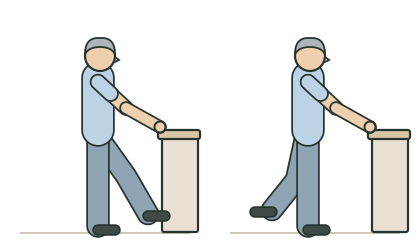
| 5. Counter-side leg swing | Hips | Hold a counter. Swing one leg forward and back in a small, easy arc. 8 swings, then switch legs. |
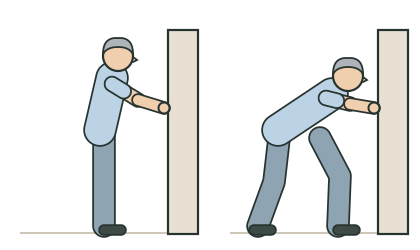
| 6. Wall calf stretch | Calves, ankles | Hands on a wall, one foot stepped back with the heel down. Lean in gently. 5 slow breaths, then switch. |
Here is each move in two poses, with a note on form:
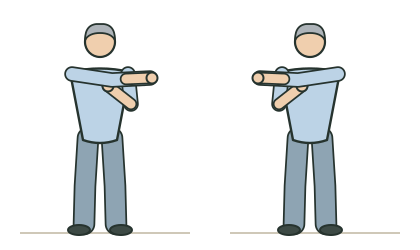
1. Cross-body shoulder stretch
Keep the arm you are stretching low enough that your shoulders stay relaxed, not hunched toward your ears. Pull the arm only until you feel a gentle stretch.
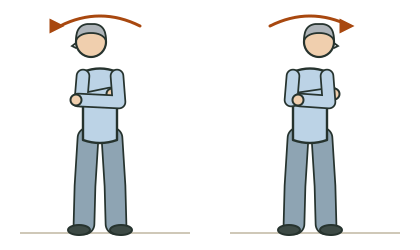
2. Standing trunk turn
Turn from the middle of your back and keep your hips and feet facing forward. Small turns count.
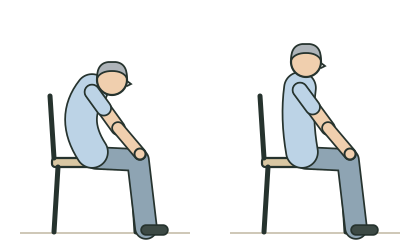
3. Seated cat-camel
Sit near the front of a sturdy chair with both feet flat. Let the breath lead: round as you breathe out, open the chest as you breathe in.
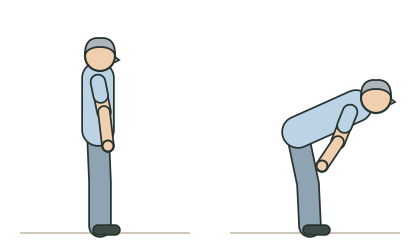
4. Standing hip hinge
The NIA safety tips say to bend forward from the hips and not the waist, keeping your back straight. Slide your hands down your thighs and stop where your back would start to round.
5. Counter-side leg swing
Keep the hand on the counter light, stand tall and keep the swing small. Do not swing so far that you lean.
6. Wall calf stretch
Keep both feet pointing forward and the back heel on the floor. Lean in only until you feel a gentle pull, not pain.
How do I ease into it this week?
The NIA says the key to starting safely is to build slowly from your current fitness level, because a steady rate of progress is the best approach. Our one-week start applies that idea:
| When | What | How it should feel |
|---|---|---|
| Days 1 to 3 | Warm-up plus moves 1, 2 and 4 | About 5 minutes. Learn how each move feels. |
| Days 4 to 7 | Warm-up plus all six moves | One round, at an easy effort. Skip a move that hurts. |
| Week 2 and on | The full ten minutes | Same routine each morning. Add a second round of a move only when it feels easy. |
Pick one trigger so you do not have to think about it, such as right after you brush your teeth or while the coffee brews. Keep it the same each day.
What if a move hurts?
The NIA AgePage says exercise should not hurt or make you feel really tired. You might feel some soreness, a little discomfort or be a bit weary, but you should not feel pain. Its safety tips include listening to your body and stopping if anything is causing you pain. For balance-style moves, like the leg swing, the NIA booklet suggests keeping a sturdy chair, a person or a wall nearby to hold onto, and moving slowly to prevent falling. If you are unsure about a movement, it says to seek guidance from your health care provider.
Have a joint condition or a recent injury?
The NIA says almost anyone, at any age, can do some type of physical activity, even with a chronic condition such as arthritis, and that for most older adults, moderate activities are safe, especially if you build up slowly. It also says to talk with a doctor about your health condition and create a plan that works for you. If you have pain, swelling or an injury, check the routine with your doctor first. Our fall-proofing checklist and balance exercises can help you stay steady.
Where does a mobility routine fit in my week?
The NIA says it is important to include all four types of exercise in your routine: endurance, strength, balance and flexibility. Doing one kind can improve your ability to do others, and variety can help reduce boredom and the risk of injury. Mobility work covers flexibility only. In our opinion, the easiest setup is this routine each morning, with walking for endurance, strength training on two days (our resistance band routine is one way) and the balance moves a few times a week. The Fitness & Food Guide shows how the pieces fit.
What should I do tomorrow morning?
- Warm up first. Two minutes of marching and arm swings before any stretch.
- Do three moves. The shoulder stretch, trunk turn and hip hinge are enough for day one.
- Stay out of pain. A gentle pull is fine; sharp pain means ease off or stop.
- Note how long the stiffness lasts. A few days of notes make it easy to tell your doctor if it regularly runs past 30 minutes.
That is the whole routine. It needs no equipment, and the best version is the one you actually do tomorrow.
Frequently asked questions
Should I stretch before or after I warm up?
After. The National Institute on Aging (NIA) says to stretch when your muscles are warmed up, and after endurance or strength exercises. That is why our routine starts with two minutes of easy walking and arm swings, not with a stretch.
How long should a morning mobility routine take?
The NIA does not set a number of minutes for stretching. Ten minutes is our own choice: two for warming up, six for the moves and two for an easy walk. Shorten it on slow mornings. A few minutes you repeat daily beat a long session you skip.
Is morning stiffness normal after 50?
It is common. A Harvard Health Q&A says people often blame age, but old age alone does not cause morning joint stiffness. It is usually a sign of worn joints, muscle tightness or inflammation from arthritis, and the average episode lasts about 10 to 15 minutes.
How long is too long for morning stiffness?
The National Institute of Arthritis and Musculoskeletal and Skin Diseases (NIAMS) says osteoarthritis stiffness usually lasts less than 30 minutes, while stiffness lasting longer than 30 minutes after waking is a common symptom of rheumatoid arthritis. If yours regularly goes past 30 minutes, mention it at your next appointment.
Do I need to get down on the floor?
No. All six moves in this routine are done standing, with a wall or counter nearby, or seated in a sturdy chair. If getting up from the floor is hard for you, leave it out; nothing here needs it.
Is stretching enough on its own?
No. The NIA lists four types of exercise: endurance, strength, balance and flexibility. Each has different benefits, and doing one can improve your ability to do the others. Mobility work covers flexibility, so pair it with walking, strength and balance.
Sources we checked for this article
- NIA (NIH): Three Types of Exercise Can Improve Your Health and Physical Ability (Flexibility section, read November 21, 2026)
- NIA (NIH): Exercise and Physical Activity for Older Adults: Staying Active as You Age (booklet, March 2025)
- NIA (NIH): AgePage, Exercise and Physical Activity for Older Adults (September 2023)
- Harvard Health Publishing: What makes my joints stiff in the morning? (Q&A published October 14, 2016)
- NIAMS (NIH): Osteoarthritis (last reviewed September 2023)
- NIAMS (NIH): Rheumatoid Arthritis (last reviewed November 2022)