
Fitness & Food · Walking
Walking After 50: How Many Steps Actually Help
By OakMan Guide Editorial Team Updated 7 min read
The short answer
A 2022 analysis of 15 studies linked more daily steps to a lower risk of death, up to about 6,000 to 8,000 steps a day for adults 60 and older. The CDC separately asks older adults for 150 minutes a week of moderate activity. Start from the steps you take now and add a little each week.
We're not doctors, and this is not medical advice.

A man walks briskly along a tree-lined park path in autumn. Realistic AI-generated image.
You have probably heard that 10,000 steps is the number to hit. The research is more encouraging than that, and it starts lower. Here is what the studies found, what the CDC asks for and how to build up without overdoing it.
Do I need 10,000 steps a day?
Probably not. The authors of a 2022 meta-analysis in The Lancet Public Health start from the same question: 10,000 steps a day is widely promoted, but there is little evidence to support that exact number. So they pooled data from 15 studies and looked at what the numbers showed.
The results are about the dose, not a magic line. More steps were linked to a lower risk of dying from any cause, and the gains were biggest at the low end. For adults 60 and older, the risk kept falling until about 6,000 to 8,000 steps a day. For adults under 60, it kept falling until about 8,000 to 10,000.
What did the studies find?
Two large studies answer most of the question. Both are observational, which means they find patterns in groups of people and cannot prove that walking caused the result. The National Cancer Institute release on the 2020 study says this plainly.
| Study | Who | What it found |
|---|---|---|
| JAMA, 2020 (NCI, NIA and CDC researchers) | About 4,800 US adults aged 40 and over, followed through 2015 | 8,000 steps a day was linked to a 51% lower risk of death than 4,000. 12,000 steps was linked to 65% lower. |
| Lancet Public Health, 2022 (15 studies) | 47,471 adults, 3,013 deaths, median follow-up 7.1 years | Risk fell as steps rose until about 6,000 to 8,000 a day at age 60 and older, and 8,000 to 10,000 below 60. |
The 2022 analysis also split people into four groups by how many steps they took. Each step up the ladder was linked to a lower risk, with the biggest jump between the first and second group:
| Group | Median steps a day | Risk of death compared with the lowest group |
|---|---|---|
| Lowest group | About 3,550 | Starting point |
| Second group | About 5,800 | 40% lower risk of death (hazard ratio 0.60) |
| Third group | About 7,850 | 45% lower (0.55) |
| Highest group | About 10,900 | 53% lower (0.47) |
The takeaway we draw is simple. If you walk about 3,500 steps a day now, getting to 5,000 or 6,000 is a real step up in what the studies measured. You do not have to wait until you can reach 10,000 to count it.
How does that fit with the CDC target?
The studies count steps. The CDC guidelines for older adults count minutes. For adults 65 and older, the CDC asks for at least 150 minutes of moderate activity a week, which it describes as 30 minutes a day, 5 days a week. Or 75 minutes of vigorous activity, or an equal mix of the two. It also asks for muscle-strengthening on at least 2 days and balance activities.
The two numbers are not the same measure, and none of the sources we read turns one into the other, so we will not invent a conversion. What they share is the message: a little regular movement is better than none. The CDC page says it directly: some physical activity is better than none at all.
Walking covers the aerobic part. For the strength part, see our starter strength plan, and for how the three fit together in a week, our Fitness and Food guide.
Does walking faster matter?
It helps to know what moderate means, because the CDC target is for moderate effort. The CDC rule of thumb is the talk test: a person doing moderate activity can talk, but not sing. The NIA puts it this way: if you are breathing hard but can still have a conversation easily, it is likely moderate. If you can say only a few words before you need a breath, it is vigorous.
As for speed versus total steps, the studies do not fully agree. The 2020 study found that step count was tied to lower risk but step intensity was not, once total steps were counted. The 2022 analysis found that the total still mattered, with some added signal from the fastest 30 or 60 minutes of the day. In our opinion, the practical reading is to count the steps first and add a brisk stretch when you can, not to chase speed at the cost of getting out at all.
How do I build up if I walk very little now?
The NIA advice is to start with lower-intensity activity that fits your current level, then increase how often, how hard and how long you go over weeks to months. It also gives a sample goal: a 10-minute walk three times a week. It says that after a break from illness or travel, you should work back up gradually.
Here is a four-week example we built from that advice. It is ours, not an official program, so slow it down if a week feels like too much.
| When | Walks | Pace |
|---|---|---|
| Week 1 | 10 to 15 minutes, 3 days | Easy pace, as in the NIA example of a 10-minute walk three times a week. |
| Week 2 | 15 to 20 minutes, 3 or 4 days | Comfortable pace. Add a short stretch that feels a little brisk. |
| Week 3 | 20 to 25 minutes, 4 or 5 days | Brisk enough to talk but not sing for part of the walk. |
| Week 4 | 30 minutes, 5 days | This reaches the CDC target of 150 minutes a week. |
Track it however you like. The NIA says a step counter or a written log both work, and that sharing your progress with a friend or doctor can help you stick with it. If you use a counter, take a normal day first to find your starting number, then aim to add a few hundred steps a week.
How do I keep walking safe?
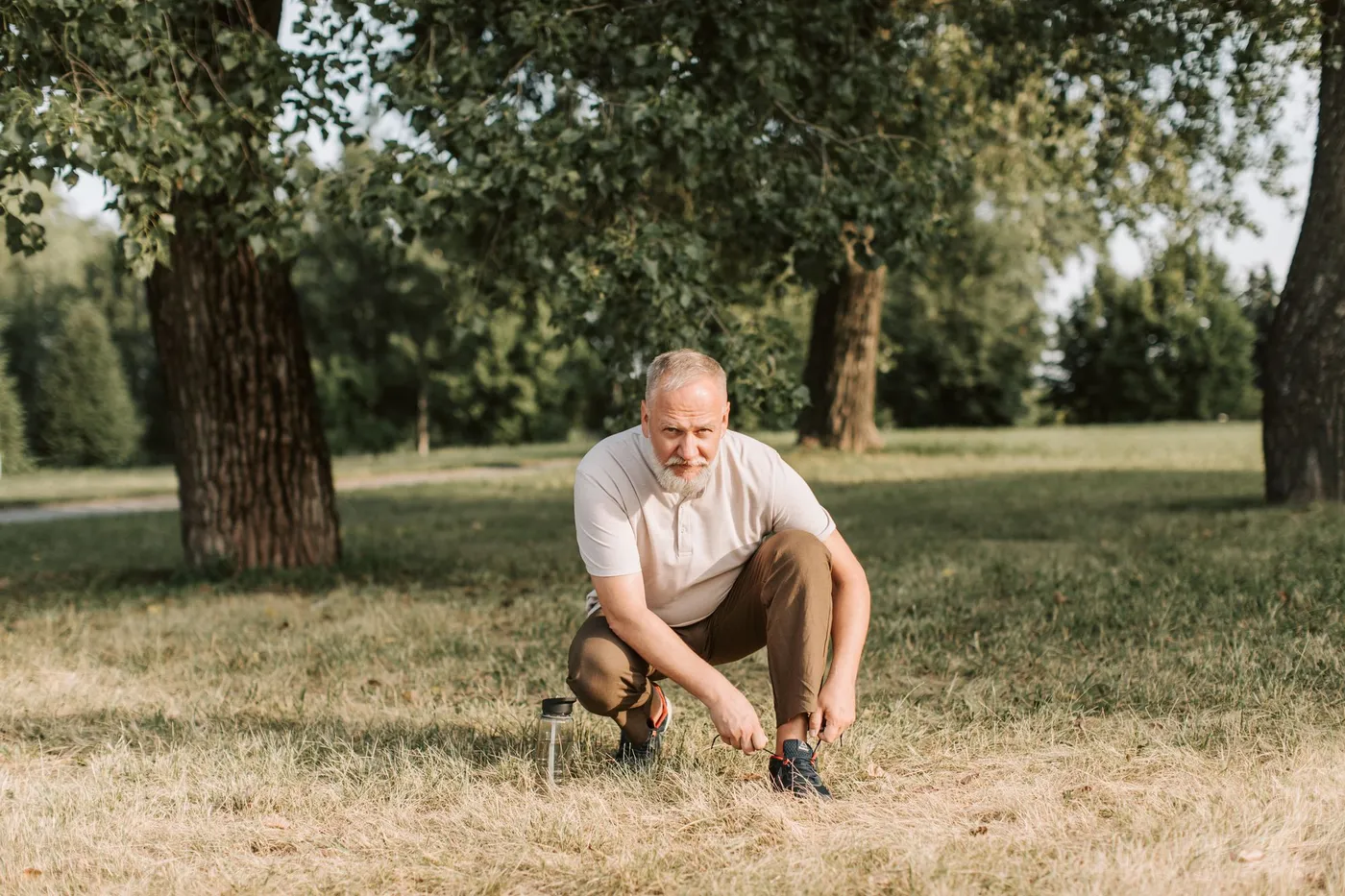
These are the NIA safety tips for aerobic activity, and they suit a walk well:
- Listen to your body. Aerobic activity should not cause dizziness, chest pain or pressure, or nausea.
- Warm up and cool down with a little easy walking before and after.
- Drink water. If your doctor has told you to limit fluids, check before drinking more.
- Mind the weather and your surroundings when you walk outdoors.
- Wear proper exercise shoes and clothes to prevent injuries.
- Ask if you are unsure about a particular activity. The NIA says to talk with your health care provider.
Is a doctor visit needed before you walk more?
For most healthy older adults, not necessarily. The NIA notes that people with no injury or chronic condition who build up gradually generally do not need to see a doctor first. If you do have a condition that makes the weekly target hard to reach, the NIA and CDC both say to do what your abilities allow and to ask your doctor what you can do. With high blood pressure, the NIA says to work with your health care provider as you add activity.
What about winter and bad-weather days?
The NIA lists bad weather as a common barrier and suggests walking indoors at a mall, a grocery store or a big-box store, or following an online fitness class at home. A few laps of the house on a rainy day still count toward your total. For the other cold-weather chore that raises the heart rate, see our guide to snow shoveling after 50, and for the house itself, our winterizing checklist.
How do I start this week?
- Find your starting point. Note your steps on a normal day, or time a usual walk.
- Pick three days and a 10 to 15 minute walk at a pace where you could talk but not sing.
- Add a little each week, following the four-week example above or your own version.
- Keep a simple log. Date, minutes and how it felt.
That is enough to begin. A walk you repeat beats a bigger plan you drop.
Frequently asked questions
Do I really need 10,000 steps a day after 50?
No. The authors of a 2022 analysis of 15 studies note that 10,000 steps is widely promoted with little evidence behind it. In their data, the risk of death kept falling with more steps until about 6,000 to 8,000 a day for adults 60 and older, and about 8,000 to 10,000 for younger adults.
How many minutes should I walk each week?
The CDC asks adults 65 and older for at least 150 minutes of moderate activity a week, for example 30 minutes a day, 5 days a week. Brisk walking counts. The NIA says to build up gradually to that amount.
Does walking faster matter more than walking farther?
The evidence is mixed. In the 2020 JAMA study, step count was linked to lower risk of death but step intensity was not, once total steps were counted. The 2022 meta-analysis found that the total still mattered most, with some added signal from a faster peak pace. Either way, more steps in the day was the clearest pattern.
How do I know my walk is moderate intensity?
Use the talk test. The CDC says a person doing moderate activity can talk but not sing. The NIA says that if you are breathing hard but can still have a conversation easily, it is likely moderate. If you can say only a few words before a breath, that is vigorous.
Do I need a doctor before I start walking more?
Not always. The NIA says healthy older adults who build up slowly generally do not need to. If a chronic condition makes the weekly target hard to reach, the NIA and CDC say to do what you can and ask your doctor what that should look like.
What if the weather is bad?
The NIA suggests walking indoors, such as at a mall, a grocery store or a big-box store, or using an at-home activity program. When you walk outdoors, it says to be aware of the weather and your surroundings.
Sources we checked for this article
- CDC: Physical Activity Guidelines for Older Adults (page dated December 4, 2025)
- CDC: Measuring Physical Activity Intensity (page dated December 4, 2025)
- NCI (NIH): Higher daily step count linked with lower all-cause mortality (news release, March 24, 2020; JAMA study by Saint-Maurice et al.)
- PubMed: Daily steps and all-cause mortality: a meta-analysis of 15 international cohorts (The Lancet Public Health, 2022; abstract read November 15, 2026)
- NIA (NIH): Exercise and Physical Activity for Older Adults: Staying Active as You Age (booklet, NIH Publication No. 25-AG-8135, March 2025)