
Fitness & Food · Food Safety
Thanksgiving Turkey Safety and Leftovers: USDA Rules in Plain English
By OakMan Guide Editorial Team Updated 9 min read
The short answer
Thanksgiving turkey safety comes down to four USDA numbers: thaw in a refrigerator at 4 °C (40 °F) or colder, cook until a food thermometer reads 74 °C (165 °F) in the breast, thigh and wing, refrigerate leftovers within 2 hours, and eat them within 3 to 4 days or freeze them. Reheat everything to 74 °C (165 °F).
We're not doctors, and this is not medical advice. The rules below are the USDA's, taken from the pages listed at the end and read on November 22, 2026.
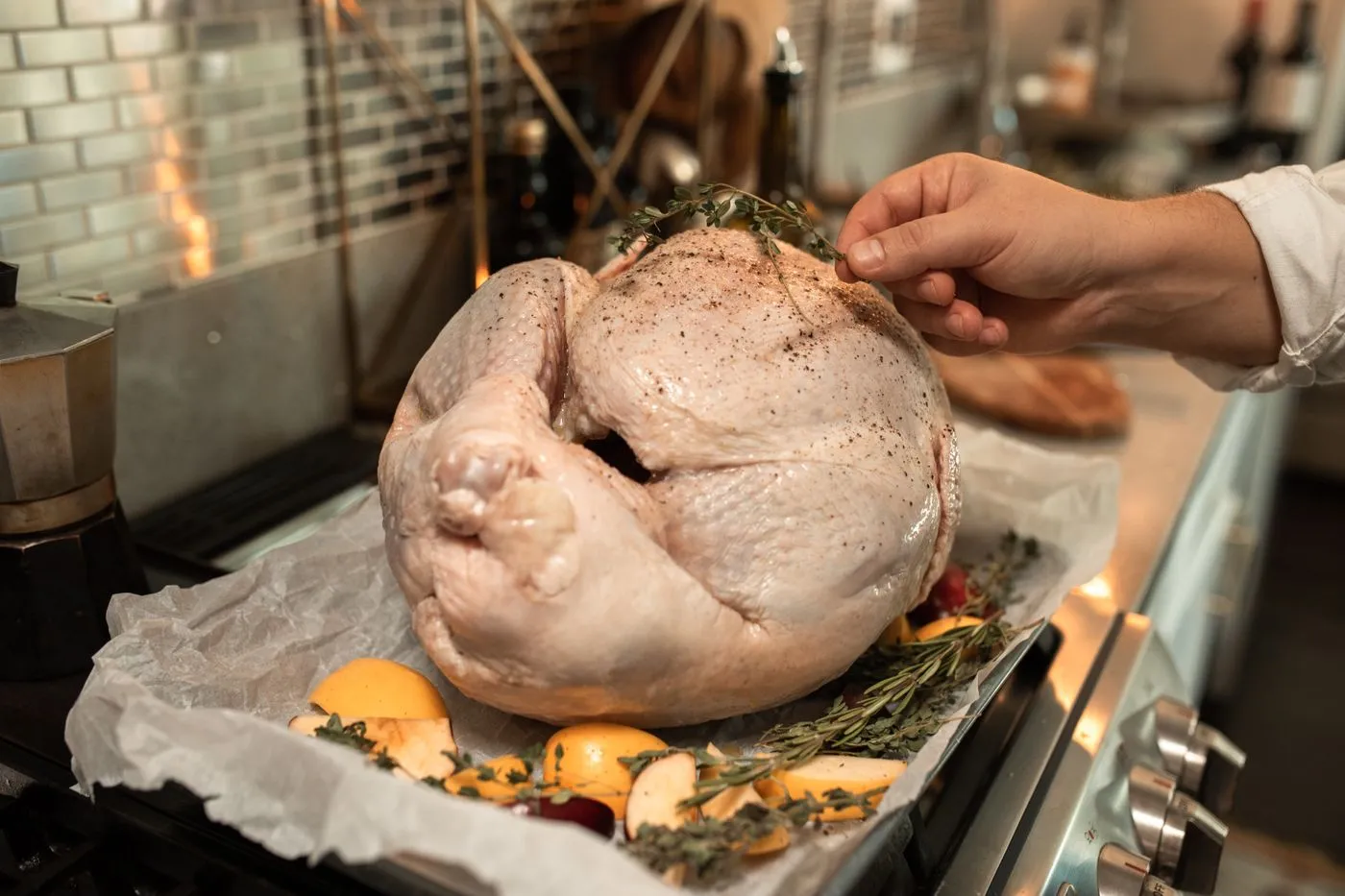
A hand places a sprig of thyme on a seasoned raw turkey in a roasting pan with apple wedges. Photo: RDNE Stock project, Pexels.
The turkey is the one dish on the table where the calendar and the thermometer matter more than the recipe. Here is what the USDA says, in the order you will need it.
What are the USDA's Thanksgiving turkey safety rules at a glance?
The USDA's Food Safety and Inspection Service (FSIS) writes the turkey rules most American kitchens follow. Its Your Safe Thanksgiving Guide, last updated on November 5, 2026, says foodborne illness causes 48 million illnesses, 128,000 hospitalizations and 3,000 deaths in the United States every year, and that simple steps at home reduce the risk. Here are those steps in one table:
| Step | What the USDA says | USDA page |
|---|---|---|
| Thawing | In the refrigerator, in cold water or in the microwave. Never on the counter or in hot water. | Safe Thawing, Safe Thanksgiving Guide |
| Cooking | Oven no lower than 163 °C (325 °F). The turkey is done at 74 °C (165 °F) minimum, measured with a food thermometer. | Roasting guide, Safe Cooking |
| Stuffing | For optimum safety, cook it outside the bird. Stuffing must reach 74 °C (165 °F) at the center either way. | Stuffing and Food Safety |
| Washing | Not recommended for raw poultry. It can spread bacteria around the kitchen. | Washing Food |
| Out on the table | 2 hours at most, 1 hour above 32 °C (90 °F). | Leftovers and Food Safety |
| Refrigerator | Turkey, stuffing and gravy: 3 to 4 days. | Roasting guide, Leftovers |
| Reheating | To 74 °C (165 °F). Bring sauces, soups and gravies to a rolling boil. | Leftovers and Food Safety |
The rest of this article explains each row. If you also want the eating side of the day, from the plate to the heartburn, our Thanksgiving After 50 article covers it.
How much turkey should I buy, fresh or frozen?
The USDA roasting guide says to allow 1 pound of turkey per person. A fresh turkey should be bought only 1 to 2 days before you plan to cook it and kept in the refrigerator on a tray or in a pan to catch any juices. A frozen turkey should stay frozen until you are ready to thaw it, and the guide says it can stay in the freezer indefinitely, although it suggests cooking it within 1 year for best quality.
Pre-stuffed birds follow different rules. The USDA says not to buy fresh pre-stuffed turkeys, because bacteria in the stuffing can multiply very quickly if it is not handled properly. It recommends only frozen pre-stuffed turkeys that display the USDA or State mark of inspection, and those must not be thawed: cook them from frozen and follow the package directions. Allow 1¼ pounds per person for those.
How do I thaw a turkey safely, and when do I start?
While a turkey is frozen it is safe indefinitely, but once it starts to thaw any bacteria on it can begin to grow again, says the USDA thawing page. Take it home from the store and put it in the freezer right away, not on the back porch, in a car trunk or in a basement, where the temperature cannot be monitored. A turkey left on the counter for more than 2 hours is not at a safe temperature: even if the center is still frozen, the outer layer is in the Danger Zone between 4 and 60 °C (40 and 140 °F), where bacteria multiply rapidly.
The USDA lists three safe ways to thaw: the refrigerator, cold water and the microwave oven.
Refrigerator. Plan on about 24 hours for every 4 to 5 pounds, in a refrigerator at 4 °C (40 °F) or below. Keep the turkey in its original wrapper and put it on a tray or in a pan to catch juices. A thawed turkey can stay in the refrigerator for 1 to 2 days before cooking, and one thawed this way can be refrozen without cooking, with some loss of quality.
Cold water. Allow about 30 minutes per pound. Wrap the turkey securely so water cannot leak in, submerge it in cold tap water and change the water every 30 minutes. Cook it immediately after it thaws, and do not refreeze it raw.
Microwave. Check your owner's manual for the size that fits, remove all outside wrapping and use a microwave-safe dish for the juices. Cook the turkey immediately afterwards, because some areas may start to cook and any bacteria would not have been destroyed. Do not refreeze or refrigerate it after microwave thawing. The USDA notes that not many whole turkeys fit in a microwave.
Whichever way you thaw it, remove the giblets from the cavities once the turkey has thawed and cook them separately. Here are the USDA times next to the dates that matter this year:
| Turkey weight | Refrigerator (USDA) | Start by, for Thursday, Nov 26, 2026 | Cold water (USDA) |
|---|---|---|---|
| 4 to 12 pounds | 1 to 3 days | Monday, Nov 23 | 2 to 6 hours |
| 12 to 16 pounds | 3 to 4 days | Sunday, Nov 22 | 6 to 8 hours |
| 16 to 20 pounds | 4 to 5 days | Saturday, Nov 21 | 8 to 10 hours |
| 20 to 24 pounds | 5 to 6 days | Friday, Nov 20 | 10 to 12 hours |
What if the turkey is still frozen and Thanksgiving is close?
You have two safe options, both from the USDA. The first is the cold-water method in the table above, which is why a 16 to 20 pound turkey that is still hard on Wednesday is not a lost cause: it needs 8 to 10 hours, changing the water every 30 minutes. The second is to cook the turkey from frozen. The roasting guide says it is safe and that it takes at least 50 percent longer than the time for a fully thawed turkey. Remove the giblet packages during cooking, carefully, with tongs or a fork.
| Turkey weight | Unstuffed, fully thawed (USDA) | Unstuffed, from frozen (our math) |
|---|---|---|
| 8 to 12 pounds | 2¾ to 3 hours | at least 4¼ hours |
| 12 to 14 pounds | 3 to 3¾ hours | at least 4½ hours |
| 14 to 18 pounds | 3¾ to 4¼ hours | at least 5¾ hours |
| 18 to 20 pounds | 4¼ to 4½ hours | at least 6½ hours |
| 20 to 24 pounds | 4½ to 5 hours | at least 6¾ hours |
The one thing the USDA does not allow is a shortcut: never thaw on the counter or in hot water. In our opinion, cold water is the better rescue when you have a day, because it keeps the oven schedule normal, and cooking from frozen is the better one when you only have the morning.
How do I know the turkey is done?
Use a food thermometer. The USDA guide says the internal temperature of cooked turkey must be at least 74 °C (165 °F), however it is cooked. For a whole turkey, measure in three places: the thickest part of the breast, the innermost part of the wing and the innermost part of the thigh, and keep the thermometer from touching bone, which gives a wrong reading. Even if your turkey has a pop-up timer, the USDA says to check the temperature in those places too. It adds that for reasons of personal preference you may cook it hotter.
For the oven, the Safe Cooking page says to set it no lower than 163 °C (325 °F), put the turkey breast-side up on a flat wire rack in a shallow roasting pan and let it stand 20 minutes before carving, which for quality lets the juices set. Preheating is not necessary. The same page lists things that change the time: a partially frozen turkey, a stuffed turkey, an oven that runs hot or cold, a dark pan, a foil tent left on the whole time, a pan or turkey so large that it blocks heat, and an oven cooking bag.
| Turkey weight (unstuffed) | Approximate time at 163 °C (325 °F) |
|---|---|
| 4 to 6 pounds (breast) | 1½ to 2¼ hours |
| 6 to 8 pounds (breast) | 2¼ to 3¼ hours |
| 8 to 12 pounds | 2¾ to 3 hours |
| 12 to 14 pounds | 3 to 3¾ hours |
| 14 to 18 pounds | 3¾ to 4¼ hours |
| 18 to 20 pounds | 4¼ to 4½ hours |
| 20 to 24 pounds | 4½ to 5 hours |
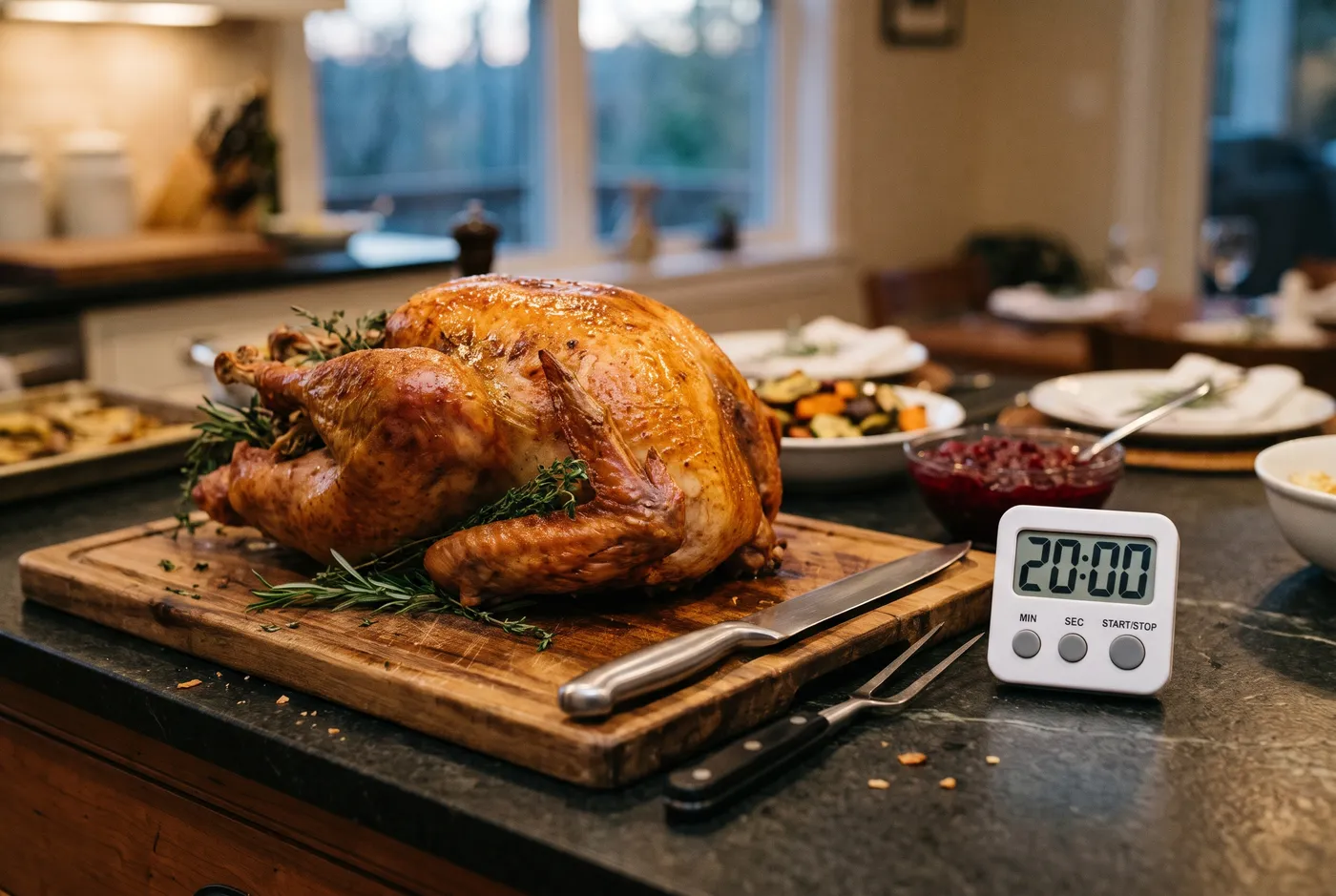
Pink is not a verdict either way. The USDA's page on pink turkey says the color of cooked poultry is not always a sure sign of its safety, that turkey can stay pink after it reaches 74 °C (165 °F), and that smoked turkey is always pink. It lists causes such as oven gases, the natural nitrites in feed or water, a young bird and grilling or smoking. The only accurate check is the thermometer.
Should I stuff the turkey, and is stuffing safe?
For optimum safety, the USDA says to cook stuffing outside the bird, in a casserole. If you do stuff the turkey, the USDA stuffing page gives four rules: mix wet and dry ingredients just before spooning the stuffing in, fill the cavity loosely with about 3/4 cup per pound, put the bird in the oven immediately and check with a thermometer that the center of the stuffing reaches 74 °C (165 °F). If the stuffing is not at 74 °C (165 °F) when the meat is done, it needs more cooking, even if the turkey itself is ready.
A few other answers from the same page. Do not refrigerate uncooked stuffing: cook it right away or freeze it. Do not stuff a turkey that will be deep-fat fried. Do not stuff a bird with leftover cooked stuffing. If you make stuffing in a slow cooker, keep it very moist, fill the cooker no more than two-thirds, keep the lid tight, start on high for at least 1 hour, and cook until the center reaches 74 °C (165 °F). Never put frozen stuffing in a slow cooker.
Should I wash the turkey first?
No. The USDA's page on washing food says washing raw poultry before cooking is not recommended as the safest method, because USDA research found it increases the risk of cross-contamination: bacteria can be splashed onto the sink, counters and nearby foods. Cooking to the right temperature kills the germs, so washing is risky and not necessary for safety. Never use soap or detergent on poultry.
What the USDA does recommend is cleaning. Wash your hands with soap and water for at least 20 seconds after touching raw turkey or its packaging. Wash counters and sinks with hot, soapy water first, then sanitize or disinfect, because the page says Campylobacter can survive in a kitchen for up to 4 hours and Salmonella for up to 32 hours. For cutting boards and utensils, it gives a homemade sanitizer of 1 tablespoon of unscented liquid chlorine bleach in 1 gallon of water, left to stand for several minutes and then rinsed. Packaging from raw turkey should be thrown away immediately.
How long can the turkey and sides sit out?
Two hours, with one adjustment. The USDA leftovers page says to refrigerate leftovers within 2 hours of cooking or of taking the food off a warming appliance, and to throw away perishable food left at room temperature for more than 2 hours, or more than 1 hour if the temperature is over 32 °C (90 °F). Bacteria grow rapidly between 4 and 60 °C (40 and 140 °F), so hot food should stay at 60 °C (140 °F) or warmer and cold food at 4 °C (40 °F) or colder.
For a buffet, the USDA suggests keeping hot food hot in chafing dishes, slow cookers or warming trays, and cold food cold by nesting dishes in bowls of ice or using small trays that you replace often.
How do I store Thanksgiving leftovers?
Cool the food fast and cover it. The USDA says to divide large amounts into shallow containers, so a big pot of soup or gravy does not take hours to cool. Cut turkey into smaller pieces and refrigerate it: slice the breast meat, and the legs and wings may be left whole. Hot food can go straight into the refrigerator or be chilled first in an ice or cold-water bath. Cover the containers or wrap them airtight, which also keeps moisture in and other food smells out.
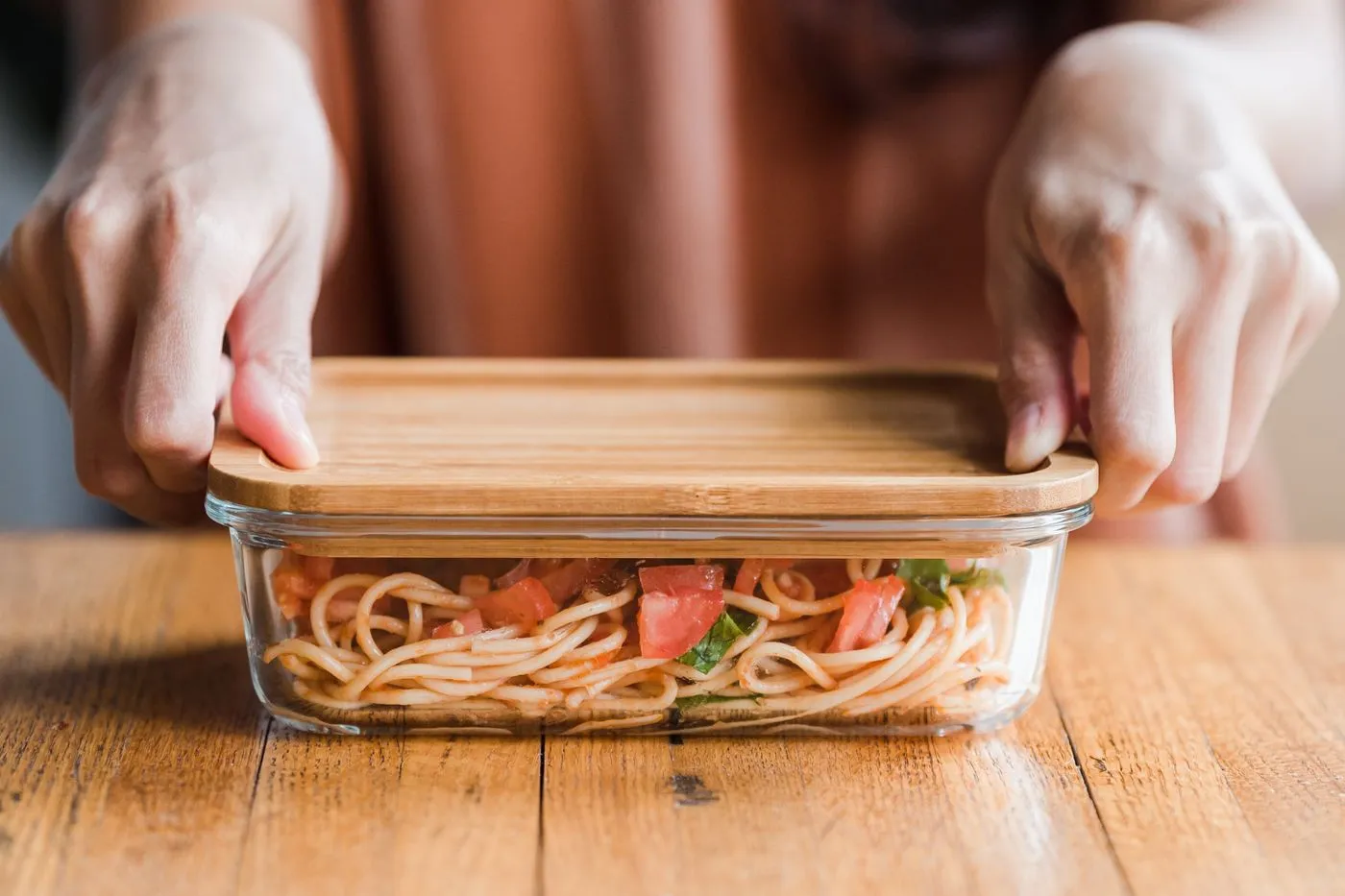
The USDA's Turkey from Farm to Table page gives storage times for the dishes on your table:
| Leftover | Refrigerator | Freezer (best quality) |
|---|---|---|
| Cooked turkey | 3 to 4 days | 4 months |
| Cooked turkey dishes (stuffing, casseroles) | 3 to 4 days | 4 to 6 months |
| Turkey broth and gravy | 3 to 4 days | 2 to 3 months |
Not every USDA page gives the same freezer range for leftovers: the leftovers page says 3 to 4 months and the roasting guide says 2 to 6 months for best quality. All of them agree on the refrigerator, 3 to 4 days, and that frozen food stays safe indefinitely while losing moisture and flavor with time. To thaw frozen leftovers, use the refrigerator, cold water in a leak-proof bag or the microwave, and use them within 3 to 4 days after thawing.
How do I reheat leftovers safely?
To 74 °C (165 °F), checked with a food thermometer. The roasting guide says cooked turkey can also be eaten cold. To reheat in the oven, set it no lower than 163 °C (325 °F) and add a little broth or water and cover the turkey to keep it moist. The leftovers page says to bring sauces, soups and gravies to a rolling boil.
In the microwave, cover the food, rotate it for even heating and let it stand before you check. Microwaves have cold spots, so the USDA says to check the temperature in several places. It is also safe to reheat frozen leftovers without thawing them, though it takes longer. If you end up with leftover leftovers, food reheated to 74 °C (165 °F) can be refrozen. If leftover turkey is going into lunches this week, our guide to protein after 50 covers how much men need in a day.
What does a safe Thanksgiving week look like in 2026?
Here is the USDA advice laid out on the calendar, for a Thursday, November 26 dinner. The dates are our count from the USDA ranges.
| When | What to do |
|---|---|
| By Monday, Nov 23 | A turkey of 12 pounds or more should already be thawing in the refrigerator, in a pan or container (see the dates above). One of 4 to 12 pounds can still start on Monday. Buy a food thermometer if you do not own one. |
| Wednesday, Nov 25 | Check that the refrigerator is at 4 °C (40 °F) or below. Keep wet stuffing ingredients chilled and separate from the dry ones. |
| Thursday morning, Nov 26 | Do not wash the turkey. Wash your hands for 20 seconds after touching it. Roast at 163 °C (325 °F) or higher. Check 74 °C (165 °F) in the breast, thigh and wing. |
| At the table | Start the 2-hour clock when the food comes off the heat. Keep hot dishes hot and cold dishes cold. |
| Right after dinner | Slice the turkey, put everything in shallow covered containers and refrigerate. A short walk is fine while the dishes cool (see our walking guide). |
| Friday to Sunday, Nov 27 to 29 | Eat the turkey, stuffing and gravy. Reheat to 74 °C (165 °F). Sunday is day 3. |
| Monday, Nov 30 | Day 4 is the last day the USDA range allows. Anything left should be in the freezer before then. |
A turkey question on the day?
The USDA Meat and Poultry Hotline, 1-888-MPHotline (1-888-674-6854), is staffed by food safety specialists and is open on Thanksgiving Day from 8 a.m. to 2 p.m. Eastern time, and from 10 a.m. to 6 p.m. Eastern time Monday to Friday. You can also email MPHotline@usda.gov.
What is the bottom line?
Thaw in the refrigerator on a schedule, or switch early to cold water. Cook to 74 °C (165 °F) in the breast, thigh and wing, skip the washing, keep stuffing to the same 74 °C (165 °F) and put leftovers in shallow containers within 2 hours. Eat them within 3 to 4 days or freeze them, and reheat to 74 °C (165 °F). The oven will run for hours on the day, so it is also a good moment to check your smoke and carbon monoxide alarms. For the rest of the everyday habits, our Fitness and Food guide is the place to start.
Frequently asked questions
How long does it take to thaw a turkey in the refrigerator?
The USDA says to allow about 24 hours for every 4 to 5 pounds in a refrigerator set at 4 °C (40 °F) or below. That is 1 to 3 days for a 4 to 12 pound turkey and 5 to 6 days for a 20 to 24 pound one.
Can I thaw a turkey on the kitchen counter?
No. The USDA says thawing a turkey on the counter or in hot water is not safe, because the outer layer reaches the "Danger Zone" between 4 and 60 °C (40 and 140 °F) while the center is still frozen.
What temperature should a Thanksgiving turkey reach?
At least 74 °C (165 °F), measured with a food thermometer in the thickest part of the breast, the innermost part of the thigh and the innermost part of the wing, without touching bone.
Is pink turkey meat safe to eat?
It can be. The USDA says turkey can stay pink even after it reaches 74 °C (165 °F), so color is not a reliable test. Only a food thermometer shows whether the turkey is done.
Should I wash the turkey before cooking it?
The USDA does not recommend it. Washing raw poultry can splash bacteria onto your sink and counters, and cooking to 74 °C (165 °F) is what kills the germs.
How long can turkey and sides sit out at room temperature?
No more than 2 hours, or 1 hour if the room is hotter than 32 °C (90 °F). The USDA says to throw away perishable food left out longer than that.
How long do turkey leftovers keep in the refrigerator?
The USDA says cooked turkey, stuffing and gravy keep for 3 to 4 days in the refrigerator. If you cannot finish them by then, freeze them.
How hot do leftovers need to be when I reheat them?
At least 74 °C (165 °F), checked with a food thermometer. The USDA says to bring sauces, soups and gravies to a rolling boil.
Can I cook a turkey straight from frozen?
Yes. The USDA says it is safe to cook a turkey from the frozen state, but it takes at least 50 percent longer than a fully thawed bird. It must still reach 74 °C (165 °F).
Who can I call with a turkey question on Thanksgiving Day?
The USDA Meat and Poultry Hotline at 1-888-674-6854. It is open from 8 a.m. to 2 p.m. Eastern time on Thanksgiving Day, and from 10 a.m. to 6 p.m. Eastern time Monday to Friday.
Sources we read for this article
- USDA FSIS: Your Safe Thanksgiving Guide (last updated November 5, 2026)
- USDA FSIS: Turkey Basics: Safe Thawing (last updated October 24, 2023)
- USDA FSIS: Let's Talk Turkey: A Consumer Guide to Safely Roasting a Turkey (last updated November 17, 2023)
- USDA FSIS: Turkey Basics: Safe Cooking (last updated October 22, 2019)
- USDA FSIS: Stuffing and Food Safety (last updated August 2, 2013)
- USDA FSIS: Is Pink Turkey Meat Safe? (last updated September 13, 2024)
- USDA FSIS: Washing Food: Does it Promote Food Safety? (last updated February 7, 2024)
- USDA FSIS: Leftovers and Food Safety (last updated July 31, 2020)
- USDA FSIS: Turkey from Farm to Table (last updated July 2, 2024)