
Men's Health · Vitality
L-Arginine and L-Citrulline for Men Over 50: What the Studies Say
By OakMan Guide Editorial Team Updated 7 min read
The short answer
The studies are encouraging but small. A 2019 review of 10 trials with 540 men found that arginine, at 1,500 to 5,000 mg a day, did better than placebo for mild to moderate erectile problems. A small trial of 24 men saw more improvement on 1.5 g of citrulline than on placebo. Doses and trial lengths varied, so read the milligrams on a label first.
We're not doctors, and this is not medical advice. This article may contain affiliate links, always to the official websites of the products mentioned. If you buy through one of these links, you support our work at no additional cost to you. This never influences what we write.
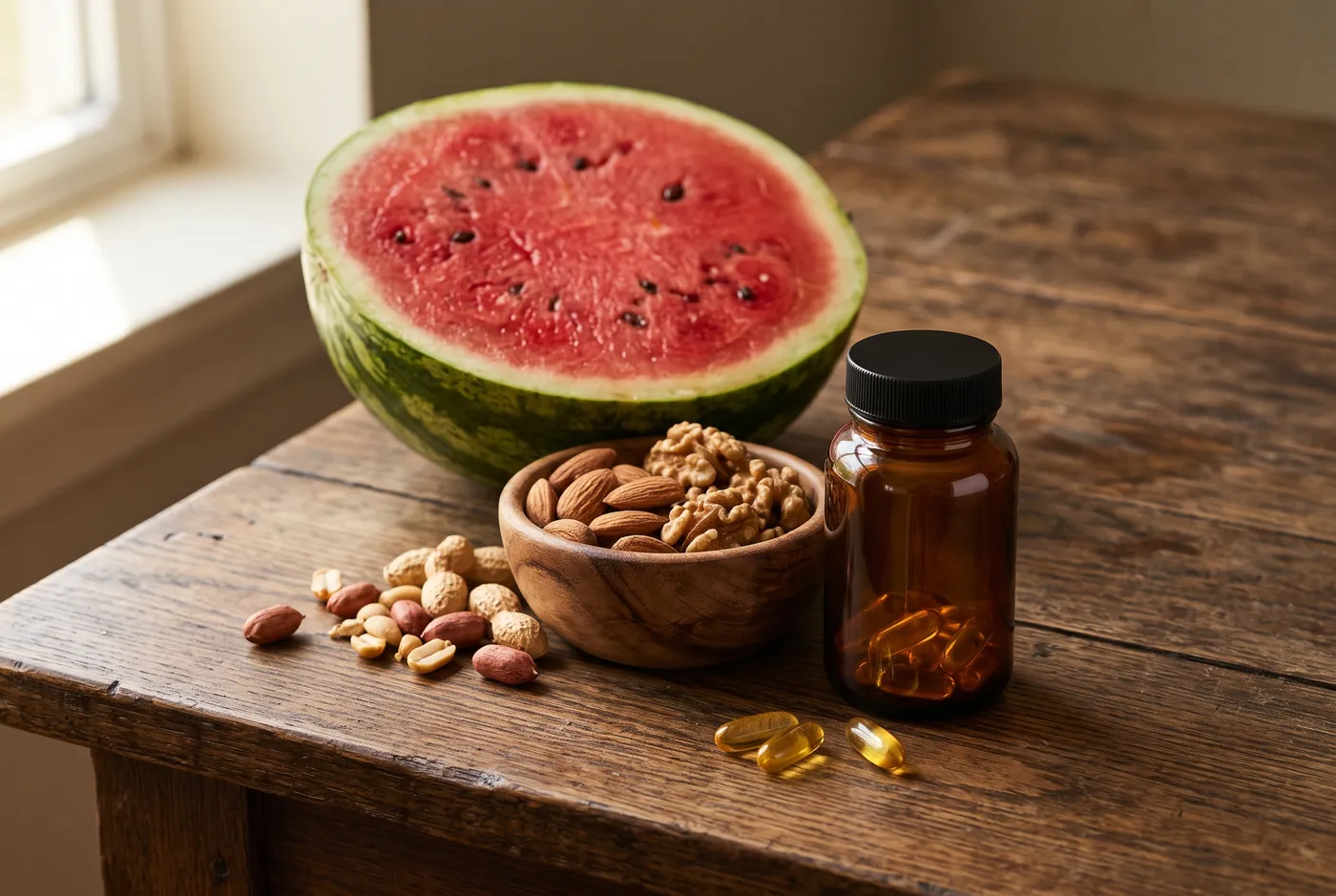
Watermelon, almonds, walnuts and peanuts beside an amber supplement bottle on an oak table. Realistic AI-generated image.
Many vitality formulas for men list L-arginine and L-citrulline together. Here is what each one is, what the human studies found and how to check the amounts on a bottle.
What are L-arginine and L-citrulline?
Both are amino acids, the building blocks of protein. Your body uses L-arginine to make nitric oxide, a signal that helps blood vessels relax and widen. L-citrulline is its partner: the body converts it into arginine, so it works as a back door into the same pathway.
That is why labels pair them. A 2008 study in 20 healthy volunteers gave placebo, citrulline and arginine in a double-blind, crossover design and found that citrulline raised blood arginine more effectively than arginine itself, with the highest dose (3 g twice a day) doing the most. The authors explain that arginine is largely broken down in the gut before it reaches the blood, while citrulline is readily absorbed.
You also get both from food. Nuts, meat, fish, dairy and beans carry arginine, and a 2025 review describes watermelon as high in L-citrulline. Our foods and habits guide leans on many of the same everyday foods.
Why do they come up for men over 50?
Nitric oxide matters for blood flow, and blood flow is part of what changes with age. A 2017 study in Andrology measured both amino acids in the blood of 122 men with erectile dysfunction. Men whose problem came from reduced blood supply to the penis had lower arginine and citrulline than the others, and men with more severe problems had lower levels than men with mild ones.
That is an association, not proof that adding the amino acids fixes it. It does explain why researchers tested them. Our erectile dysfunction guide and the piece on ED and heart health cover what blood-flow changes can mean and what to raise with your doctor.
What do the studies on L-arginine and L-citrulline show?
Three pieces of research are worth knowing:
| Study | Who and how long | What it found |
|---|---|---|
| 2019 meta-analysis of arginine | 10 randomized trials, 540 men with mild to moderate ED, 1,500 to 5,000 mg a day | Arginine did better than placebo or no treatment (odds ratio 3.37). Side effects: 8.3% on arginine, 2.3% on placebo, none severe. |
| 2011 citrulline trial | 24 men, average age 56, mild ED, 1.5 g a day for 1 month after 1 month of placebo | Erection hardness reached the normal score in 12 of 24 men on citrulline and 2 of 24 on placebo. No side effects. |
| 2008 pharmacology study | 20 healthy volunteers, 1 week on each regimen, up to 3 g of citrulline twice a day | Citrulline raised blood arginine and markers of nitric oxide signaling more than arginine did. |
The 2019 meta-analysis concludes that arginine supplements can be recommended for mild to moderate erectile problems, while noting that dose and duration varied among the trials. The 2011 citrulline trial was single-blind and small, and its authors describe citrulline as less effective than prescription medicines in the short term, but safe and well accepted. They call for more research.
In our opinion, the fair reading is a promising start. The numbers are good enough to make the ingredients worth a look and small enough that nobody should expect the same result every time.
How much do the studies use?
Arginine at 1,500 to 5,000 mg a day, citrulline at 1.5 g a day for a month and up to 3 g twice a day for a week in healthy volunteers. Those are grams, not the few milligrams you would get from a sprinkle of nuts. This is the number to keep in mind when you look at a label: the ingredient name tells you what is in the bottle, and the milligram line tells you how much.
These are the amounts that were tested, not a dose for you. Your doctor can tell you what fits your health and medicines.
Where does a gummy like AlphaErec fit in?
If you like the idea of both amino acids in one daily habit, AlphaErec is a berry gummy, one a day, that names both L-arginine and L-citrulline, plus Panax ginseng and several traditional herbs. It is a one-time payment backed by a 60-day money-back guarantee, which gives you time to see how you feel. Our AlphaErec review goes through the full ingredient list and the prices.
As the label advises, ask your doctor first if you take medication or have a medical condition. Whatever product you look at, the Supplement Facts panel on the bottle is where the milligrams are printed, and that panel is what you compare with the study amounts above. The wider picture, including other formulas and ingredients, is in our men's vitality guide.
How do I read an arginine and citrulline label?
- Find each amino acid by name. Look for L-arginine (often as L-arginine HCl) and L-citrulline on separate lines.
- Read the milligrams. Compare them with the study amounts in grams. A formula can include both and still give you less than the trials used.
- Check for a blend. An ingredient inside a blend may show only the total weight of the blend.
- Count your daily total. Add every product that contains either amino acid.
- Plan a trial of several weeks. Write down how you feel before you start and review it with your doctor at your next checkup.
Ingredients with their own research, such as Tongkat Ali and boron, are covered in separate pieces.
What is the bottom line?
L-arginine and L-citrulline have more human research behind them than most ingredients on a vitality label, and the results lean positive for mild to moderate problems. The trials are small or mixed in design, the doses are in grams and the label is where you check what a product gives you. Eat the foods, pick a format you will take daily and keep your doctor in the loop. Our men's health guide ties the pieces together.
Frequently asked questions
What is the difference between L-arginine and L-citrulline?
L-arginine is the amino acid your body uses to make nitric oxide, a signal that relaxes blood vessels. L-citrulline is a related amino acid that the body converts into arginine. In a 2008 study of 20 healthy volunteers, citrulline raised blood arginine more effectively than arginine itself.
Do L-arginine supplements help men over 50?
A 2019 meta-analysis of 10 randomized trials with 540 men who had mild to moderate erectile problems found that arginine, at 1,500 to 5,000 mg a day, did better than placebo or no treatment. The trials differed in dose and length, so the result is encouraging but not final.
How much L-citrulline did the studies use?
A small trial of 24 men with mild erectile dysfunction used 1.5 g a day for one month. A pharmacology study in healthy volunteers used up to 3 g twice a day for one week. These are the amounts that were tested, not a recommendation.
Are L-arginine and L-citrulline safe?
In the 2019 meta-analysis, side effects were reported by 8.3% of men taking arginine and 2.3% of men on placebo, and none were severe. The citrulline trial of 24 men reported no side effects. Both findings come from short studies, so ask your doctor first if you take medication or have a medical condition.
Which foods have L-arginine and L-citrulline?
Nuts, meat, fish, dairy and beans are everyday sources of arginine. A 2025 review notes that watermelon is high in L-citrulline. Food gives smaller amounts than the supplement doses used in studies.
How do I read an L-arginine and L-citrulline label?
Find the milligrams of each one on the Supplement Facts panel, check whether the amount sits on its own line or inside a blend, and compare it with the amounts used in the studies. A formula can name both ingredients and still give you less than the studies used.
How long do these supplements take to work?
The citrulline trial lasted one month, and the pharmacology study one week. Most supplement research runs for weeks, so a fair trial is several weeks of steady daily use, with a note of how you feel before and after.
Sources we checked for this article
- Rhim HC, Kim MS, Park YJ, Choi WS, Park HK, Kim HG, Kim A, Paick SH. The Potential Role of Arginine Supplements on Erectile Dysfunction: A Systemic Review and Meta-Analysis. J Sex Med 2019;16(2):223-234 (abstract read November 13, 2026)
- Cormio L, De Siati M, Lorusso F, Selvaggio O, Mirabella L, Sanguedolce F, Carrieri G. Oral L-citrulline supplementation improves erection hardness in men with mild erectile dysfunction. Urology 2011;77(1):119-22 (abstract read November 13, 2026)
- Schwedhelm E, Maas R, Freese R, et al. Pharmacokinetic and pharmacodynamic properties of oral L-citrulline and L-arginine: impact on nitric oxide metabolism. Br J Clin Pharmacol 2008;65(1):51-9 (abstract read November 13, 2026)
- Barassi A, Corsi Romanelli MM, Pezzilli R, et al. Levels of L-arginine and L-citrulline in patients with erectile dysfunction of different etiology. Andrology 2017;5(2):256-261 (abstract read November 13, 2026)
- Baião DDS, da Silva DVT, Paschoalin VMF. Watermelon Nutritional Composition with a Focus on L-Citrulline and Its Cardioprotective Health Effects: A Narrative Review. Nutrients 2025;17(20):3221 (abstract read November 13, 2026)