
Money & Medicare · Social Security
When to Claim Social Security: 62 vs Full Retirement Age vs 70
By OakMan Guide Editorial Team Updated 9 min read
The short answer
There is no single best age. The Social Security Administration (SSA) lets you start at 62, and a check started then is about 30% smaller if your full retirement age is 67. Waiting past 67 adds 8% for each year, up to 24% at 70. Your health, work, spouse and other income decide which trade-off fits.
This guide explains rules the Social Security Administration publishes. It is general information, not financial or tax advice, and your own earnings record and household decide what applies to you.

An older woman taps a calculator while the man beside her writes on a notepad. Photo: Kampus Production, Pexels.
Social Security gives you a range of starting ages, and the monthly check is different at each one. Here is what SSA says changes, with the arithmetic shown, so you can look at your own numbers.
What are the ages that matter for claiming Social Security?
There are three. SSA says you can start retirement benefits as early as age 62, but you are entitled to full benefits only when you reach your full retirement age. If you delay from full retirement age up to 70, the amount increases. After 70, it does not.
Your full retirement age comes from your birth year. SSA explains that it was 65 for many years, and that a 1983 law raised it gradually because people are living longer and are generally healthier in older age. It reaches 67 for people born in 1960 and later. If your birthday is January 1, SSA says to use the previous year.
| Year of birth | Full retirement age | Cut if you start at 62 | A $1,000 benefit becomes |
|---|---|---|---|
| 1943 to 1954 | 66 | 25.00% | $750 |
| 1955 | 66 and 2 months | 25.83% | $741 |
| 1956 | 66 and 4 months | 26.67% | $733 |
| 1957 | 66 and 6 months | 27.50% | $725 |
| 1958 | 66 and 8 months | 28.33% | $716 |
| 1959 | 66 and 10 months | 29.17% | $708 |
| 1960 and later | 67 | 30.00% | $700 |
Everything below uses 67, the age for anyone born in 1960 or later. If you were born earlier, the table above shows your own age and the size of the cut at 62.
How much smaller is the check at 62?
With a full retirement age of 67, SSA says it is 30% smaller. Starting at 62 means 60 months before full retirement age, and the SSA actuaries give the formula: the benefit is reduced 5/9 of 1% for each month up to 36 months, and 5/12 of 1% for each month after that. So 36 months at 5/9 of 1% is 20%, plus 24 months at 5/12 of 1% is 10%, for 30% in all.
The cut is permanent, which is the point of the formula: you collect for more months, at a smaller amount each month. SSA puts it this way: the advantage of an early start is that you collect benefits for a longer period, and the disadvantage is that the benefit is reduced. Each person's situation is different.
How much more do I get if I wait past full retirement age?
SSA calls the increase delayed retirement credits. For anyone born in 1943 or later, the rate is 8% for each year, or 2/3 of 1% for each month, and it stops when you reach 70. If your full retirement age is 67, three years of credits make the check 24% higher at 70 than at 67.
There is a timing detail on the same page. If you start before 70, some of your delayed credits are not applied until the January after you start receiving benefits. SSA's own calculator shows an estimate with every credit applied.
What does that look like in dollars?
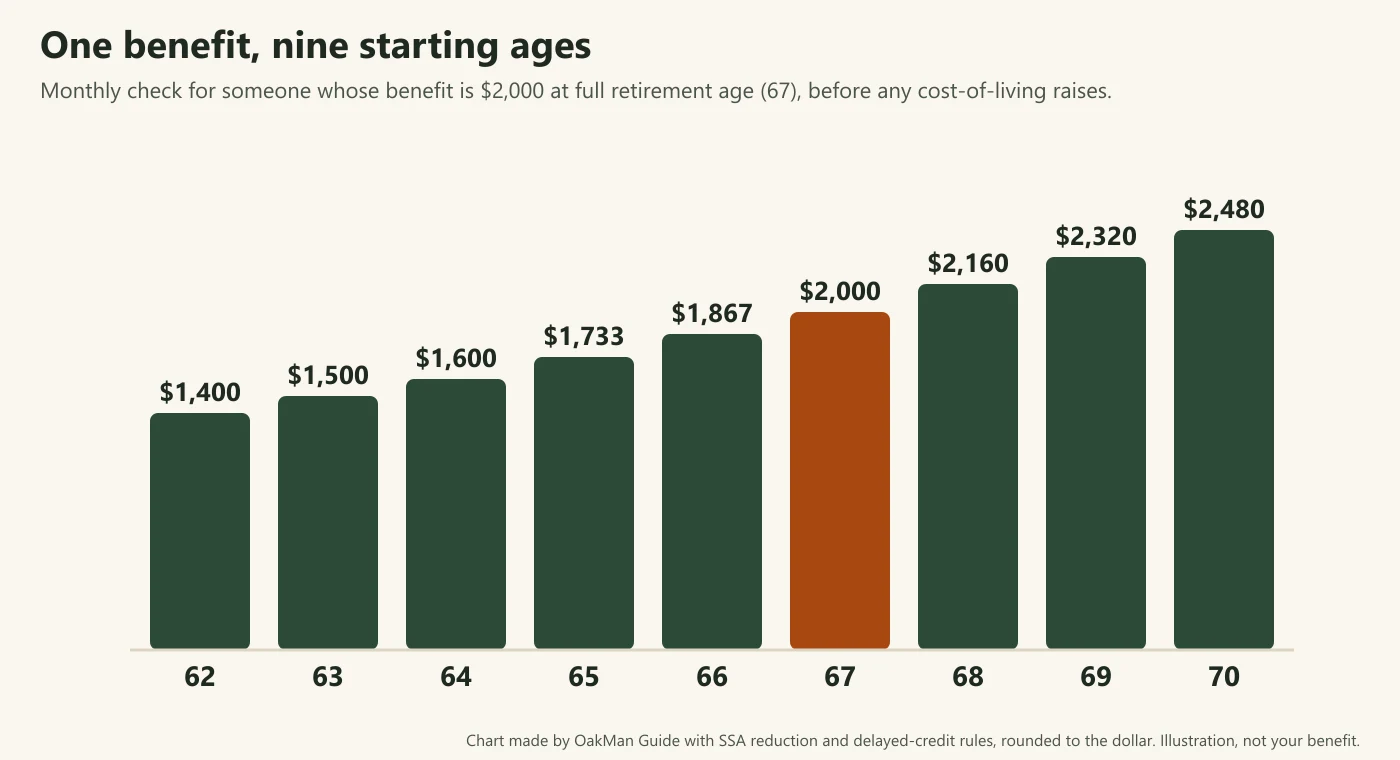
Take someone whose benefit is $2,000 a month at full retirement age of 67. These are the checks at each starting age, using the SSA rules above and rounded to the dollar:
| Start at | Monthly check | Change from age 67 | Difference per month |
|---|---|---|---|
| 62 | $1,400 | −30% | −$600 |
| 63 | $1,500 | −25% | −$500 |
| 64 | $1,600 | −20% | −$400 |
| 65 | $1,733 | about −13% | −$267 |
| 66 | $1,867 | about −7% | −$133 |
| 67 (full retirement age) | $2,000 | 0% | $0 |
| 68 | $2,160 | +8% | +$160 |
| 69 | $2,320 | +16% | +$320 |
| 70 | $2,480 | +24% | +$480 |
Two things to notice. The steps are not even: each year you wait from 62 to 64 shrinks the cut by 5 points (5/12 of 1% a month), each year from 64 to 67 shrinks it by about 6.7 points (5/9 of 1% a month), and each year past 67 adds 8 points (2/3 of 1% a month). And the check at 70 is $1,080 a month larger than the check at 62 in this example, which is the whole range the rules create.
Can I work and collect before full retirement age?
Yes. SSA says you can work while you receive retirement or survivors benefits, but if you are younger than full retirement age and earn above the yearly limit, SSA may reduce your benefit. The limits go up in 2027, and we cover that in our Social Security 2027 raise article.
| Your situation | 2026 limit | 2027 limit | What SSA deducts |
|---|---|---|---|
| Under full retirement age all year | $24,480 | $25,560 | $1 for every $2 above the limit |
| The year you reach full retirement age | $65,160 | $67,920 | $1 for every $3 above the limit |

In the year you reach full retirement age, SSA counts earnings only up to the month before you reach that age, so the rest of the year does not count. It also has a special rule for the first year of benefits: SSA can pay a full check for any whole month it considers you retired, whatever your earnings for the year. Once you reach full retirement age, the limit stops applying.
One more point from SSA: each year it reviews the records of beneficiaries who had wages reported, and if your latest year is one of your highest, it recalculates your benefit and pays any increase you are due.
How does the starting age affect a spouse?
SSA says a spouse can get up to half of the worker's benefit amount. The SSA age-reduction page shows the starting age matters for the spouse as well: if the spouse starts at 62 and the full retirement age is 67, a $500 spouse's benefit becomes $325, a cut of 35%. SSA adds that the maximum spouse's benefit is 50% of the benefit the worker would get at full retirement age, and the reduction is applied after that 50%.
SSA also says that if you qualify for more than one benefit, you get the one that gives the highest payment, not the two added together. That is why each spouse's own record matters, not only one of them.
What about a survivor benefit?
If a spouse dies, the surviving spouse may qualify for a monthly payment based on the work history of the person who died, according to SSA. For a spouse or ex-spouse, payments start at 71.5% of the late spouse's benefit and increase the longer the survivor waits to apply:
| Survivor applies at | Share of the late spouse's benefit |
|---|---|
| 61 | Over 75% |
| 63 | Over 80% |
| 65 | Over 90% |
| Survivor full retirement age (66 to 67) | Up to 100% |
SSA also says that if you qualify for Survivor and another benefit, you choose the payment that is best for you, and you can switch later. Its example is starting with Survivor benefits and changing to Retirement at 70, when that payment is highest.
Does my Social Security age change my Medicare date?
No, and SSA is direct about it: Medicare does not wait for Social Security. If you put off your benefits beyond 65, sign up for Medicare within 3 months of turning 65 anyway, because a later sign-up may make medical insurance (Part B) and prescription drug coverage (Part D) cost more. Our Medicare Open Enrollment guide and the Medicare vs Medicare Advantage basics cover the plan side, and the Money and Medicare After 50 guide puts every date in one place.
What can I look at before I decide?
- Write down your birth year. It gives you your full retirement age and the size of the cut at 62.
- Log in to your my Social Security account. It lists your earnings record and an estimate for each starting age.
- Check your earnings record. The estimates are only as good as the record behind them.
- List your other income. Work income before full retirement age is where the earnings limit applies.
- Put your Medicare date on the calendar. It is set by your 65th birthday, not by when you claim.
- Call with questions. SSA lists 1-800-772-1213 (TTY 1-800-325-0778), Monday through Friday, 8 a.m. to 7 p.m. in most U.S. time zones.
Frequently asked questions
What is the earliest age I can claim Social Security retirement benefits?
Age 62. SSA says you can start retirement benefits as early as 62, but you are entitled to full benefits only at your full retirement age. You must be at least 62 for the entire month to receive a benefit for it.
What is my full retirement age?
It depends on your birth year: 67 if you were born in 1960 or later, 66 and 10 months for 1959, and two months less for each earlier year, down to 66 for 1943 through 1954.
How much smaller is my check if I start at 62?
If your full retirement age is 67, SSA says a $1,000 benefit becomes $700, a cut of 30%. For earlier birth years the cut is smaller, from 29.17% for 1959 down to 25% for 1954 and earlier.
How much more do I get if I wait past full retirement age?
SSA adds delayed retirement credits of 2/3 of 1% for each month, or 8% for each year, for anyone born in 1943 or later. Credits end at 70; with a full retirement age of 67, that tops out at 24% more.
Is there any reason to wait past 70?
Not for the benefit amount. SSA says the increase stops when you reach 70, so waiting longer adds no credits.
Can I work and claim Social Security before full retirement age?
Yes, but there is an earnings limit. For 2026 it is $24,480 if you are under full retirement age all year, and SSA takes back $1 of benefits for every $2 above it. In the year you reach that age the limit is $65,160, at $1 for every $3.
What happens to a spouse's benefit if I claim early?
A spouse can get up to half of the worker's full-retirement-age benefit, and SSA reduces it if the spouse starts before full retirement age. At 62 with a full retirement age of 67, SSA lists a $500 spouse's benefit as $325, a cut of 35%.
Do I still need to sign up for Medicare at 65 if I wait on Social Security?
Yes. SSA says Medicare does not wait: sign up within 3 months of turning 65 even if you delay your benefits. A later sign-up may make Part B and Part D cost more.
Sources we checked for this article
- SSA: Starting Your Retirement Benefits Early (page text read November 9, 2026)
- SSA: Delayed Retirement Credits (page text read November 9, 2026)
- SSA: Retirement Age Calculator (page text read November 9, 2026)
- SSA Office of the Chief Actuary: Early or Late Retirement? (formula page, last modified 2008; read November 9, 2026)
- SSA: Receiving Benefits While Working (page text read November 9, 2026)
- SSA: Family benefits (page text read November 9, 2026)
- SSA: What you could get from Survivor benefits (page text read November 9, 2026)
- SSA: Retirement benefits (page text read November 9, 2026)