
Men's Health · Checkups
Eye Exams After 50: What the Eye Doctor Checks For
By OakMan Guide Editorial Team Updated 9 min read
The short answer
An eye exam after 50 checks how clearly you see, your side vision and your eye pressure, then uses drops to widen your pupils and look at the lens, retina and optic nerve for cataracts, glaucoma and macular degeneration. The NEI says to get a dilated exam every 1 to 2 years if you are over 60, because many eye diseases have no early symptoms.
We're not doctors, and this is not medical advice. Everything below comes from the official sources listed at the end, and how often your own eyes need checking is a question for your eye doctor.
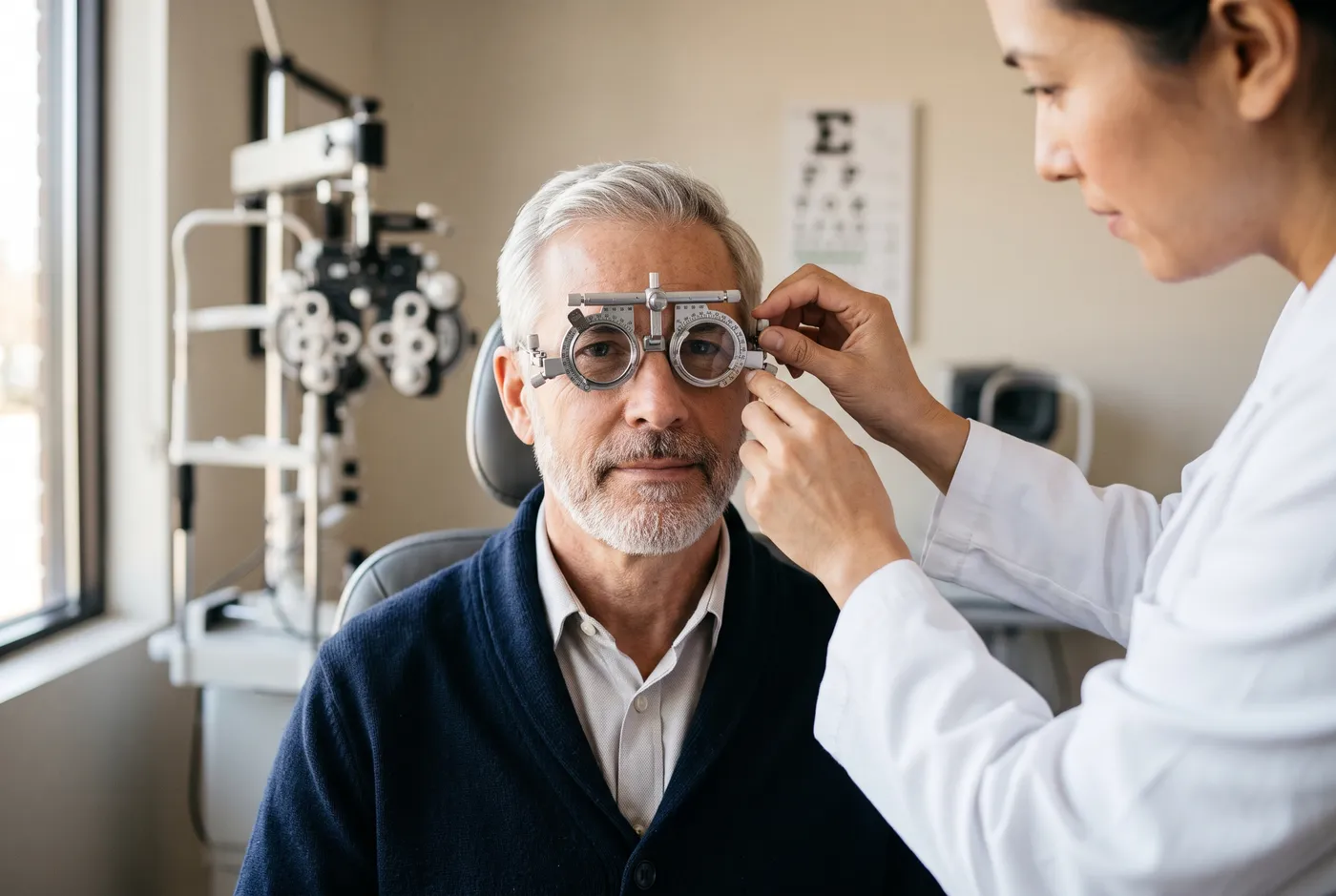
An optometrist adjusts a trial frame on a gray-haired man during a vision test. Realistic AI-generated image.
Most men over 50 only book an eye exam when the print gets small. The trouble is that the diseases that cost people their sight tend to start without any sign. Here is what the exam looks for and how to get ready for it.
Why do I need an eye exam after 50 if I see fine?
Because seeing fine and having healthy eyes are not the same thing. The NEI says many eye diseases have no symptoms or warning signs, so you could have a problem and not know it. It calls the dilated eye exam the only way to check for eye diseases early on, when they are easier to treat and before they cause vision loss.
The AAO lists four age-related conditions the doctor checks for in older adults: cataracts, diabetic retinopathy, age-related macular degeneration and glaucoma. The table shows how quietly they can start:
| Condition | Early symptoms | Later signs |
|---|---|---|
| Glaucoma | Often none | Loss of side vision, blind spots |
| Cataracts | None at first | Blurry or cloudy vision, faded colors, glare, halos, trouble seeing at night |
| Age-related macular degeneration (AMD) | None in the early stage | Blurry or wavy central vision, blank spots |
| Diabetic retinopathy | None at first | Blurry vision, dark floating spots or streaks |
The numbers explain why. The NEI says half of people with glaucoma do not even know they have it. It says more than half of all Americans age 80 or older have cataracts or have had surgery to get rid of them, and that 11 million people in the United States have AMD. It also says glaucoma usually costs side vision first, which happens so slowly that many people cannot tell at first.
The same pages carry the hopeful part. The NEI says early treatment of glaucoma can often stop the damage, that cataract surgery is safe and corrects the vision problems cataracts cause, and that early treatment of diabetic retinopathy can stop the damage and prevent blindness. All of that starts with finding the problem. If you are building a checkup routine, our list of men's health checkups after 50 is a good place to add the eyes.
How often should I get an eye exam after 50?
It depends on your risk, and the two main sources word it a little differently. The NEI says how often you need a dilated exam depends on your risk for eye disease and to talk to your doctor about what is right for you. The AAO says that if you are 65 or older, you should have your eyes checked every year or two. Both say to follow the schedule your own eye doctor gives you after an exam.
| If you... | How often | Source |
|---|---|---|
| You are over 60 | Every 1 to 2 years | NEI |
| You are 65 or older | Every year or two | AAO |
| You are African American and over 40 | Every 1 to 2 years | NEI |
| A parent, brother or sister had glaucoma | Every 1 to 2 years | NEI |
| You have diabetes or high blood pressure | Most people, at least once a year; ask your doctor | NEI |
Two of those rows tie to the numbers you already track. Diabetes and high blood pressure both put you on the yearly list, so our guides to blood sugar numbers and checking blood pressure at home cover the other half of the picture. The NEI also says diabetes makes you 2 to 5 times more likely to develop cataracts and nearly doubles your risk of open-angle glaucoma.
What does the eye doctor check during the exam?
Ten things, in roughly this order. The NEI and the AAO describe the same exam from two angles, and the table puts them together so you know what each step is for:
| Step | What happens | What it can show |
|---|---|---|
| Your history | Questions about your vision, general health, family history, medicines and glasses | Risk factors such as diabetes, high blood pressure or a family history of eye disease |
| Visual acuity | You read letters up close and far away, one eye at a time | How clearly you see |
| Your glasses prescription | You look at a chart through a device with different lenses | The best prescription for glasses or contacts |
| Pupil response | A small flashlight shows how your pupils react to light | A pupil that does not respond can point to an underlying problem |
| Side vision (visual field) | You say when you see objects off to the sides without moving your eyes | Loss of side vision, an early sign of glaucoma you cannot feel |
| Eye movement | You follow an object with your eyes | Problems with eye alignment or the muscles around the eyes |
| Eye pressure (tonometry) | A quick puff of air, or a gentle touch with a special tool | High eye pressure, one sign of glaucoma |
| The front of the eye (slit lamp) | A microscope with a bright light looks at the eyelids, cornea, iris and lens | Cataracts, scars or scratches on the cornea |
| Dilation | Drops widen the pupil so the doctor can look at the retina and optic nerve | Glaucoma, AMD and diabetic retinopathy |
| Extra imaging, if needed | For example OCT, which takes pictures of the inside of the eye | Changes at the back of the eye, such as in AMD |

Two details are worth knowing. First, the NEI says the eye pressure test does not hurt, and the AAO says the doctor may use numbing drops for it. Second, the NEI notes that some people with high eye pressure never get glaucoma, and that one type of glaucoma happens in people with normal eye pressure. That is why the side vision test and the look at the optic nerve matter as much as the pressure number.
What is dilation like, and can I drive afterward?
Dilation is simpler than it sounds. The doctor puts drops in your eyes to widen the pupils, then examines the retina and optic nerve for signs of damage. The NEI says that for a few hours afterward your vision may be blurry and you may be sensitive to light, so it suggests asking a friend or family member to drive you home and bringing your sunglasses. The AAO says a full exam usually takes 45 to 90 minutes, and that a staff member may do parts of it.
If everything looks healthy, the NEI says you are all set until your next exam, and suggests booking that appointment before you leave the office so you do not forget. In our opinion, that last tip is worth following, since an exam you never rebook is an exam you skip.
Which eye symptoms should not wait for the next exam?
The schedule above is for routine checks. Some signs call for a faster response, and the official sources are specific about them:
| Sign | What the sources say to do |
|---|---|
| Sudden intense eye pain with nausea, a red eye and blurry vision | Go to your doctor or an emergency room now (NEI, angle-closure glaucoma) |
| Straight lines look wavy or crooked | See your eye doctor right away (NEI, a warning sign of late AMD) |
| Sudden floaters, flashes or patterns of light | Call your ophthalmologist (AAO) |
| Dark floating spots or streaks like cobwebs, if you have diabetes | Get treatment right away, even if the spots clear up (NEI) |
| Eye infection, injury or eye pain | Call your ophthalmologist (AAO) |
Slower changes also deserve a call, even if they feel like normal aging. The NEI lists cloudy or blurry vision, faded colors, trouble seeing at night, lamps or headlights that seem too bright, halos around lights, double vision and needing a new glasses prescription often. It says to talk with your eye doctor if you have any of these, because they could also be signs of other eye problems.
What does Medicare cover for eye exams?
Less than most people expect. The Medicare.gov routine eye exams page says Original Medicare does not cover routine eye exams for eyeglasses or contact lenses (sometimes called eye refractions), and you pay all costs. What it does cover is tied to specific conditions:
| Service | Original Medicare | Details |
|---|---|---|
| Routine eye exam for glasses or contacts | Not covered | You pay all costs. |
| Glaucoma screening | Covered by Part B | Once every 12 months if you are at high risk: you have diabetes, a family history of glaucoma, you are African American and 50 or older, or you are Hispanic and 65 or older. After the deductible, 20% of the Medicare-approved amount. |
| Eye exam for diabetic retinopathy | Covered by Part B | Once a year if you have diabetes. After the deductible, 20% of the Medicare-approved amount. |
| Macular degeneration tests and treatment | May be covered by Part B | Certain diagnostic tests and treatments if you have AMD. In most cases, 20% after the deductible. |
| Glasses or contacts | Usually not covered | One pair with standard frames, or one set of contacts, after each cataract surgery that implants an intraocular lens. You pay 20% after the deductible, plus any upgrade. |
The Medicare.gov pages carry the same caution each time: your doctor may recommend services Medicare does not cover or offers too frequently, so ask why and what Medicare will actually cover. What you owe depends on other insurance you may have, what your doctor charges, whether your doctor accepts assignment, the type of facility and where you get the service. Ask the office before the visit which parts of the exam they will bill to Medicare.
Some Medicare Advantage Plans offer extra vision benefits that Original Medicare does not, according to Medicare.gov, and you need to contact the plan for details. If you are comparing plans right now, our Medicare versus Medicare Advantage basics and open enrollment 2026 guide explain how to read what each plan includes.
What should I bring and ask at the appointment?
A little preparation makes the visit shorter and the answers more useful. This checklist pulls the items the NEI, the AAO and Medicare.gov mention:
| Bring | Why |
|---|---|
| A list of your medicines | The AAO says the doctor will ask what you take. |
| Your family history of eye disease | The AAO lists it among the history questions, and the NEI ties glaucoma risk to it. |
| Your current glasses or contacts | The AAO says the doctor will ask whether you wear corrective lenses. |
| Sunglasses | Your eyes may be sensitive to light for a few hours after dilation, says the NEI. |
| A ride home | The NEI suggests asking a friend or family member to drive you, since vision may be blurry. |
| Time | The AAO says a comprehensive exam should not take more than 45 to 90 minutes. |
| Your insurance card and plan details | Medicare.gov says the amount you owe depends on things like other insurance, what your doctor charges and the type of facility. |
Then ask two things before you leave: what your own risk factors are, and when to come back. The AAO says your doctor can tell you how often you should have your eyes checked in the future, and that it is important to follow that schedule as you age. If your hearing is on your mind too, our guide to hearing loss after 50 covers that check.
What can I do for my eyes between exams?
The NEI says there is no way to prevent glaucoma, which is exactly why the exam matters. For the other conditions, it lists habits that may help:
- Cataracts: wear sunglasses and a brimmed hat, wear protective eyewear for power tools and some sports, quit smoking, and eat plenty of fruits, vegetables, leafy greens, nuts and whole grains.
- AMD: research suggests you may lower your risk, or slow vision loss, by quitting smoking, staying physically active, keeping blood pressure and cholesterol in a healthy range, and eating leafy green vegetables and fish.
- Diabetic retinopathy: managing your diabetes by staying active, eating healthy and taking your medicine can help prevent or delay vision loss.
Two of those lines point at numbers you can check at home or at your next visit: our guides to cholesterol numbers after 50 and blood pressure at home explain what to look for.
What is the bottom line?
A dilated eye exam every 1 to 2 years is the only way the NEI says to find glaucoma, cataracts and macular degeneration before they cost you vision, and the AAO says every year or two from 65. Original Medicare covers specific eye services but not the routine exam, so ask before you book. For a wider look at what else to schedule, start from the Men's Health Guide.
Frequently asked questions
How often should I get an eye exam after 50?
The NEI says to get a dilated eye exam every 1 to 2 years if you are over 60, are African American and over 40, or have a family history of glaucoma. The AAO says every year or two from age 65. With diabetes or high blood pressure, most people need one at least once a year, so ask your doctor what is right for you.
What does an eye doctor check during an eye exam?
The NEI lists a visual acuity test, a visual field test for side vision, an eye muscle test, a pupil response test, eye pressure (tonometry) and dilation to check the inside of the eye. The AAO adds your medical history, your glasses prescription and a slit-lamp look at the front of the eye.
Why do they put drops in my eyes?
The drops dilate, or widen, your pupil. The NEI compares it to opening a door to let light into a dark room. It lets the doctor see inside the eye to check for diabetic retinopathy, glaucoma and age-related macular degeneration.
Can I drive after a dilated eye exam?
The NEI says your vision may be blurry and you may be sensitive to light for a few hours afterward, and it suggests asking a friend or family member to drive you home. Bring sunglasses.
Can I have glaucoma, cataracts or macular degeneration without symptoms?
Yes. The NEI says early glaucoma usually has no symptoms (half of people with glaucoma do not know they have it), early cataracts may cause none, and early dry macular degeneration causes none. That is why the dilated exam is the way to find them early.
What eye symptoms should not wait for my next exam?
The NEI says sudden intense eye pain with nausea, a red eye and blurry vision needs a doctor or an emergency room now, and that straight lines looking wavy is a warning sign for late macular degeneration, so see your eye doctor right away. The AAO says to call your ophthalmologist about sudden floaters and flashes.
Does Medicare cover eye exams?
Original Medicare does not cover routine eye exams for glasses or contact lenses, says Medicare.gov. Part B does cover a glaucoma screening once every 12 months if you are at high risk, and an eye exam for diabetic retinopathy once a year if you have diabetes. After the Part B deductible you pay 20% of the Medicare-approved amount.
Does Medicare pay for glasses?
Usually not. Medicare.gov says Part B covers one pair of eyeglasses with standard frames, or one set of contact lenses, after each cataract surgery that implants an intraocular lens. Some Medicare Advantage Plans offer extra vision benefits, so ask your plan.
Sources we checked for this article
- NEI, NIH: Get a Dilated Eye Exam (last updated November 26, 2025)
- NEI, NIH: Glaucoma (last updated August 19, 2026)
- NEI, NIH: Cataracts (last updated August 19, 2026)
- NEI, NIH: Age-Related Macular Degeneration (AMD) (last updated June 22, 2021)
- NEI, NIH: Diabetic Retinopathy (last updated September 11, 2025)
- American Academy of Ophthalmology: Eye Exam and Vision Testing Basics (published February 14, 2024)
- Medicare.gov: Eye exams (routine) (read November 21, 2026)
- Medicare.gov: Glaucoma screenings (read November 21, 2026)
- Medicare.gov: Eye exams (for diabetes) (read November 21, 2026)
- Medicare.gov: Macular degeneration tests & treatment (read November 21, 2026)
- Medicare.gov: Eyeglasses & contact lenses (read November 21, 2026)