
Fitness & Food · Strength
Resistance Bands at Home: A 20-Minute Full-Body Routine for Men Over 50
By OakMan Guide Editorial Team Updated 7 min read
The short answer
A 20-minute band routine for men over 50 is six moves done in turn: a seated row, chest press, squat, glute bridge, shoulder pull-apart and trunk turn. Do one or two sets of 8 to 12 slow repetitions, twice a week, on days that are not back to back, as the NIA and HHS advise. Check the band for tears before every session.
We're not doctors, and this is not medical advice.
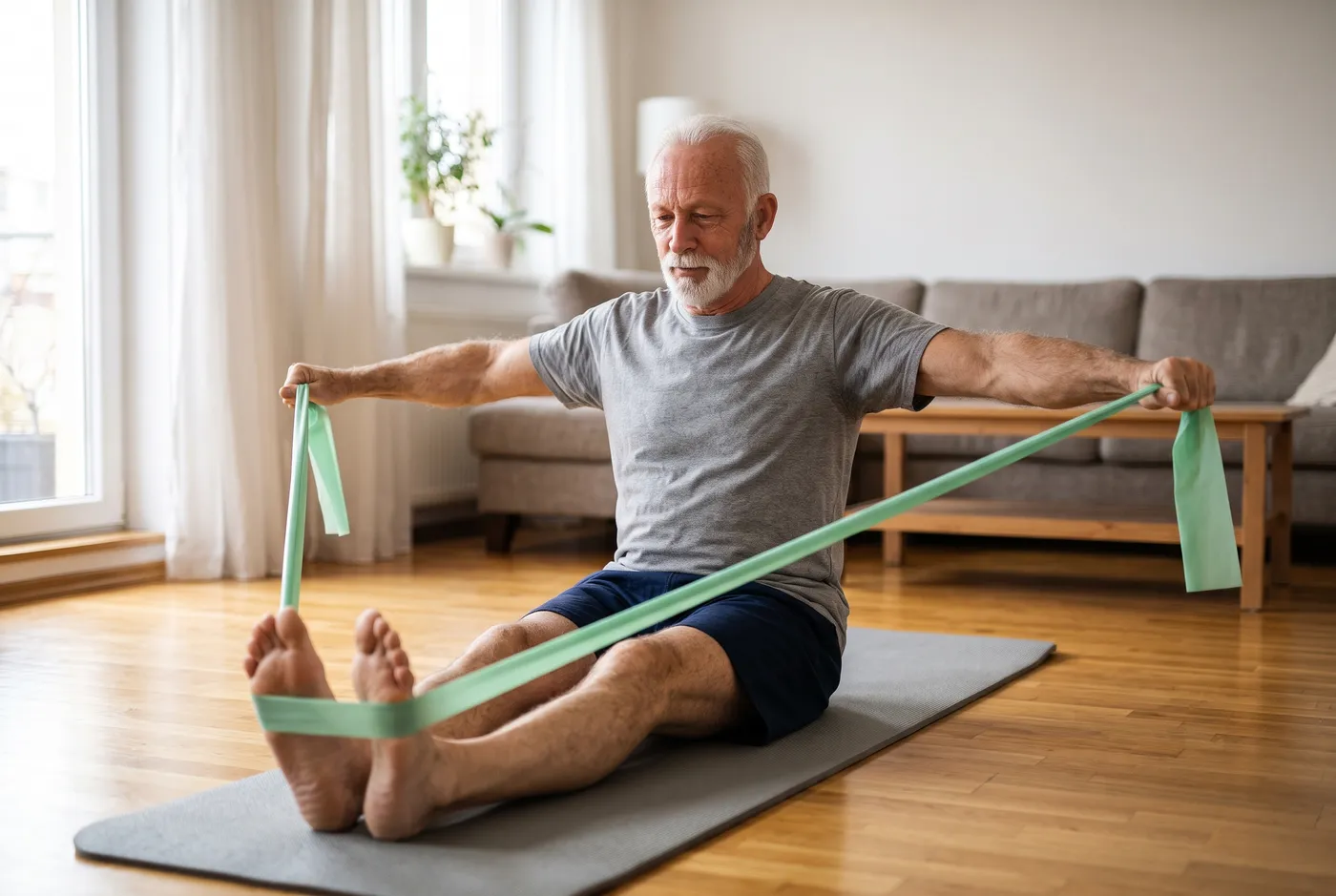
A man sits on an exercise mat with a resistance band looped around his feet. Realistic AI-generated image.
A resistance band weighs almost nothing, fits in a drawer and lets you train your whole body in the living room. Here is a 20-minute routine built around it: six moves, a simple clock and a clear way to make it harder as you get stronger.
Why use resistance bands after 50?
Because they count. The National Institute on Aging (NIA) lists using resistance bands among its examples of muscle-strengthening activities, and the HHS Physical Activity Guidelines for Americans list working with resistance bands in the same group as lifting weights and doing push-ups and planks. The HHS guidelines also say that muscle-strengthening can be done by using elastic bands for resistance.
The NIA says this kind of exercise helps with daily tasks, like standing up from a chair, taking the stairs or bringing in the groceries, and that it helps slow muscle loss and prevent falls. In our opinion, a band is one of the easiest ways to start, because the effort is easy to adjust and nothing heavy can drop on your foot. If you want the wider plan, our strength training starter plan covers the basics, and the Fitness & Food Guide shows where it fits in the week.
What do I need, and how do I check the band first?
Very little: a band, a mat or carpet, a sturdy chair and a fixed object to anchor the band to for the last move. The NIA notes that resistance bands come in varying strengths, and that beginners can try the exercises without bands until they are comfortable with the movements. That is why week 1 below starts light.
Before each session, run through the checks from a hospital physiotherapy leaflet on resistance bands, written for patients of a UK hospital:
- Look for flaws. Examine the band for small tears or punctures that may cause it to break. If you find any, replace the band.
- Anchor it. Make sure the band is securely anchored to a sturdy object before you begin, and that you have a good grip on it.
- Keep it away from your eyes. Do not do any exercise with the band near or level with your eyes, so it cannot snap back into them.
- Check for latex. The leaflet says a band may contain natural latex, which can cause an allergic reaction. If you are allergic to latex, do not use the band.
- Store it well. Keep the band at room temperature, out of direct sunlight and away from extreme heat such as radiators.
What does the 20-minute routine look like?
The clock below is our own way to fit six moves into 20 minutes. It is not an official program. The NIA and HHS say what a good session needs: all the major muscle groups (legs, hips, chest, back, abdomen, shoulders and arms), at least a moderate effort, and a warm-up with lighter or no weight.
| When | Part | What to do |
|---|---|---|
| Minutes 0 to 3 | Warm-up | Walk or march in place at an easy pace. Then do your first few repetitions of each move with no band or a very light one. |
| Minutes 3 to 18 | Six moves | About 2.5 minutes for each move: 2 sets of 8 to 12 slow repetitions with a short break between sets. In week 1, do just 1 set. |
| Minutes 18 to 20 | Cool-down | Slow walking, then easy stretches for the muscles you just worked. Breathe, and do not stretch so far that it hurts. |
The six moves in the next section cover every muscle group on that list, so one session works the whole body.
What are the six moves?
The NIA and HHS name resistance bands and the muscle groups to work, but they do not prescribe specific moves. Choosing these six is our own call. Each uses one band and works a different part of the body.
| Move | Works | Set-up |
|---|---|---|
| 1. Seated row | Back, arms | Seated on the floor, band around both feet. Draw your hands back to your waist. |
| 2. Chest press | Chest, shoulders, arms | Band across your upper back, an end in each hand at chest height. Press forward. |
| 3. Band squat | Legs, hips | Stand on the middle of the band with the ends at your shoulders. Sit back toward a chair, then stand. |
| 4. Glute bridge | Hips, lower back | Lie on your back with the band just above your knees. Lift your hips and lower them. |
| 5. Pull-apart | Shoulders, upper back | Hold the band in front of your chest with both hands. Pull your hands apart to the sides. |
| 6. Trunk turn | Abdomen, shoulders | Band anchored at chest height. Stand sideways to it and turn your arms slowly away. |
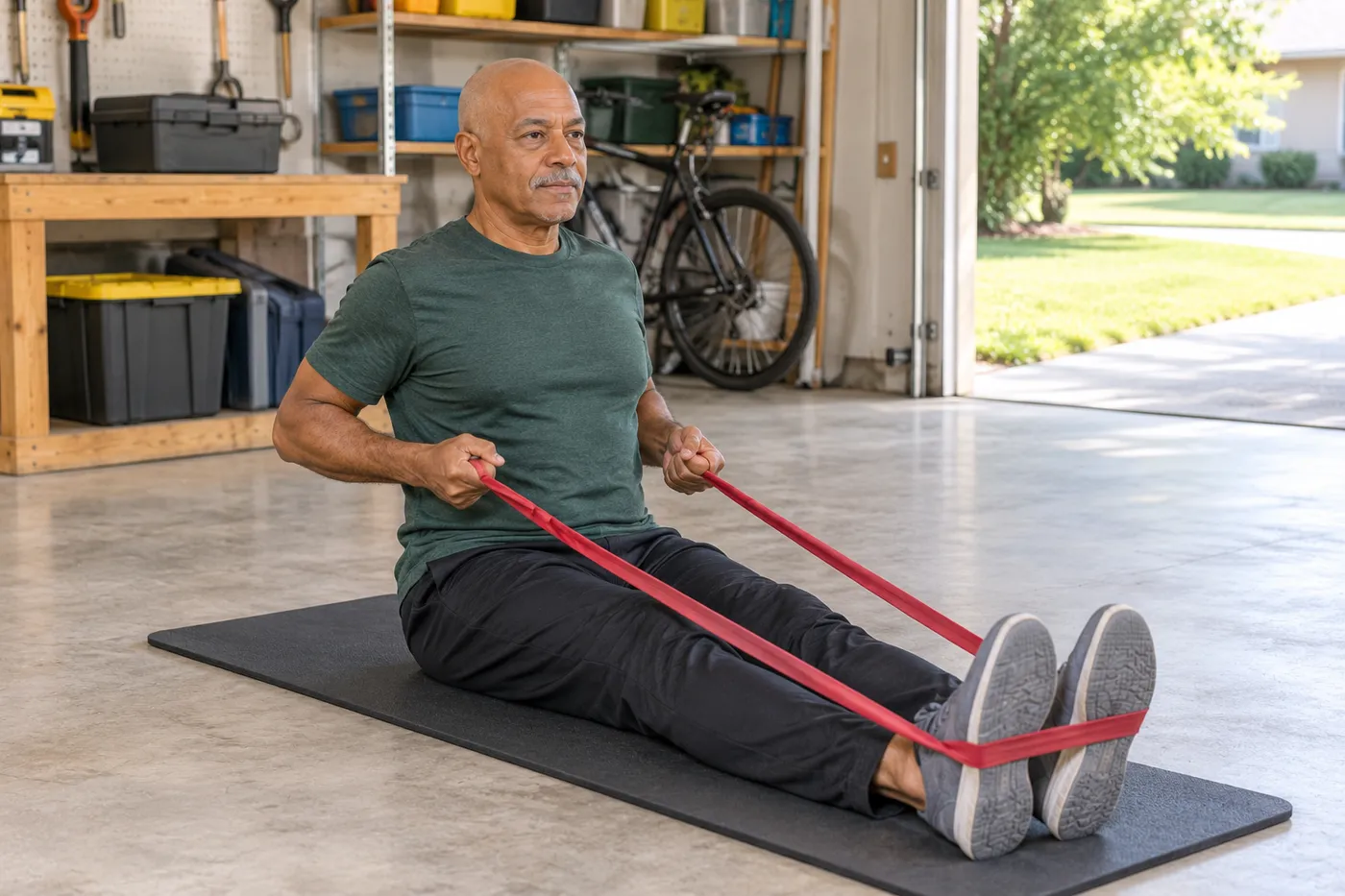
A few cues, ours and kept simple:
- Seated row. Sit tall, loop the band around both feet and take an end in each hand. Draw your elbows back so your hands travel to your waist, then ease forward again without letting the band snap.
- Chest press. Pass the band across your upper back, under your arms, with an end in each hand. Press your hands forward until your arms are almost straight, without locking the elbows, then return slowly.
- Band squat. Stand on the middle of the band with your feet shoulder-width apart and hold the ends at your shoulders. Sit back toward a chair, touch it lightly and stand up. Use the chair as often as you need.
- Glute bridge. Lie face up with your knees bent, feet flat and the band sitting just above your knees. Push through your heels to raise your hips, keep your knees from drifting inward, and lower them in a smooth motion.
- Pull-apart. Hold the band in front of your chest, below eye level, with both hands. Pull your hands apart to your sides and let them come back together slowly.
- Trunk turn. Anchor the band securely at chest height. Stand sideways to it, hold the band in both hands at your chest and turn your arms slowly away from the anchor, then back. Keep your feet planted.
Move slowly and smoothly, and let the band return under control. If a move is hard on your shoulder or back, Joint and muscle aches after 50 explains which aches are common and which are worth a mention at your next appointment.
How do I progress over four weeks?
Both the NIA and HHS say strength builds when you slowly add resistance, sets, repetitions or training days. For a beginner, the HHS guidelines describe starting at a single day a week with a light or moderate effort and growing to 2 days, then perhaps more. With a band, adding resistance means a thicker band or more stretch. Our four-week example puts that into a calendar.
| When | Days | Sets and repetitions | Band and effort |
|---|---|---|---|
| Week 1 | 1 day | 1 set of 8 to 12 | The lightest band, or no band. Learn the six moves. |
| Week 2 | 2 days (for example Mon and Thu) | 1 set of 8 to 12 | Light band. Keep the form slow and smooth. |
| Weeks 3 and 4 | 2 days | 2 sets of 8 to 12 | The full 20-minute routine. The last repetitions should feel hard. |
| After week 4 | 2 or 3 days, never back to back | 2 or 3 sets of 8 to 12 | When 12 clean repetitions feel easy, step up to a thicker band or give the band more stretch. |
The NIA warns against training the same muscles on consecutive days, so leave a gap between sessions. Use that gap for walking: the HHS guidelines treat aerobic activity as its own goal, and strength work generally does not count toward it. Our guide to walking after 50 covers that side, and protein after 50 covers eating for the muscle you are building.
How do I stay safe while I train?
The NIA's muscle-strengthening safety tips fit every band move here. Overdoing it can mean exhaustion, painful joints or a pulled muscle, so match the effort to what your body allows. Start with the lightest resistance or none, breathe out as you pull or press and in as you return, and keep your elbows and knees slightly soft instead of locking them straight. If a movement worries you, the NIA says to ask your health care provider, and it suggests a session or two with a trainer or a group class to learn form.
The hospital leaflet adds that you should stop right away if you feel sharp pain, shortness of breath, dizziness or light-headedness while using the band. It also says that muscle soreness is common in the first few days, and that if pain persists you should stop using the band and consult your physiotherapist. Balance is part of staying steady on your feet too, and our balance exercises and fall-proofing checklist pair well with this routine.
Should I check with my doctor first?
For older adults with no injury or chronic condition who build up gradually, the NIA says a doctor visit is generally not needed before becoming more active. With a chronic condition, it says to talk with a doctor about how that condition may affect your activity. With high blood pressure, it adds that adjustments to blood pressure medication may be needed as you become more active, so work with your health care provider. Our guide to blood pressure at home after 50 can help you keep track of your numbers, and our checkups guide has a list of topics to bring to your next visit.
How do I get started this week?
- Check the band. Run through the five checks above, from tears to latex to eye level.
- Pick your days. One session this week, two next week, with a gap between them.
- Do one set of each move. Use the lightest band, or none, and keep every repetition slow.
- Keep a short log. A line with the date, the band you used and how it felt makes the next step obvious.
That is the whole routine. Keep it modest at first: a session you can repeat every week does more than an ambitious one you drop after ten days.
Frequently asked questions
Do resistance bands count as strength training after 50?
Yes. The National Institute on Aging (NIA) and the HHS Physical Activity Guidelines both list using resistance bands as a muscle-strengthening activity, next to hand-held weights, machines and body-weight moves such as push-ups and planks.
How often should I do a band workout?
Twice a week or more, covering the major muscle groups, per the NIA and HHS. The NIA also advises against training the same muscles on back-to-back days, which makes a full-body routine on Monday and Thursday, for example, a natural fit.
How many sets and repetitions should I do with a band?
Both sources call a single set of 8 to 12 repetitions effective, and say 2 or 3 sets may work better. Aim for an effort where another repetition would be hard. If you are new to this, begin with one set.
Which band strength should I start with?
The NIA notes that resistance bands come in varying strengths, and that beginners can try the exercises without bands until the movements feel comfortable. In our opinion, the lightest band is the right first one, because you can move to a thicker band later without losing form.
How do I check a band before using it?
A UK hospital physiotherapy leaflet says to examine the band before each use for small tears or punctures, and to replace it if you find any flaws. It also says to anchor the band securely to a sturdy object and to keep it away from eye level so it cannot snap back into the eyes.
Can I do band exercises if I have high blood pressure or another condition?
The NIA says that if you have no injury or chronic condition and build up gradually, you generally do not need a doctor visit first. With a chronic condition, it says to talk with a doctor. For high blood pressure, it adds that adjustments to blood pressure medication may be needed as you become more active, so work with your health care provider.
Do band workouts replace walking?
No. The HHS guidelines say that, in general, muscle-strengthening activities do not count toward the aerobic goal of 150 to 300 minutes of moderate-intensity activity a week. The two work side by side, and walks fit well on the days between band sessions.
Sources we checked for this article
- NIA (NIH): Exercise and Physical Activity for Older Adults: Staying Active as You Age (booklet, March 2025)
- HHS: Physical Activity Guidelines for Americans, 2nd edition (PDF, read November 19, 2026)
- West Hertfordshire Teaching Hospitals NHS Trust: Resistance Bands (physiotherapy patient information leaflet) (ratified October 2024)