
Home & DIY · Ladder Safety
Ladder Safety After 50: Hanging Holiday Lights and Cleaning Gutters
By OakMan Guide Editorial Team Updated 8 min read
The short answer
Set the ladder on firm, level ground, face it and keep three points of contact, two hands and a foot or two feet and a hand. Never stand on the top rung, keep your belly button between the rails and move the ladder instead of reaching. Stay far from power lines, ask someone to hold the base and skip the climb if you feel dizzy or tired.
We're not doctors, and this is not medical advice.
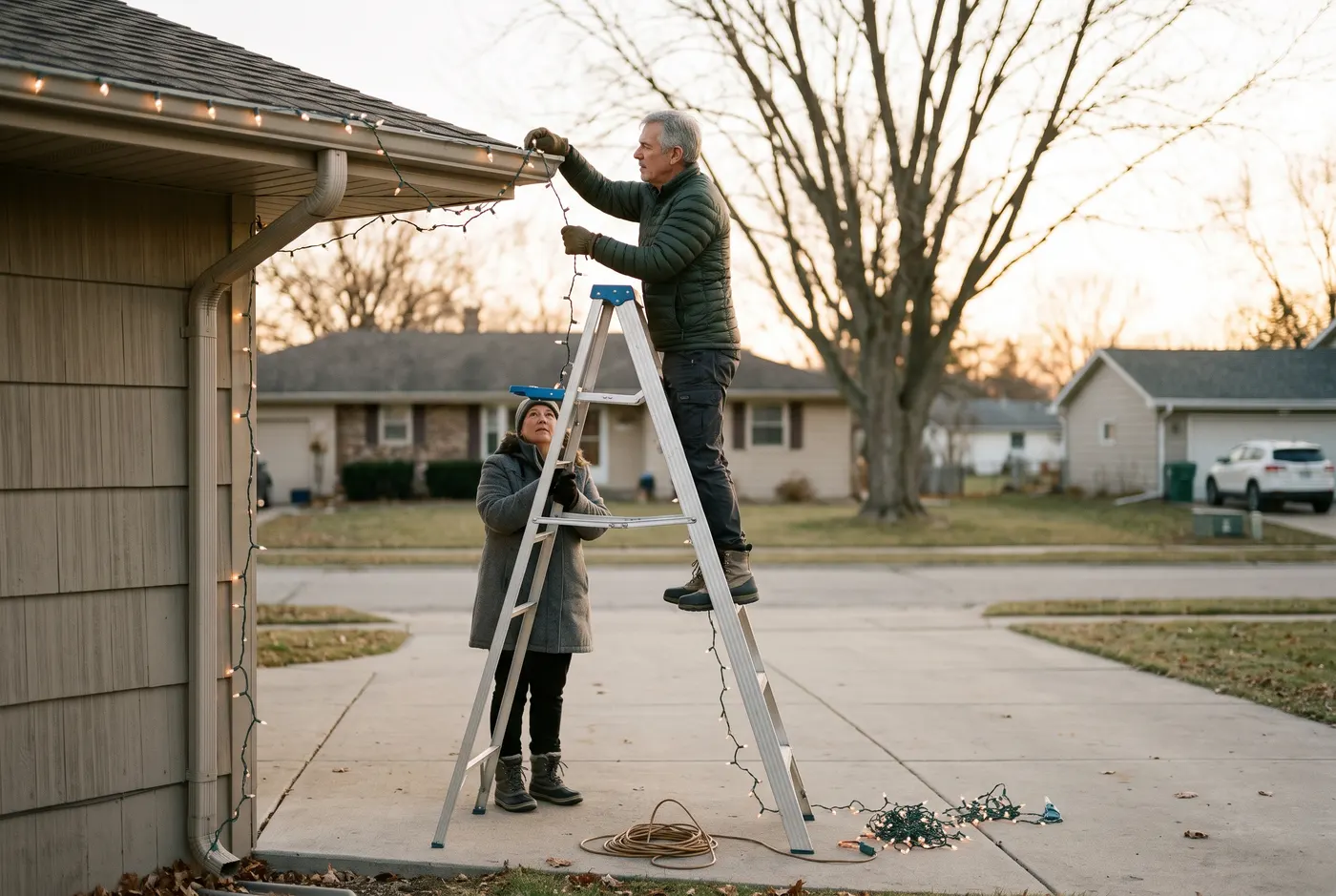
A man on a stepladder fixes a string of lights along a roof edge at dusk while a woman holds the ladder. Realistic AI-generated image.
In its outdoor repair checklist, the CPSC says adults 65 and older are 80% more likely than other adults to end up in an emergency room with an injury involving a ladder or stool. Lights and gutters put many of us on a ladder in the same few weeks, so here is how to do both with less risk.
Why does ladder safety matter more after 50?
The CPSC lists ladder falls first among the risks of outdoor home repairs. It says falls from ladders can cause injuries ranging from bruises to fractures and even death, and that if you are a senior you should use extra caution. The AAOS page, which quotes CPSC data, counts more than 580,000 ladder-related injuries requiring medical treatment in 2018.
NIOSH, the federal agency for workplace safety, says more than 100 people die each year in the U.S. from ladder-related falls, and that individual ladder users, homeowners included, do not typically receive the training for safe use of extension ladders and stepladders. Holiday decorating adds to the count. A CPSC release estimated 14,700 holiday decorating injuries treated in emergency rooms during November and December of 2016, with falls the most frequent type at 41%, and 3 deaths involving ladder falls. Those are older figures, but the jobs have not changed.
None of this means you should stop climbing. It means a few minutes of setup should come before the first rung.
Which ladder should I use, and what should I check first?
NIOSH says to match the ladder to the job. It should be tall enough that you are not stretching, because a ladder that is too short leads to overreaching and instability. It should also have a duty rating, the maximum weight it is built to carry, that covers your weight plus your tools and anything you carry. The AAOS adds that a low stepladder is usually enough inside the house, while outside chores may call for a taller stepladder or an extension ladder.
Then inspect it. The AAOS says never to use a ladder that is damaged, broken or bent, to check for loose screws, hinges or rungs, and to clean off mud, grease, oil or snow. It also says not to patch a broken or missing part, because the repair could fail when you are high off the ground. NIOSH suggests tagging a defective ladder with a Do Not Use note so no one grabs it by mistake.
| Check | What to look for |
|---|---|
| Height | Tall enough to reach without stretching; a short ladder leads to overreaching |
| Weight rating | Covers your weight plus tools, lights and anything you carry |
| Condition | No missing rungs, bolts or screws, no bends; mud, snow and grease cleaned off |
| Ground | Firm and level; a flat board under a foot if it is soft or uneven |
| Angle | 1 foot out for every 4 feet up; stepladder fully open and locked |
| Wires | Look up first; assume every overhead wire is live |
| Helper | Someone to hold the base and to call for help |
How do I set the ladder up safely?
- Firm, level ground. The AAOS points out that the ground outside can turn bumpy after winter freezing and thawing, or stay soft and muddy. The CPSC suggests a flat piece of wood under one or both feet on uneven or soft ground, and tying off the ladder if possible.
- The 4-to-1 rule. For every 4 feet of height, set the base 1 foot from the wall. NIOSH gives the same rule and says it comes to an angle of about 75 degrees. Its free Ladder Safety app has an angle indicator if you want a check.
- Above the roof edge. If you climb onto a roof, NIOSH says an extension ladder should reach at least 3 feet above the roof or structure edge.
- Stepladders fully open. The spreaders must be fully extended and locked, says the AAOS, and NIOSH adds that all four feet must be in contact with the ground. Never set a stepladder on boxes or a countertop for extra height.
- Nothing breakable behind the top. NIOSH says not to rest the top of a ladder against anything breakable or movable, such as a window. In our opinion, the same caution fits a thin gutter that can bend.
- Clear the area. NIOSH suggests a low-traffic spot, or barriers, so no one bumps the ladder. The CPSC says no one, pets included, should walk underneath.
How do I keep a ladder away from power lines?
This is the hazard that gutter work and light hanging share. The CPSC says consumers use ladders near overhead wires to clean gutters, paint, trim trees and repair roofs, that many overhead power lines are not insulated, and that it knows of 15 non-work electrocution deaths between 2000 and 2009 when a ladder touched a wire around the home.
- Look up first. Check every overhead wire, including the line from the street to your house. The CPSC says to assume all overhead wires carry electricity, and that a coating on a line is not meant to protect against electrocution.
- Keep your distance. NIOSH says at least 10 feet from power lines. The CPSC says the distance to the nearest line should be at least twice the length of the ladder, so a 20-foot ladder stays 40 feet away. Taking the larger of the two is simple.
- Choose the material. The CPSC advises a ladder that does not conduct electricity, such as fiberglass with non-conductive side rails, near overhead wires. Metal ladders, and wood ladders with metal reinforcement wire, can conduct electricity.
- Carry it low. Lower the ladder when you move it, and get help with a long one.
- Skip windy days. A gust can shift the ladder into a line, the CPSC warns.
If a ladder touches a power line
The CPSC says to let go of the ladder if it starts to fall into an overhead line, and never try to move it. Do not leave it unattended, and have someone call the power company to cut off the line before anyone moves the ladder. Never pull a person away from a ladder in contact with a line using your hands.
How should I climb and work on the ladder?
- Wear the right shoes. The AAOS says lace-up shoes or boots with clean soles, tied securely, and no sandals, flip-flops or leather soles.
- Face the ladder, stay centered. The AAOS says to stay in the center of the rails and grip both rails while climbing.
- Keep three points of contact. NIOSH says two hands and a foot, or two feet and a hand, are touching the ladder at all times. That means both hands are free, so nothing goes up in your hands.
- Mind the last step. NIOSH notes that a common fall happens on the way down, when people think the floor is about to arrive and it is still a full rung away.
- Move the ladder, do not stretch. The AAOS says leaning too far to one side or reaching too far overhead can throw you off balance, and that your belly button should not go beyond the sides of the ladder.
- Respect the top. Never stand on the top rung or the pail shelf. NIOSH sets the limit at the second highest step on a stepladder and the fourth highest rung on an extension ladder. The AAOS draws the extension line one rung higher, at the third from the top. In our opinion, the lower limit is the one to follow.
- One person at a time, and never use the ladder as a seat.
For the carrying part, NIOSH suggests lowering and raising items in a container or basket while a helper steadies the ladder, or using a shoulder bag or backpack if you are alone.
How do I hang holiday lights more safely?
The lights themselves need as much attention as the ladder. The CPSC suggests this list for the strings and cords:
- Use only lights tested by a nationally recognized testing laboratory.
- Check each set, new or old, for broken or cracked sockets, frayed or bare wires and loose connections, and throw out damaged sets.
- Check outdoor lights for a label showing they are certified for outdoor use.
- Plug them only into a GFCI-protected receptacle or a portable GFCI.
- Make sure each extension cord is rated for the intended use and has no cuts or fraying.
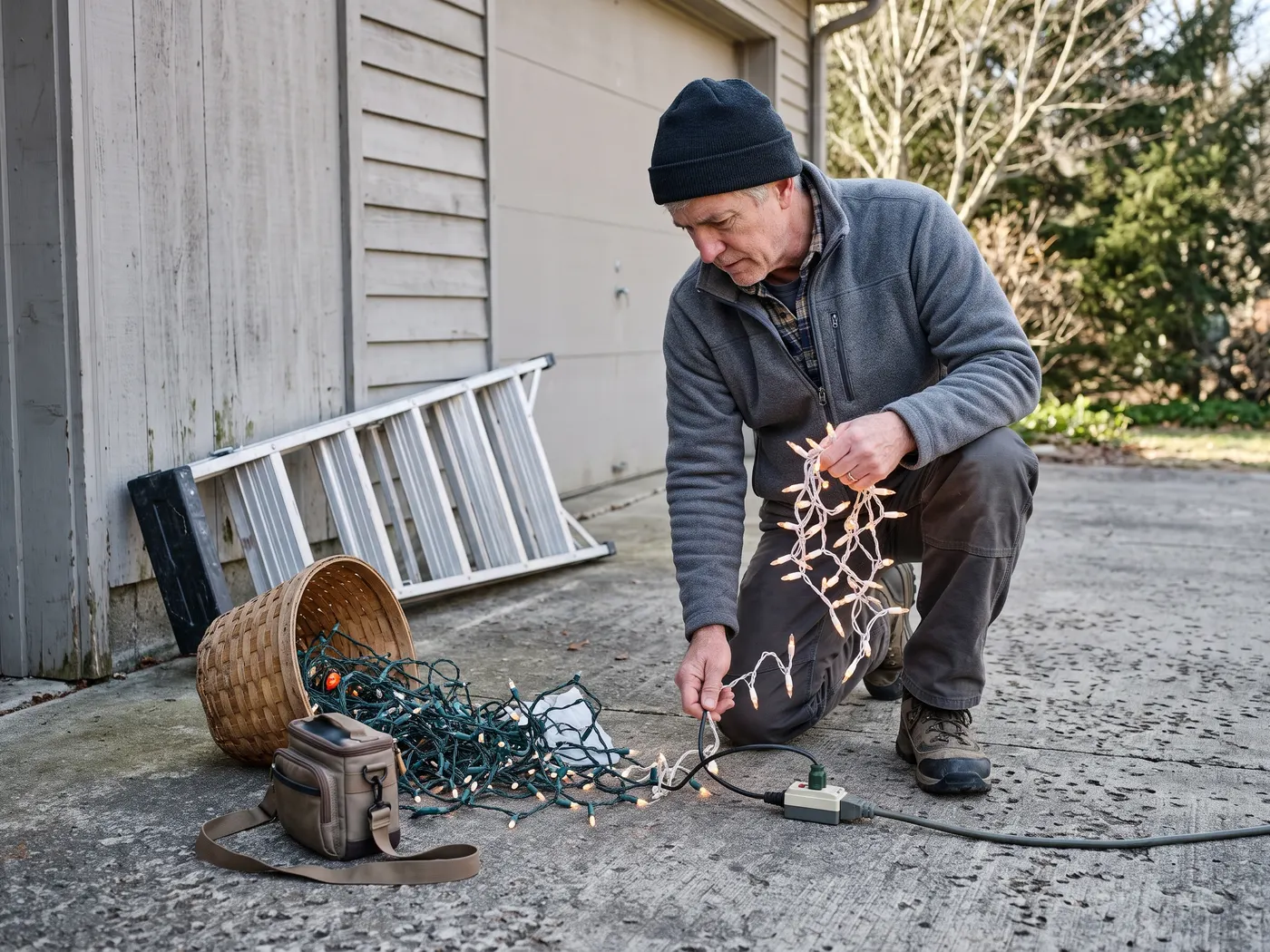
Most of that can be done on the ground, before you climb. In our opinion, testing every string on the driveway, then hanging it in short sections from a ladder that you move along the wall, is a much safer job than one long stretch from a single spot. If the plan needs more than a stepladder, or a ladder leaned against a roof edge or an upper floor, hiring someone is a reasonable choice. And a chair is never a substitute: our fall-proofing guide explains why.
How do I clean gutters without a fall?
The CPSC names gutter cleaning among the ladder jobs where it wants a helper holding the bottom of the ladder and the ladder positioned away from power lines. A gutter job has a few extra traps, and the AAOS and NIOSH cover most of them:
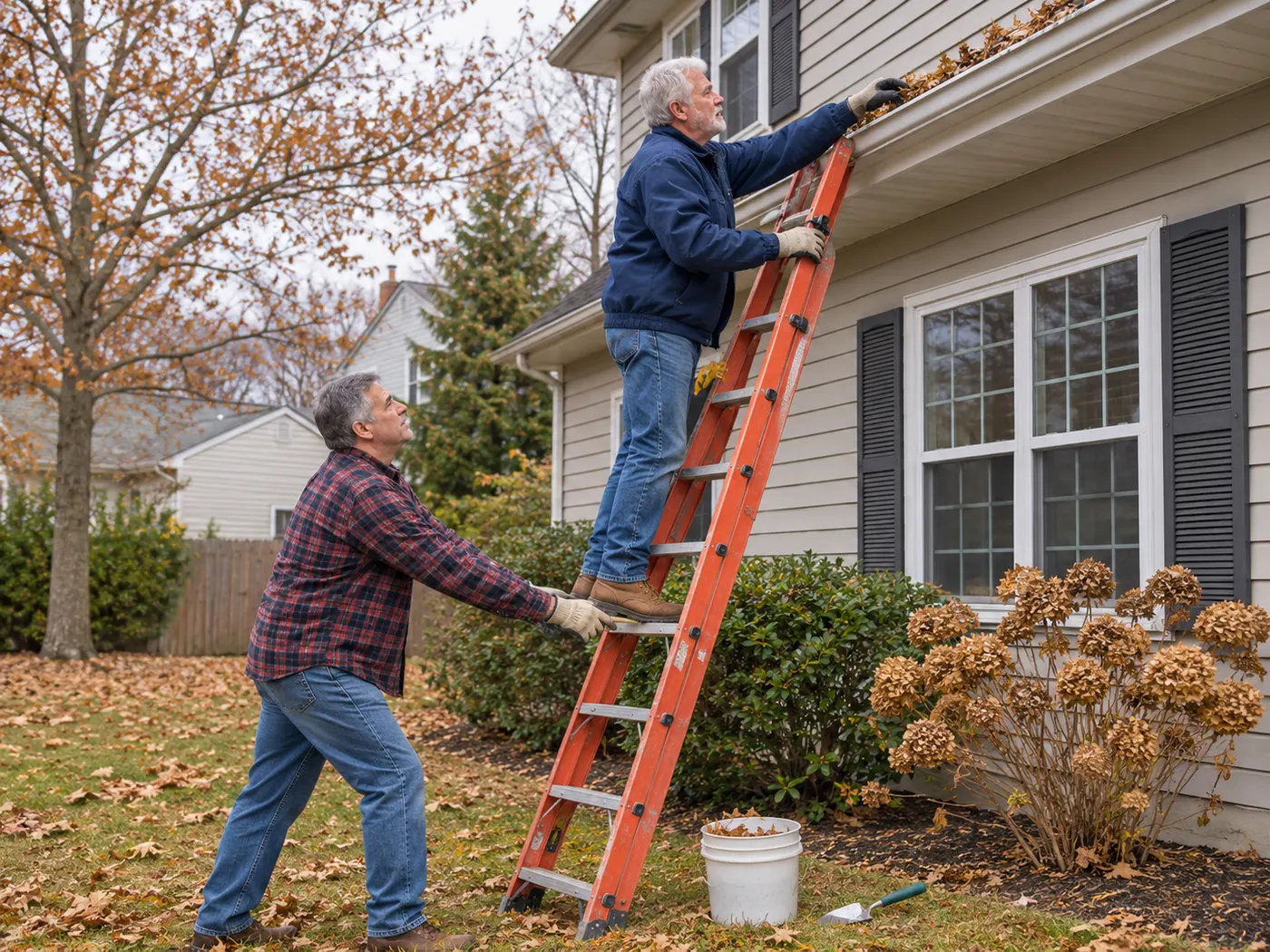
- Move along the house. Gutters invite sideways reaching, and the sideways reach is what the AAOS says can throw you off balance. In our opinion, the habit to build is to climb down and shift the ladder every arm's length or so.
- Check the ground after bad weather. The AAOS says outside ground can be bumpy or soft after freeze-thaw cycles, so check that the ladder is level even in a spot you used last month.
- Clean the rungs and your boots. The AAOS says to clean mud, grease, oil, snow and other slippery liquids off the ladder, and to keep the soles of your shoes clean too.
- Mind the wires. The CPSC names gutter cleaning as one of the jobs that brings a ladder near overhead wires. Check before you set the ladder, not after.
- Pick the day. The AAOS says never to use a ladder in high winds, and the CPSC says no wind near overhead wires.
Winter weather adds its own list, from clearing snow to heating, in our winterize your home checklist and our snow shoveling guide.
When should I skip the climb?
The AAOS lists the conditions: do not use a ladder if you tire easily, are subject to fainting spells, or are taking medications or drinking alcohol that may make you dizzy or drowsy. Two more reasons to wait: high winds, and ground that is not firm and level.
Skipping is not failing. A neighbor, a family member or a hired helper can do the high part while you hold the base. Better balance helps for the jobs you keep, and our guide to balance exercises for men over 50 is a simple place to begin.
What if I do fall?
The AAOS gives a short sequence. If you are conscious, stay calm and check whether you are hurt. If you can, get up slowly, and if you start to feel intense pain, weakness or dizziness, sit or lie back down. If an injury stops you from standing or walking, call for help, and call 911 if it is serious. If you are not hurt, rest and recover your composure before you climb again. Our fall-proofing guide covers what the CDC says about hitting your head, which is worth reading before a day on the ladder.
What does a safe ladder job look like from start to finish?
- Pick a calm, dry day and a time when someone can hold the ladder.
- Inspect the ladder, and look up for wires before you set it down.
- Test every light string on the ground and throw out the damaged ones.
- Set the base at 1 foot out for every 4 feet up on firm, level ground.
- Climb with empty hands, move the ladder instead of stretching, and stay below the top.
- Use the ladder for one more job: with it already out, check the ceiling alarms, as our alarm guide explains.
The cold-weather jobs that follow are in our space heater guide and frozen pipes guide, and the full seasonal list is in the Home and DIY guide.
Frequently asked questions
How far from the wall should the base of a ladder be?
NIOSH and the AAOS both give the 4-to-1 rule: for every 4 feet of height the ladder reaches, move the base 1 foot away from the wall. A ladder that touches the wall at 16 feet should have its feet 4 feet out. NIOSH adds that this works out to an angle of about 75 degrees.
How high can I stand on a ladder?
Not on the top. NIOSH says never to step above the second highest step of a stepladder or the fourth highest rung of an extension ladder. The AAOS says never to stand on the top rung of any ladder and puts the limit on an extension ladder at the third rung from the top. The lower limit is the safer one.
Can I carry the lights up the ladder?
Not in your hands. NIOSH says three points of contact are needed at all times, which is only possible with both hands free. It suggests lowering and raising items in a container or basket with a helper, or using a shoulder bag or backpack when no one is available.
How close can a ladder be to a power line?
NIOSH says to stay at least 10 feet away from power lines. The CPSC says the distance to the nearest overhead line should be at least twice the length of the ladder, and it advises treating every overhead wire as live, including the line from the street to the house.
Do I really need someone to hold the ladder?
Yes, according to the CPSC and the AAOS. The CPSC suggests a helper who holds the bottom of the ladder, and the AAOS says never to climb without someone nearby to spot you. Keep people and pets from walking underneath.
Are outdoor Christmas lights safe to plug in anywhere?
No. The CPSC says to use lights tested by a nationally recognized testing laboratory, to check outdoor lights for a label showing they are certified for outdoor use, and to plug them only into a GFCI-protected receptacle or a portable GFCI. Throw out sets with cracked sockets or frayed wires.
What shoes should I wear on a ladder?
The AAOS says lace-up shoes or boots with clean soles, tied securely, with pant legs that do not extend under the shoes. Skip sandals, flip-flops and leather soles, which can be slippery.
When should I not climb a ladder at all?
The AAOS says not to use a ladder if you tire easily, are subject to fainting spells, or are taking medications or drinking alcohol that may make you dizzy or drowsy. It also says never to use a ladder in high winds.
What should I do if I fall off a ladder?
The AAOS says to stay calm and check yourself, get up slowly if you can, and sit or lie back down if you feel intense pain, weakness or dizziness. If an injury keeps you from standing or walking, call for help, and call 911 if it is serious.
Sources we checked for this article
- U.S. Consumer Product Safety Commission: Home Safe, Outdoor Repairs (read November 20, 2026)
- U.S. Consumer Product Safety Commission: Ladders and Electricity Don't Mix (Publication 5060) (read November 20, 2026)
- U.S. Consumer Product Safety Commission: Put Safety at the Top of Your List When Decorating this Holiday Season (release dated December 6, 2017, covering the 2016 season, read November 20, 2026)
- CDC/NIOSH: Falls from ladders are preventable, make ladder safety a priority (last reviewed March 1, 2024, read November 20, 2026)
- CDC/NIOSH: Ladder Safety in the Wholesale and Retail Trade Sector, Take the Right Steps towards Safety (June 28, 2017, read November 20, 2026)
- American Academy of Orthopaedic Surgeons, OrthoInfo: Ladder Safety Guide (read November 20, 2026)