
Men's Health · Sleep
Sleep Apnea in Men Over 50: Snoring, Pauses and When to Get Checked
By OakMan Guide Editorial Team Updated 8 min read
The short answer
Sleep apnea is common in men over 50, and the signs are usually loud snoring, pauses in breathing or gasping that someone else notices, plus heavy sleepiness in the daytime. The NHLBI says to talk to your healthcare provider if you have them. A sleep study, which can sometimes be done at home, is how it is diagnosed, and untreated it raises the risk of stroke and heart attack.
We're not doctors, and this is not medical advice. Everything below comes from the official sources listed at the end, and what your own sleep needs is a question for your doctor.
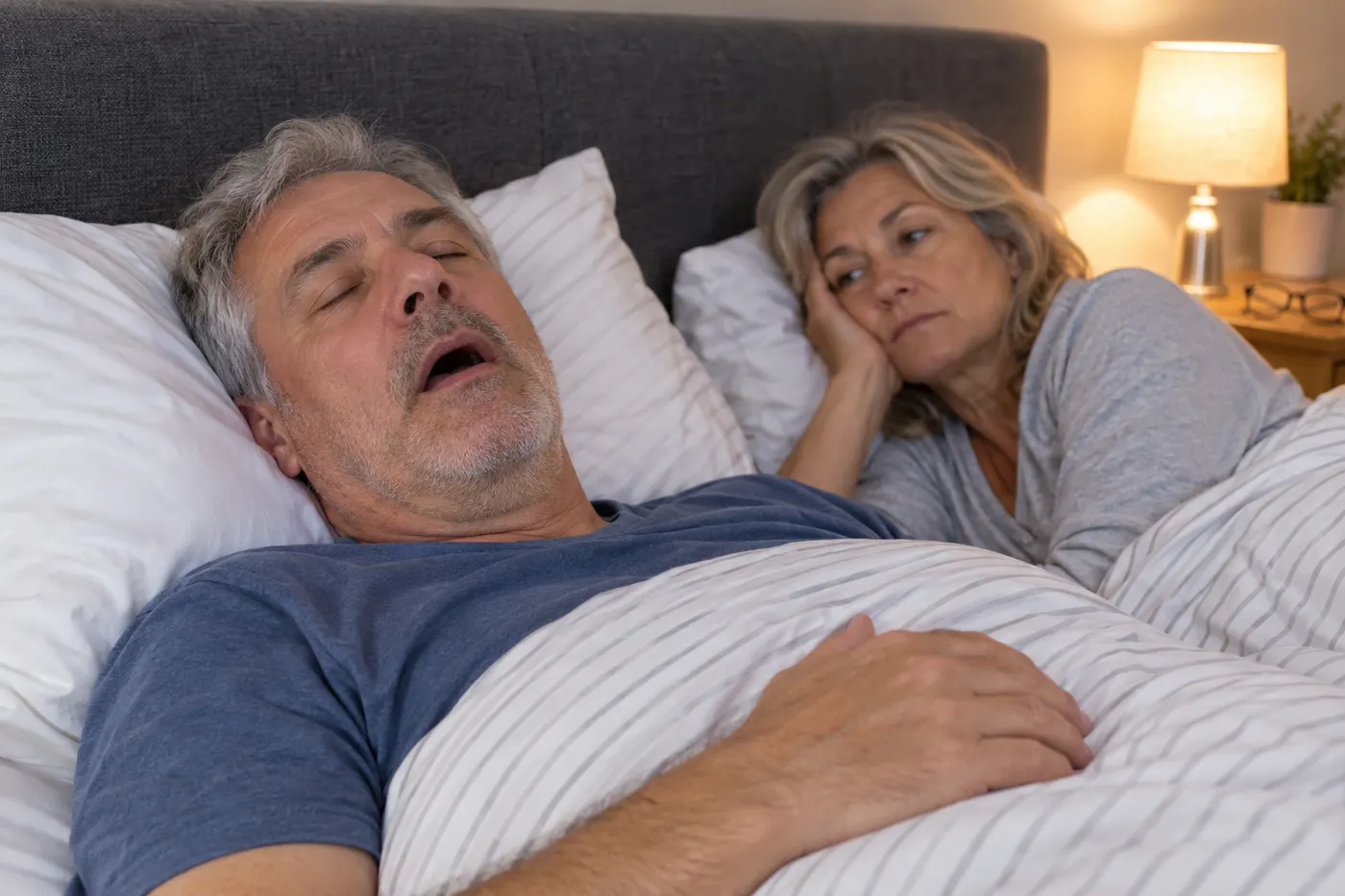
A man sleeps on his back with his mouth open while his partner watches with a tired look. Realistic AI-generated image.
The first person to notice sleep apnea is often the one who shares your bedroom. They hear the snoring and the silences, while you only feel the tiredness. Here is what the official sources say to look for and what comes next.
What is sleep apnea, and why does it matter after 50?
Sleep apnea, says the NHLBI, is a common condition in which your breathing stops and restarts many times while you sleep, which can keep your body from getting enough oxygen. The most common kind is obstructive sleep apnea, which happens when the upper airway becomes blocked many times during the night. The blockage can reduce or completely stop airflow. A second kind, central sleep apnea, happens when the brain does not send the signals needed to breathe.
It matters because of what happens over time. The NHLBI says untreated sleep apnea can lead to trouble concentrating, making decisions and remembering things, and increases the risk for stroke, heart attack and other serious problems. If you already track your numbers, our guides to checking blood pressure at home and erections and heart health cover two of the same risks from another side.
What are the signs of sleep apnea?
The NHLBI symptom list splits the signs in two. Some happen while you sleep, and you will probably not know about them unless someone tells you. Others you may notice yourself during the day and night:
| Sign | Who usually notices | What the NHLBI says |
|---|---|---|
| Breathing that starts and stops | Usually someone else | The NHLBI lists it first. Breathing stops and restarts many times during sleep. |
| Frequent loud snoring | Usually someone else | More common in men, says the NHLBI. |
| Gasping for air | Usually someone else | You may not know about any of these three until someone tells you. |
| Daytime sleepiness and tiredness | You | The NHLBI says it can lead to problems with learning, focusing and reacting. |
| Dry mouth | You | On the NHLBI symptom list. |
| Waking often at night to urinate | You | On the same list. |
| Sexual dysfunction or decreased libido | You | On the same list. |
Two of those rows are easy to blame on something else. Waking often to urinate has other common causes, and our guide to waking up to pee at night covers them. Decreased libido and sexual dysfunction can look like a problem of their own, and our guide to erectile problems and lifestyle covers that one. Either can be part of the same sleep problem, so mention your sleep when you mention them.
One caution from the NIA: snoring can point to sleep apnea, but a snorer does not necessarily have it. That is why the signs that count are the ones that come together, such as loud snoring, pauses or gasping, and tiredness that eight hours in bed does not fix. The NIA also describes sleep apnea as repeated pauses in breathing, of a few seconds each, during sleep.
Why are men over 50 at higher risk?
Because several of the risk factors the NHLBI lists point at us. Men get sleep apnea more often than women, tend to have the more serious kind and are diagnosed younger. The risk also grows with age. The table shows the main factors for obstructive sleep apnea and whether you can change them:
| Factor | What the NHLBI says | Can you change it? |
|---|---|---|
| Age | Risk goes up as you get older; fatty tissue can build up in the neck and tongue. | No |
| Being a man | More common in men, who are more likely to have serious sleep apnea and to be diagnosed younger. | No |
| Family history | Genes help set the size and shape of your skull, face and upper airway. | No |
| Weight | Extra fat deposits in the neck can block the upper airway. | Yes |
| Alcohol | It can relax the muscles of the mouth and throat, which may close the upper airway. | Yes |
| Smoking | It can cause inflammation in the upper airway, which affects breathing. | Yes |
| Large tonsils, neck or tongue | They can narrow the upper airway or let the tongue fall back and block it. | Partly |
| Hormone changes | Low thyroid hormone levels, or high levels of insulin or growth hormone, are on the NHLBI list. | With a doctor |
| Heart or kidney failure | They can cause fluid to build up in the neck, which can block the upper airway. | With a doctor |
The same page says you may be able to prevent obstructive sleep apnea with healthy lifestyle changes: a heart-healthy diet, aiming for a healthy weight, quitting smoking and limiting alcohol. If evening drinks are part of your routine, our guide to caffeine, alcohol and night-time urination explains how they affect your nights, and why men over 50 wake up tired covers the wider picture.
When should I get checked for sleep apnea?
The NHLBI answers in one sentence: if someone tells you that you snore or gasp for air during sleep, you may want to talk to your healthcare provider. It adds that you may also want to ask about sleep apnea if you have other signs of poor sleep quality, such as excessive daytime sleepiness. The NIA says the same in its own words: if you suspect you have sleep apnea, talk to your doctor, because undiagnosed or untreated sleep apnea can lead to serious health problems, including heart attack.
In our opinion, the cheapest first step is to ask whoever shares your bedroom what they hear. A short answer such as "you stop breathing for a bit and then gasp" is more useful at the appointment than any guess about your own sleep. Not sure who to ask? Your primary care doctor is a normal place to start, and our list of men's health checkups after 50 is a good place to add a sleep question.

What should I bring to the appointment?
The NHLBI and the NIA name five things that help your provider reach a diagnosis:
| Bring | Why |
|---|---|
| What you and whoever shares your bedroom notice | The NHLBI says you may not know about the snoring, pauses or gasping until someone tells you. |
| A sleep diary | The NIA suggests two weeks: bedtime, night wakings, wake-up time, caffeine, alcohol and exercise. The NHLBI says it helps your provider diagnose. |
| Family history | The NHLBI says your provider will ask whether sleep apnea runs in your family. |
| Your medicines | Your provider will ask about medicines such as opioids that could affect your sleep or breathing. |
| Recent travel | The NHLBI says to mention trips above 6,000 feet, because low oxygen can cause sleep apnea symptoms for a few weeks. |
What is a sleep study, and can I do one at home?
Your provider may ask you to see a sleep specialist or go to a center for a sleep study, also called polysomnography. The NHLBI describes it as a painless test that measures how well you sleep and how your body responds to sleep problems. The most common kind records brain waves and monitors your heart rate, breathing and the oxygen level in your blood during a full night of sleep. For sleep apnea, it can show which type you have and how serious it is.
Where you do it is your doctor's call. The NHLBI says your doctor will determine whether you need your sleep test at a sleep center or can do it at home with a portable device. A test at a sleep center usually lasts overnight, with removable sensors on your scalp, face, eyelids, chest, limbs and a finger. There is a small risk of skin irritation from the sensors, which goes away once they come off. The NHLBI says your doctor then reviews the results and develops a treatment plan for any sleep disorder found.
A tracker is not a sleep study
The NHLBI describes activity monitors, worn at home for several days or sometimes weeks, as a way for doctors to see how much and how well you sleep. They are one tool among several. If you wear a wrist tracker and wonder what its sleep numbers can and cannot show, our sleep and recovery article goes through it.
Does Medicare cover a sleep study?
Medicare.gov says Part B covers Type I, II, III and IV sleep tests and devices if you are eligible. Eligible means you have clinical signs and symptoms of sleep apnea. After you meet the Part B deductible, you pay 20% of the Medicare-approved amount. Medicare covers a Type I test only if you get it in a sleep lab facility, and your doctor or other health care provider must order the test.
The same page says your doctor may recommend services Medicare does not cover or offers too frequently, so ask what Medicare will actually cover, and note that the amount you owe depends on things like other insurance you may have, how much your doctor charges and the type of facility. If you are comparing coverage this season, our Medicare versus Medicare Advantage basics explains how to read plan details.
What happens if the test shows sleep apnea?
That is a conversation for your provider, and we do not go into treatments here. The NHLBI says that if a sleep study shows you have sleep apnea, your provider may talk to you about lifelong healthy lifestyle changes, and that you may also benefit from a positive airway pressure device, an oral device or other treatments that keep your airways open while you sleep. The point of getting checked is that those options exist, and that a diagnosis comes first.
What is the bottom line?
Loud snoring, pauses or gasping that someone else notices, and tiredness that sleep does not fix, are worth one phone call to your doctor. The NHLBI says a sleep study is how sleep apnea is diagnosed, and your doctor decides whether it happens in a sleep center or at home. For a wider look at what to ask at your next visit, start from the Men's Health Guide.
Frequently asked questions
What are the first signs of sleep apnea?
The NHLBI lists breathing that starts and stops, frequent loud snoring (more common in men) and gasping for air as the signs that show up during sleep. You may not know about them until someone tells you. Daytime sleepiness and tiredness, dry mouth and waking often at night to urinate are the ones you may notice yourself.
Does snoring mean I have sleep apnea?
Not always. The NIA says snoring can be a sign, but not everyone who snores has sleep apnea. The NHLBI suggests talking to your healthcare provider if someone tells you that you snore or gasp for air, especially along with other signs of poor sleep such as heavy sleepiness in the daytime.
Why is sleep apnea more common in men?
The NHLBI says sleep apnea is more common in men than in women, and that men are more likely to have serious sleep apnea and to be diagnosed at a younger age. The risk also goes up with age, because fatty tissue can build up in the neck and tongue.
How is sleep apnea diagnosed?
Your provider asks about your symptoms, risk factors and family history, and may ask you to see a sleep specialist or go to a center for a sleep study. The NHLBI says sleep studies can show which type of sleep apnea you have and how serious it is.
Can a sleep study be done at home?
Sometimes. The NHLBI says your doctor decides whether you need your sleep test at a sleep center or can do it at home with a portable device. Tests at a sleep center usually last overnight, with removable sensors on your scalp, face, eyelids, chest, limbs and a finger.
Does Medicare cover a sleep study?
Medicare.gov says Part B covers Type I, II, III and IV sleep tests and devices if you are eligible, meaning you have clinical signs and symptoms of sleep apnea. After the Part B deductible you pay 20% of the Medicare-approved amount. Medicare covers a Type I test only in a sleep lab, and your doctor or other health care provider must order the test.
Is untreated sleep apnea dangerous?
The NHLBI says untreated sleep apnea increases the risk for stroke, heart attack and other serious problems, and can make it harder to concentrate, make decisions and remember things. Its sleep studies page adds a link to injury and car accidents. That is the main reason to get a persistent snoring or sleepiness problem looked at.
Can I lower my risk of sleep apnea?
The NHLBI says you may be able to prevent obstructive sleep apnea with healthy lifestyle changes: a heart-healthy diet, aiming for a healthy weight, quitting smoking and limiting alcohol. It lists age and family history among the factors you cannot change.
Sources we checked for this article
- NHLBI, NIH: Sleep Apnea, What Is Sleep Apnea? (last updated January 9, 2025)
- NHLBI, NIH: Sleep Apnea, Symptoms (last updated January 9, 2025)
- NHLBI, NIH: Sleep Apnea, Diagnosis (last updated January 9, 2025)
- NHLBI, NIH: Sleep Apnea, Causes and Risk Factors (last updated January 9, 2025)
- NHLBI, NIH: Sleep Apnea, Treatment (last updated January 9, 2025)
- NHLBI, NIH: Sleep Studies (last updated March 24, 2022)
- NIA, NIH: Sleep and Older Adults (reviewed February 6, 2025)
- Medicare.gov: Sleep studies (read November 20, 2026)