
Men's Health · Sleep
Sleep Problems in Men Over 50: Why You Wake Up Tired and What Helps
By OakMan Guide Editorial Team Updated 8 min read
The short answer
Men over 50 wake up tired mostly because sleep gets lighter with age and a few common things break it further: night bathroom trips, alcohol, snoring or sleep apnea, medicines and stress. The National Institute on Aging says older adults still need seven to nine hours. Fix the habits you control first, and see a doctor if snoring, gasping or daytime sleepiness does not go away.
We're not doctors, and this is not medical advice. Everything below comes from the official sources listed at the end, and what suits your own health and medicines is a question for your doctor.
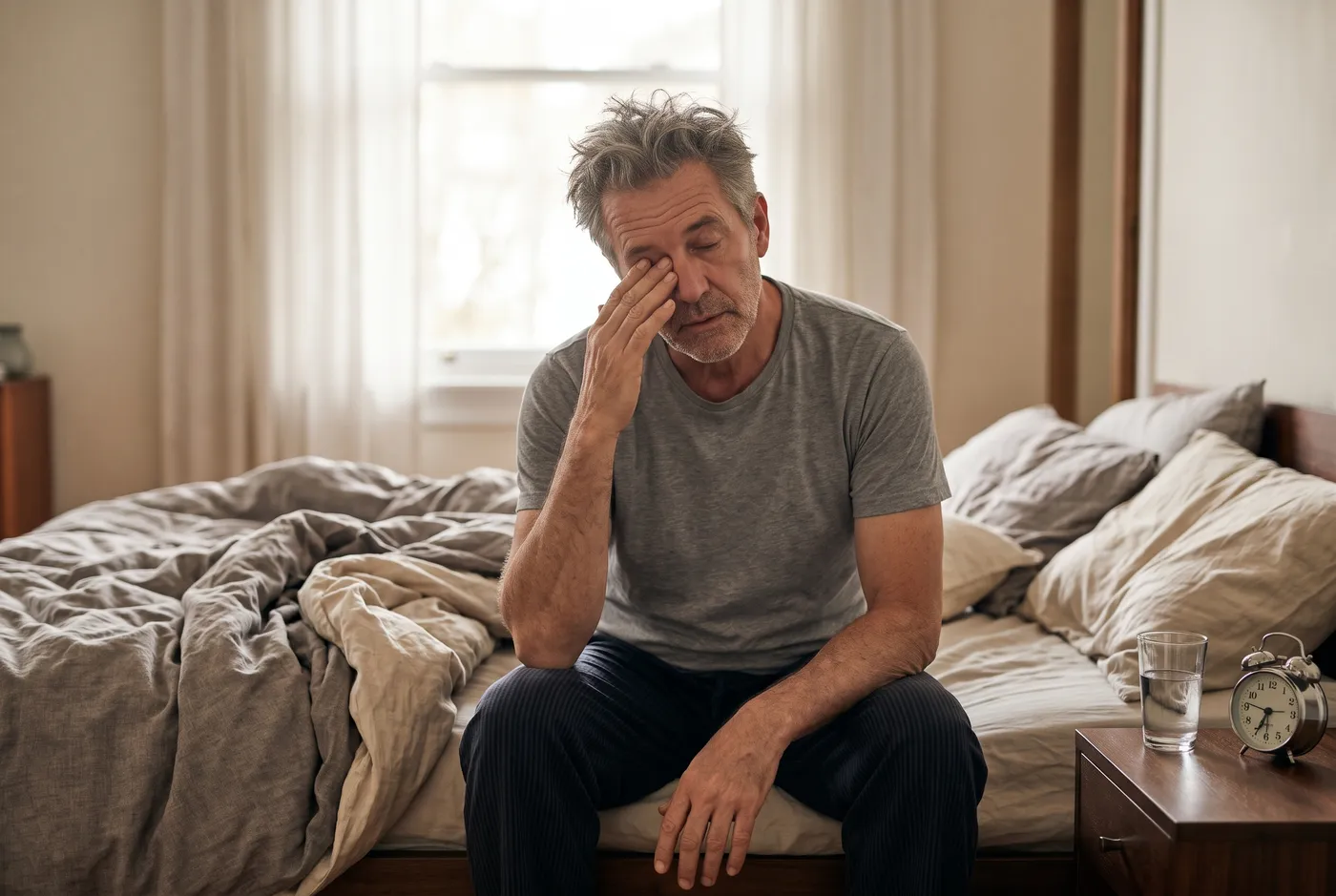
A man in pajamas sits on the edge of an unmade bed in the morning, rubbing his eyes. Realistic AI-generated image.
Eight hours in bed and still dragging by ten in the morning is a common story after 50. The cause is rarely one thing, and most of the pieces can be named. Here is what the official sources say.
What is the right amount of sleep after 50, and what changes?
The National Institute on Aging (NIA) puts the need at seven to nine hours a night, the same as for any adult. What shifts is the shape of the night. Bedtime and wake-up time drift earlier, the time spent in each type of sleep decreases, sleep gets shorter and lighter, and you may wake more often. The NIA adds that older adults are also more likely to take medicines and live with medical conditions that affect sleep.
So a lighter night is normal. A night that leaves you worn out day after day is the part worth looking into. The NIA lists the signs of poor sleep plainly: waking up tired, feeling easily annoyed, and having trouble falling or staying asleep.
Why do I wake up tired even after a full night in bed?
Time in bed is not the same as sleep. The NHLBI describes sleep deficiency as more than too few hours: it also covers sleeping at the wrong time of day, not getting all the types of sleep your body needs, and a sleep disorder that cuts the quality. These are the usual suspects for men our age, each taken from the official pages in the sources.
| Possible cause | What the sources say | A clue |
|---|---|---|
| Night bathroom trips | The NIDDK lists waking at night to urinate among the symptoms of an enlarged prostate | You are up two or more times |
| Sleep apnea | The NHLBI: breathing stops and restarts many times during sleep | Loud snoring or gasping |
| Alcohol | The NIA says to avoid it, even in small amounts | Bad nights follow drinks |
| Medicines, pain, illness | The NIA names all three as things that make good sleep harder | Sleep changed with a new pill or flare-up |
| Stress or a new routine | The NIA: short-term insomnia can come from stress or changes to routine | It began with a change |
| Restless legs | The NIA: tingling or crawling in the legs, worse at night, better with movement | Your legs will not settle |
More than one can be at work at the same time, which is why a single fix, such as a new pillow, often disappoints.
Can the prostate and night bathroom trips be behind it?
For many men, yes. The NIDDK lists nocturia among the symptoms of an enlarged prostate, and says you can cut the number of trips by drinking less in the hours before bed and cutting down on alcohol and caffeine. Every trip breaks a sleep cycle, and light sleep after 50 makes it easy to stay awake afterward.
We cover this in detail elsewhere. Start with the night-time bathroom trips guide, then what late coffee and alcohol do to the bladder. If a weak stream or dribbling comes with the night trips, the enlarged prostate symptoms guide lists other signs to watch.
Could it be sleep apnea?
It is the one to rule out first when the tiredness is heavy. Sleep apnea is a common condition in which breathing stops and restarts many times during sleep. The NHLBI says the risk goes up with age, that alcohol can relax the muscles of the mouth and throat enough to close the airway, and that sleep apnea is more common in men, who are also more likely to have serious sleep apnea and to be diagnosed at a younger age than women.
The symptom list starts with breathing that stops and restarts, frequent loud snoring (more common in men) and gasping for air. You may not notice any of it yourself. Other signs on the list include daytime sleepiness and tiredness, dry mouth, waking often at night to urinate, and sexual dysfunction or decreased libido. The NIA makes one useful point: snoring can be a sign, but not everyone who snores has sleep apnea.
Why it matters beyond tiredness: the NHLBI says untreated sleep apnea increases the risk for stroke, heart attack and other serious problems. Only a doctor can sort it out, usually with a sleep study, and our guide to sleep apnea in men over 50 walks through the signs, the test and when to get checked. Our pieces on erections and heart health and checking blood pressure at home cover two numbers worth bringing to that visit.
Does a nightcap really help?
The official answer is no. The NIA advises avoiding alcohol, even small amounts, among its tips for better sleep, and the NHLBI explains one reason: alcohol relaxes the muscles of the mouth and throat and may close the upper airway. If sleep is a problem, an evening drink is one of the first things we would test. Try two weeks without it and see what your mornings feel like.
What helps you sleep better, starting tonight?
The NIA gives a short list for older adults. We have grouped it by when it happens.
- During the day: get regular exercise, but not within three hours of bedtime, and keep naps out of the late afternoon and evening. Keep caffeine (coffee, tea, chocolate, soda) to the early part of the day.
- In the evening: leave two to three hours between a big meal and bed, and go easy on drinks late in the day. Build a short routine to wind down, such as a book, soothing music or a warm bath.
- In the bedroom: keep the temperature not too hot or cold, and try not to use a television, computer, phone or tablet there.
- Every day: go to sleep and get up at the same times, including weekends and trips.
- If you snore or sleep on your back: the NHLBI says a provider may recommend sleeping on your side, as that can help keep the airway open, along with a healthy weight, regular activity and limiting alcohol and caffeine.
None of this is exciting, and our men's health guide puts it in a wider picture. In our opinion, the most useful step is the dullest one: a fixed wake-up time, seven days a week. It costs nothing and it gives the rest a chance to work.
What about sleep aids and supplements?
The NIA is cautious. It says sleeping pills can bring short-term relief, yet they carry risk and can lead to dependence, you may not feel refreshed or clearheaded the next day, and some lose their effect over time. Its advice is to talk with your doctor before starting any medicine or supplement for sleep. For long-lasting insomnia, the NIA notes that cognitive behavioral therapy, a type of counseling, can help.
If you want numbers to bring to that talk, a wrist band can add some. See what a tracker can and cannot show about sleep.
When is it time to see a doctor?
The NIA describes insomnia as trouble falling or staying asleep at least three nights a week. It becomes chronic past three months, when no other medical cause explains it, and it is the sleep problem most common in adults 60 and older. Ask your doctor sooner if you are always sleepy, if someone tells you that you snore or gasp, or if your legs will not settle at night.
There is a safety reason, too. The NHLBI says sleepiness while driving is responsible for serious car crash injuries and deaths, and that in older adults, sleep deficiency may be linked to a higher chance of falls and broken bones. Mention sleep at your next checkup. If you want a first step you can take today, our piece on sleep and the time change describes a simple sleep diary to bring along.
What is the bottom line?
Lighter sleep after 50 is normal, but being exhausted every morning is a signal. Check the pieces you control, the evening drinks, the late coffee, the bedtime and the wake-up time. Then look at the ones a doctor can sort out: night bathroom trips, snoring and breathing pauses, medicines and pain. Most men who work through that list find something to fix.
Frequently asked questions
What is the right amount of sleep for a man past 50?
The NIA puts the need for older adults at seven to nine hours a night, as for any other adult. What changes is timing: bedtime and wake-up time tend to drift earlier with age.
Is poor sleep just a normal part of getting older?
Part of it is. The NIA says sleep tends to get shorter and lighter with age and that you may wake more often. It also says many older adults do not sleep well because of illness, medicines, mental health or pain, and that better habits and treatment for a sleep disorder may help.
Can an enlarged prostate wreck my sleep?
It can, through night trips to the bathroom. The NIDDK lists nocturia, waking at night to urinate, among the symptoms of an enlarged prostate, and says that drinking less before bed and easing off alcohol and caffeine can reduce the number of trips.
What are the signs of sleep apnea?
The NHLBI lists breathing that starts and stops, frequent loud snoring (more common in men) and gasping for air during sleep. You may not know until someone tells you. Daytime sleepiness, dry mouth and waking often at night to urinate are other signs on its list.
Does a drink before bed help me sleep?
The NIA advises avoiding alcohol, even in small amounts, and the NHLBI notes that alcohol can relax the muscles of the mouth and throat, which may close the upper airway and raise the risk of sleep apnea.
Should I take a sleep aid or a supplement?
Ask your doctor first. The NIA says sleeping pills can bring short-term relief but carry risk and can lead to dependence, and it recommends talking with your doctor before starting any medicine or supplement for sleep.
When should I see a doctor about my sleep?
The NIA says to talk with a doctor if you are always sleepy or find it hard to get enough sleep at night. The NHLBI adds that snoring or gasping that someone else notices, along with heavy daytime sleepiness, is a reason to ask about sleep apnea.
Sources we checked for this article
- National Institute on Aging (NIH): Sleep and Older Adults (reviewed February 6, 2025, read November 9, 2026)
- NHLBI (NIH): Sleep Apnea, What Is Sleep Apnea? (last updated January 9, 2025)
- NHLBI (NIH): Sleep Apnea, Symptoms (last updated January 9, 2025)
- NHLBI (NIH): Sleep Apnea, Causes and Risk Factors (last updated January 9, 2025)
- NHLBI (NIH): Sleep Apnea, Treatment (last updated January 9, 2025)
- NHLBI (NIH): Sleep Deprivation and Deficiency (last updated March 24, 2022)
- NIDDK (NIH): Enlarged Prostate (Benign Prostatic Hyperplasia) (last reviewed June 2024)